










You have a great clinic. Your registered physiotherapists are credentialled, your outcomes are strong, and your Google Business Profile is set up. Yet every time a patient in Scarborough or Mississauga searches “physiotherapy near me,” Sunnybrook, UHN, or St. Michael’s Hospital pops up first and your clinic is buried on page two. You are not alone, and this is not a fluke.
Hospital-affiliated physiotherapy departments benefit from massive institutional domain authority, decades of online presence, and a flood of backlinks from government health portals, the Ontario Ministry of Health, and university research departments. Competing head-to-head on their highest-volume terms is like a neighbourhood café trying to outrank Tim Hortons for “coffee Toronto.” The right play is a different keyword map and a different content strategy built around the things hospitals simply cannot do. This guide shows you how.
If you want a specialist to audit your current rankings and build this strategy for your clinic, our physiotherapy SEO Toronto service is designed specifically for independent Ontario practices from Etobicoke to Pickering. But first, let’s break down why the gap exists and exactly how to close it.
| 41% | of Canadians click a result within the first three positions on Google yet most independent physio clinics don’t appear there for their highest-value neighbourhood terms (BrightEdge, 2025). |
Why Hospital Physio Departments Outrank Independent Clinics
Before you can beat a competitor, you need to understand why they are winning. For hospital-affiliated physiotherapy, three structural advantages drive their search dominance and knowing each one reveals the opening you can exploit.
Domain Authority Built Over Decades
Hospitals like Toronto General, Mount Sinai, and Sunnybrook have been building their web presence since the late 1990s. Their root domains carry domain authority scores in the 70–85 range (on a 100-point scale) because government bodies, universities, news outlets, and health charities all link to them constantly. When they publish a page titled “Physiotherapy Department Toronto General Hospital,” Google treats it as inherently credible.
Your clinic’s domain, launched in 2019 or 2022, may sit at a domain authority of 8–18. That gap does not mean you cannot rank it means you cannot rank for the same keywords. The healthcare SEO Toronto framework we use at BizStori identifies the keyword pockets where independent clinics have a genuine structural advantage over hospital mega-sites.
Backlink Profiles That Independent Clinics Can’t Replicate (Yet)
Every time a university research paper cites a hospital’s physiotherapy unit, every time a local news article references a hospital spokesperson, every time a government health portal links out to a referral pathway, the hospital gains another high-authority backlink. The quantity and quality of those links is a primary Google ranking signal.
Independent clinics can build meaningful backlink profiles through local sports teams, workplace wellness partnerships, community health blogs, and Ontario physiotherapy association directories but it takes 12–18 months to move the needle meaningfully. That is why your keyword strategy cannot wait for your link profile to catch up.
Brand Searches Masquerading as Category Searches
Many patients in the GTA search “physiotherapy Sunnybrook” or “UHN physio” even when they are open to any clinic. Google interprets these branded searches as strong relevance signals and weights the institution’s other pages upward. The hospital does not need to optimise these pages the brand recognition does the work automatically.
Independent clinics cannot replicate brand-level authority on a short timeline. But you can build strong local SEO signals at the neighbourhood level where hospitals are often invisible and capture patients who are searching by condition, insurance type, or specific practitioner credential rather than by institution name.
| 💡 | The Key Insight
Hospitals dominate broad category terms (“physiotherapy Toronto”) because of domain authority. They are far weaker on neighbourhood terms (“physiotherapy Leslieville”), condition-specific searches (“pelvic floor physiotherapy Etobicoke”), and credential searches (“registered physiotherapist direct billing OHIP”). These are your lanes. |
Neighbourhood-Level Keyword Targeting: Your Biggest Advantage
The single most effective tactic for an independent GTA clinic is granular geographic targeting. Hospitals serve all of Toronto, so they optimise for city-wide terms. You serve a specific set of postal codes, which means you can go deeper on neighbourhood language than any hospital page ever will.
Why “Physiotherapy Toronto” Is the Wrong Target
Search volume for “physiotherapy Toronto” sits in the 1,000–2,000 monthly searches range, with keyword difficulty above 50. The top results are dominated by Sunnybrook, UHN, St. Michael’s, and large aggregator directories like Healthlinkbc and Zocdoc. A clinic with a domain authority below 30 will not break into the top 10 for this term within a two-year horizon.
Instead, our physiotherapy SEO Ontario approach maps the full keyword tree at the neighbourhood and suburb level. Terms like “physiotherapy Leslieville,” “physiotherapy Scarborough,” “physiotherapy North York,” and “physiotherapy Brampton” each carry 50–300 monthly searches, keyword difficulty below 25, and almost no hospital competition. A single well-optimised page can rank in the top 3 within 60–90 days.
How to Build Your Neighbourhood Keyword Map
Start with the neighbourhoods and suburbs within a 10-kilometre radius of each clinic location. For each area, identify three layers of keyword intent:
- Generic location: “physiotherapy [neighbourhood]”, “registered physiotherapist [suburb]”, “physio clinic near [landmark]”
- Condition-specific: “sports injury physio [neighbourhood]”, “pelvic floor physio [suburb]”, “post-surgical rehab [area]”
- Intent-specific: “direct billing physio [neighbourhood]”, “no referral physiotherapy [suburb]”, “evening physio appointments [area]”
Each of these keyword clusters maps to a dedicated landing page or service page on your site. The content on each page must be genuinely localised references to the specific neighbourhood, nearby transit, common workplace injury patterns in local industries, and your clinic’s travel time from recognisable local landmarks.
Condition Pages That Hospitals Cannot Personalise
Hospital physio pages describe what conditions their department treats. They rarely go deep on condition-specific content the page has to serve all of Toronto and all of their referral pathways simultaneously. An independent clinic can publish a 1,500-word page on “ACL recovery physiotherapy in Etobicoke” that speaks directly to recreational hockey players at Etobicoke Olympium. A hospital cannot.
Condition pages that consistently perform well for Ontario physio clinics include: pelvic floor physiotherapy, vestibular rehabilitation, concussion management, post-mastectomy rehab, running injury assessment, geriatric physiotherapy, and post-operative orthopaedic rehab. Each of these is a physiotherapy SEO Ontario content pillar that builds topical authority while generating low-competition organic traffic.
| Top 3 | A well-optimised neighbourhood physiotherapy page for a GTA independent clinic typically reaches a top-3 Google Maps ranking within 60–90 days compared to 12–18 months for broad city-level terms competing against hospitals. |
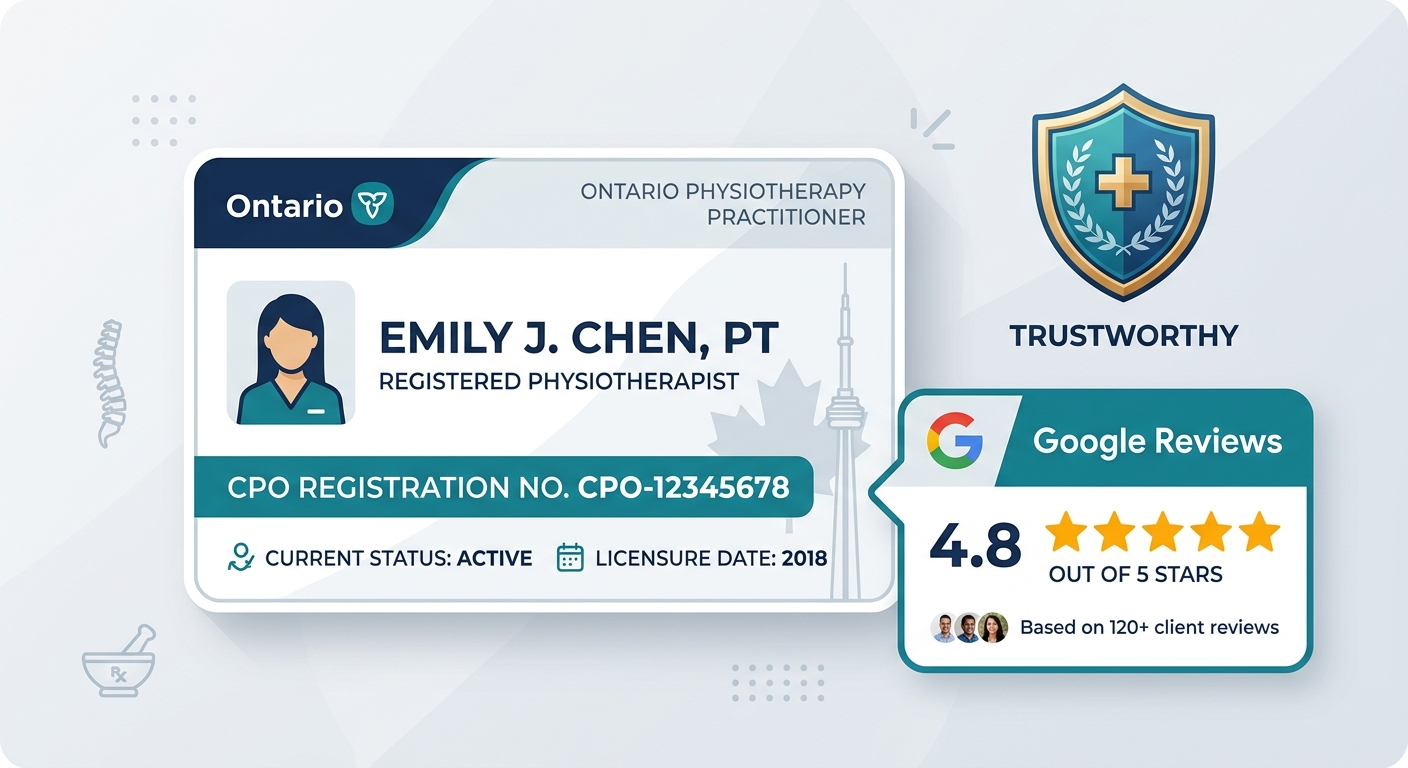
E-E-A-T Signals for CPO-Regulated Physiotherapists
Google’s quality evaluator guidelines place healthcare content in the “Your Money or Your Life” (YMYL) category meaning they apply heightened scrutiny to health-related websites. For Ontario physiotherapy clinics, this scrutiny runs alongside the advertising standards set by the College of Physiotherapists of Ontario (CPO). Demonstrating E-E-A-T (Experience, Expertise, Authoritativeness, Trustworthiness) through your site content is both a Google ranking requirement and a professional compliance matter.
Experience: Practitioner Credentials on Every Page
Every registered physiotherapist on your team should have a dedicated practitioner bio page. The bio must state their registration number with the CPO, their years of clinical experience, their specific areas of practice, their post-graduate training (if any), and any specialist certifications (e.g. FCAMT, acupuncture certificate, pelvic health training). This is not optional for SEO Google’s quality raters are explicitly instructed to look for professional credentials on healthcare pages.
Beyond the bio page, author each service page or blog post with a practitioner byline. When a patient (or Google’s algorithm) sees a page on “post-partum pelvic floor physiotherapy” authored by a registered physiotherapist with a named CPO registration number, the trust signal is exponentially stronger than an unsigned page.
Expertise: What CPO Rules Allow You to Say
The CPO advertising standards require that Ontario physiotherapists advertise truthfully and not in a manner that is likely to mislead. Key rules that affect your online content include:
- You may describe the services you offer and the conditions you treat “We provide physiotherapy assessment and treatment for musculoskeletal injuries.”
- You may state your credentials and registration status “Our team of Registered Physiotherapists (R.P.T.) are registered with the College of Physiotherapists of Ontario.”
- You may not guarantee specific outcomes or imply a specific result avoid “We will eliminate your back pain” or “Guaranteed recovery in 6 visits.”
- You may use patient testimonials, but these must be accurate representations of real patient experiences and must not make promises to prospective patients.
- You may advertise fees and billing arrangements, including direct billing to insurance providers and OHIP-covered services where applicable.
The practical SEO implication: write service pages and condition pages that describe what your physiotherapists do, what training they have, and what conditions they assess and treat. Avoid the outcome-guarantee language that conversion copywriters often recommend it violates CPO standards and, increasingly, also triggers Google’s quality downgrade signals for healthcare sites making unsubstantiated claims.
Authoritativeness: CPO Registration as a Trust Badge
Every Ontario physiotherapist is searchable on the CPO’s public register. Include your CPO registration number in your footer, your practitioner bios, and your contact page. Link to your CPO registration profile where applicable. This is something hospital pages rarely do at the individual practitioner level making it a genuine differentiator for your independent clinic when competing on healthcare SEO in Toronto.
Trustworthiness: Schema Markup for Health Professionals
Implement LocalBusiness and MedicalBusiness schema markup on your homepage and clinic location pages. Within the schema, include:
- “@type”: “PhysicalTherapist” or “MedicalClinic”
- “medicalSpecialty” using Schema.org health specialties vocabulary
- “hasCredential” linking to each practitioner’s CPO profile
- “isAcceptingNewPatients”: true (updated in real time)
- “currenciesAccepted”: “CAD” and “paymentAccepted” listing direct billing insurers
If your clinic website needs a structural overhaul to implement these signals correctly, our healthcare web design Toronto service builds physio clinic sites with schema, CPO compliance, and local SEO architecture built in from day one.
| ⚠ | CPO Compliance Red Flag
Outcome guarantees in your content “We’ll fix your pain in 3 sessions,” “Guaranteed results” violate CPO advertising standards and expose your registration to a complaint. Beyond compliance risk, Google’s health quality evaluators flag these claims as low-trust signals, actively harming your rankings. A compliant content strategy and a high-ranking one are the same strategy. |
OHIP Signals and Canadian-Intent Content Markers
One of the most under-used ranking advantages for Ontario physio clinics is Canadian-intent content signalling. Google personalises search results based on user location and content language signals. A page that reads like it was written for Ontario patients with explicit references to OHIP, direct billing to Ontario insurers, provincial health programs, and CPO registration sends stronger Canadian relevance signals than a generic physiotherapy page that could have been written anywhere in North America.
What OHIP Coverage Actually Means for Your SEO
Physiotherapy is partially covered by OHIP in limited circumstances primarily for patients discharged from hospital within one year of the discharge date, and for Ontario residents aged 19 and under and those 65 and over under specific conditions. Clearly explaining what is and is not covered by OHIP on your website serves two purposes: it provides genuine patient value (reducing the most common phone enquiry), and it generates Canadian-specific content that international physio sites cannot produce.
A dedicated “Direct Billing and OHIP” page accurately describing what OHIP covers for physiotherapy in Ontario, which private insurance providers you bill directly, and how WorkSafe (WSIB) claims work is one of the highest-converting pages a GTA physio clinic can build. Patients searching “does OHIP cover physiotherapy Ontario” are in active decision-making mode. A clear, accurate, locally-written answer from your clinic places you at the point of that decision.
Ontario-Specific Content That Builds Geographic Relevance
Beyond OHIP, seed your service and blog content with Ontario-specific references:
- Reference WSIB (Workplace Safety and Insurance Board) claims for workplace injury physiotherapy a high-volume, high-intent search category across the GTA industrial corridors.
- Mention OHIP+, the free prescription drug and coverage programme for youth patients asking about coverage for their children will find your content more credible with accurate provincial references.
- Cite the Regulated Health Professions Act (RHPA) and the Physiotherapy Act, 1991 (Ontario) as the legislation governing your practice this specificity builds trustworthiness for Google’s YMYL evaluators.
- Reference the physiotherapy standards and guidelines from the CPO by name, and link to collegept.org where appropriate.
- When writing about sports injury rehab, reference Ontario Sports Medicine and Physiotherapy Foundation (OSMPF) research and local Ontario sport contexts the OHL, Varsity athletics, Toronto sports leagues.
These signals collectively tell Google’s algorithms that your content was written for Ontario residents by Ontario health professionals not by an SEO content mill producing generic health content. That distinction matters increasingly in 2026 as Google’s Helpful Content system prioritises first-hand, geographic-specific expertise. See also our guide on how medical clinics in Toronto can dominate local search for how these principles apply across all regulated health professions.
| 🍁 | Canadian Intent Signal Checklist
OHIP coverage explanation for physiotherapy in Ontario · WSIB claim process and direct billing · CPO registration number in footer and bios · References to Ontario provincial legislation (Physiotherapy Act 1991, RHPA) · Direct billing to Ontario insurer networks (Manulife, Sun Life, Green Shield, Great-West Life) · Ontario-specific sports and workplace contexts |
Google Business Profile Optimisation for GTA Physio Clinics
For neighbourhood-level searches, the Google Maps “Local Pack” the three business listings that appear at the top of a local search results page drives approximately 75% of clicks. Ranking in the Local Pack is often faster than ranking organically, and physiotherapy SEO Ontario efforts without a fully optimised Google Business Profile (GBP) are working at half power.
Primary Category and Secondary Categories
Set your primary GBP category to “Physiotherapist.” Add secondary categories that match your specialties: “Sports Medicine Clinic,” “Rehabilitation Center,” “Physical Therapist,” “Occupational Therapist” (if applicable), and “Women’s Health Clinic” for clinics with pelvic health services. Each additional relevant category expands the search queries your listing can appear for.
Services and Attributes That Drive Conversions
Complete every available service attribute in your GBP. Key attributes for Ontario physio clinics include:
- Accepting new patients update this in real time; patients filter for it.
- Wheelchair accessible entrance, parking, and restrooms essential for geriatric and post-surgical patients.
- Direct billing state which major Ontario insurers you bill directly.
- WSIB claims accepted extremely high-intent signal for workplace injury searches.
- Online booking available include a direct link to your booking system.
- Languages spoken in GTA neighbourhoods with high Cantonese, Mandarin, Punjabi, or Tamil-speaking populations, listing these languages expands your reachable patient base significantly.
GBP Posts and Q&A for Local Ranking Signals
Publish a GBP post at least once per week. Posts should be short (150–300 words), reference your neighbourhood and clinic name, and highlight a specific service or condition you treat. Posts that mention the neighbourhood by name (“serving patients in East York and Leaside”) reinforce geographic relevance.
Seed your GBP Q&A section with the 10 most common patient questions: Does OHIP cover physiotherapy in Ontario? Do you direct bill insurance? What is the difference between physiotherapy and chiropractic? Do I need a doctor’s referral for physiotherapy in Ontario? (Answer: No direct access physiotherapy is available in Ontario without a referral.) These pre-seeded answers reduce friction for prospective patients and generate keyword-rich content in your listing.
Review Velocity and Response Strategy
Local Pack rankings are heavily influenced by both review count and review recency. A clinic with 12 reviews from 2022 will rank below a clinic with 8 reviews from 2026 recency matters. Build an automated post-visit review request sequence through your EMR or booking platform. The message should go out 24–48 hours after the appointment and link directly to your Google review form.
When responding to Google reviews, include the neighbourhood name and a specific service in your reply: “Thank you for visiting our Danforth Avenue clinic for your shoulder rehabilitation we look forward to supporting your recovery.” These keyword-embedded responses are indexed by Google and contribute to your local relevance signals.
| 75% | of clicks on a local search results page go to the Google Maps Local Pack the top 3 business listings. Clinics not ranking in the Local Pack for their neighbourhood terms are invisible to three-quarters of their potential patient pool. |
Technical SEO Foundations for Physiotherapy Clinic Websites
Neighbourhood keyword targeting and GBP optimisation are only effective if your website’s technical foundation meets Google’s minimum requirements. Our healthcare web design Toronto team frequently audits physio clinic sites that have good content but are losing rankings due to technical issues that are invisible to the clinic owner.
Core Web Vitals for Health Clinic Websites
Google’s Core Web Vitals Largest Contentful Paint (LCP), Cumulative Layout Shift (CLS), and Interaction to Next Paint (INP) are ranking signals with particular impact on mobile searches. GTA patients increasingly book physiotherapy on their phones. A clinic website with an LCP above 2.5 seconds on mobile is being penalised in rankings regardless of the quality of its content.
Common causes of slow LCP on physio clinic sites: unoptimised hero images, third-party booking widgets that block page rendering, and uncompressed video backgrounds. Each of these can be resolved without redesigning the site. Run your site through PageSpeed Insights (pagespeed.web.dev) and address every “Opportunities” item flagged as LCP-relevant.
Mobile-First Site Architecture
Google indexes the mobile version of your site first. If your mobile navigation hides your service pages behind a hamburger menu that requires JavaScript to open, Google’s crawler may not be indexing those pages at all. Every service page must be reachable from the homepage via a maximum of two clicks on a mobile browser.
Location Page Structure for Multi-Location Clinics
If your clinic has more than one GTA location, each location needs its own dedicated page with:
- The full street address, city, postal code, and phone number matching your GBP exactly.
- An embedded Google Map.
- A description of the neighbourhood and transit access.
- The specific practitioners based at that location.
- Services available at that location (which may differ between locations).
- A unique, non-duplicated meta title and description referencing the specific neighbourhood.
Do not use the same “About Us” or “Services” page content across all location pages with only the address swapped. Google’s duplicate content detection will suppress the weaker-trafficked pages. If you are running Google Ads for your physiotherapy clinic alongside organic SEO, these location pages also serve as high-converting landing pages when the targeting is neighbourhood-specific.
| ⚙ | Quick Technical Checklist
Core Web Vitals pass on mobile (PageSpeed Insights) · HTTPS with valid SSL certificate · XML sitemap submitted to Google Search Console · robots.txt not blocking /services/ or /blog/ · LocalBusiness / MedicalBusiness schema on each location page · No duplicate content across location pages · Each service page indexed and not returning a 404 |
Content Strategy: Building Topical Authority Against Hospital Competitors
Domain authority is slow to build. Topical authority Google’s recognition that your website is a genuine subject-matter expert in a specific area of physiotherapy can be established in 3–6 months with consistent, well-structured content. This is the fastest legitimate path for an independent GTA physio clinic to outrank hospital department pages for condition-specific and neighbourhood-specific searches. Our broader Toronto SEO company approach applies this same principle across all healthcare verticals.
The Physio Content Cluster Model
Topical authority is built through content clustering: a primary “pillar page” covering a broad topic (e.g., “Pelvic Floor Physiotherapy in the GTA”) supported by 4–6 “cluster pages” that go deep on sub-topics (e.g., “Post-Partum Pelvic Floor Recovery,” “Pelvic Floor Physio After Prostate Surgery,” “Bladder Prolapse Physiotherapy Ontario”). Each cluster page links back to the pillar page and to each other.
Google maps the semantic relationships between these pages and recognises the site as authoritative on pelvic floor physiotherapy a topic the hospital physio page, which covers all physiotherapy in one or two pages, cannot compete with in terms of depth.
Content Types That Outperform Hospital Pages
Focus your blog and service page content on formats that hospitals never produce for their physiotherapy departments:
- Patient education guides written by your registered physiotherapists: “What to Expect at Your First Physiotherapy Session in Ontario,” “How to Prepare Your Home for Post-Surgical Rehab.”
- Neighbourhood-specific sports injury guides: “Common Running Injuries on the Waterfront Trail” or “Hockey Shoulder Injuries in Scarborough.”
- Ontario insurance and billing explainers: “How to Use Your Ontario Benefits Plan for Physiotherapy,” “WSIB Physiotherapy Claims: A Step-by-Step Guide.”
- Practitioner insight posts: individual physiotherapists writing about their clinical area pelvic health, concussion, hand therapy under their name and CPO number.
For a detailed walkthrough of this approach for Ontario practices, see our earlier guide: Physiotherapy SEO Toronto: How to Get More Ontario Patients from Google in 2026. It covers keyword mapping, content planning, and the GBP optimisation sequence in depth.
How Long Does It Take to Outrank a Hospital?
The honest answer depends on your starting position, your content velocity, and your link building activity. A realistic timeline for a GTA independent clinic:
- Days 1–30: Technical audit and fixes, GBP optimisation, schema implementation, neighbourhood service pages published.
- Days 31–60: Local Pack ranking improvements for neighbourhood-level searches (low-competition terms). First organic traffic from condition-specific pages.
- Days 61–90: Neighbourhood-level search rankings in positions 3–8 for primary service area terms. GBP reviews accumulating if automation is running.
- Days 91–180: Topical authority building. Condition-specific pages ranking for long-tail searches. Referral traffic from local business partnerships beginning.
- Days 181–365: City-sub-area keyword rankings improving. Blog content compounding. First signs of ranking above hospital pages for neighbourhood + condition combinations.
Clinics that pair this organic strategy with a targeted healthcare PPC campaign covering the keyword gap while organic rankings build see the highest patient acquisition rates during the first 90 days. The two channels reinforce each other: paid traffic improves engagement signals on the pages you most want to rank organically.
| 3–6 mo | The timeline for an independent GTA physio clinic to build genuine topical authority in a specialty area enough to outrank hospital department pages for condition-specific neighbourhood searches is 3 to 6 months of consistent content production. |
Link Building for Independent Physio Clinics in Ontario
Backlinks remain one of the strongest organic ranking signals. You will not out-link a hospital in raw volume, but you can out-link them in locally-relevant links and local relevance is what matters for neighbourhood and condition-specific searches.
High-Value Link Sources for Ontario Physio Clinics
- Ontario Physiotherapy Association (OPA): Member clinics are listed in the OPA’s public directory. This is a direct, authoritative health-sector link on a .ca domain.
- Local sports clubs and recreation organisations: Become the official physio partner of a local hockey association, running club, or recreational league. Most will list you on their website in exchange for a discounted team rate or educational session.
- Workplace wellness partnerships: Partner with GTA employers on ergonomic assessment programmes. The employer’s intranet health page and often their public corporate site will link to your clinic.
- Ontario health blogs and medical directories: Submit to Healthlink BC equivalents for Ontario, physio-specific directories, and condition-specific patient community sites.
- Local journalism and community media: Local Toronto neighbourhood papers (The East End, Beaches News) and community blogs frequently quote local health professionals on health topics. A physiotherapist who comments on a running injury story in a local paper earns a high-value local citation.
This link building approach mirrors the broader strategy we outline for all regulated healthcare professions in our healthcare SEO Toronto guide build locally-relevant, professionally credible links that hospital departments are structurally unable to pursue at the neighbourhood level.
Putting It All Together: Your 90-Day Ranking Plan
Here is the sequence we recommend for a GTA physiotherapy clinic starting from a position of limited organic visibility. This plan assumes a clinic that has a functional website, at least one active Google Business Profile, and at least two registered physiotherapists on staff. For a more customised roadmap, our physiotherapy SEO Toronto service builds a clinic-specific plan based on your current rankings, your patient geography, and your specialty mix.
Month 1: Foundation
- Conduct a full technical SEO audit: Core Web Vitals, mobile-first indexing, schema, robots.txt, sitemap.
- Claim and fully optimise your Google Business Profile: all categories, services, attributes, and booking link.
- Implement LocalBusiness / PhysicalTherapist schema on homepage and all location pages.
- Publish or refresh practitioner bio pages with CPO registration numbers, credentials, and clinical specialties.
- Identify your primary 5–10 neighbourhood keywords and audit whether you have dedicated pages for each.
- Create a direct billing and OHIP coverage page accurate, Ontario-specific, and linked from the main navigation.
Month 2: Neighbourhood Visibility
- Publish location or neighbourhood-specific service pages for your primary patient catchment areas.
- Begin a weekly GBP post schedule referencing each neighbourhood by name.
- Launch an automated review request sequence through your booking system.
- Submit your clinic to the OPA directory and any relevant condition-specific patient directories.
- Identify your top 3 condition specialties and begin planning condition-specific content clusters.
- Set up Google Search Console if not already active track impressions for neighbourhood terms week by week.
Month 3: Topical Authority and Content Compounding
- Publish 2–4 practitioner-authored condition pages per month, each with a named CPO-registered author. See our guide on getting more Ontario patients from Google for the content template that works best.
- Build 2–3 local backlinks per month from community sports organisations, local media, and Ontario health directories.
- Begin patient story content (with written consent) authentic patient perspective content, compliant with CPO advertising standards, builds strong E-E-A-T signals.
- Seed GBP Q&A with the 10 most common patient questions, including direct billing, OHIP, no-referral access, and wait times.
- Review rankings weekly for all neighbourhood keyword targets. Adjust content and GBP posts based on which terms are entering the top-10.
| 📊 | Track These 5 KPIs Monthly
1. Local Pack impressions for each neighbourhood keyword (Google Search Console + GBP Insights) · 2. Organic click-through rate on neighbourhood service pages · 3. New Google reviews (target: 2–4 per month per location) · 4. GBP profile views for each location · 5. New patient bookings attributed to organic search (ask in intake forms) |
| Ready to Outrank the Hospitals in Your Neighbourhood?
BizStori builds physiotherapy SEO strategies for independent GTA clinics neighbourhood keyword maps, CPO-compliant content, and GBP optimisation that generates real patient bookings. |
