










SEO for physiotherapists is the process of optimising your clinic’s online presence so that Toronto patients find you on Google when they search for the care you provide. For physiotherapy clinics, this means appearing in the Maps Pack for searches like “physio near me” and ranking in organic results for condition-specific searches like “physiotherapy for lower back pain North York” or “ACL recovery physio Scarborough.”
Physiotherapy clinics have a structural SEO advantage that most of them never fully exploit: their patients search with extremely specific, high-intent queries not just ‘physiotherapist Toronto’ but ‘physio for rotator cuff injury,’ ‘post-surgical rehab clinic North York,’ and ‘sports physiotherapy accepting direct billing Toronto.’ These condition-specific searches have lower competition and higher conversion rates than generic location keywords. The clinic that ranks for them fills its schedule.
This guide covers the complete SEO strategy for Toronto physiotherapy clinics from Google Business Profile setup to condition-specific keyword targeting, neighbourhood content, CPO-compliant E-E-A-T, and local link building. For BizStori’s full physiotherapy SEO service, visit our physiotherapy SEO Toronto service page.
Why Physiotherapy SEO Is Different From General Local SEO
Most local SEO guides treat all service businesses the same way claim your Google Business Profile, get reviews, build citations, publish blog posts. For a restaurant or a plumber, this generic approach produces reasonable results. For a physiotherapy clinic in Toronto, it leaves most of the available search traffic on the table.
Physiotherapy SEO differs from general local SEO in three important ways:
- Condition-specific search intent: The majority of your highest-converting patients don’t search ‘physiotherapy Toronto.’ They search for their specific condition ‘physio for lower back pain,’ ‘ACL recovery clinic,’ ‘post-partum physiotherapy.’ A generic SEO strategy that only targets service keywords misses this entire patient pool.
- College of Physiotherapists of Ontario (CPO) compliance: All content published by or on behalf of physiotherapy practices in Ontario must comply with CPO advertising standards. Claims about treatment outcomes, patient testimonials, and scope-of-practice representations are all regulated. Non-compliant content doesn’t just create legal risk it creates E-E-A-T risk that suppresses Google rankings.
- Direct billing as a conversion signal: “Direct billing available” is one of the most searched phrases by Ontario physiotherapy patients. Clinics that prominently feature direct billing partnerships OHIP, Green Shield, Blue Cross, Manulife, Sun Life on their website, GBP, and service pages see significantly higher click-through rates and conversion rates from local search.
How Toronto Patients Search for Physiotherapy
Before building your SEO strategy, you need to understand the patient journey from injury or referral to booked appointment. The 2026 Toronto physiotherapy patient journey looks like this:
- Injury or referral occurs: Patient experiences pain, receives a doctor’s referral, or is discharged from hospital with a rehabilitation plan.
- Google search condition-specific: Patient searches their specific condition: ‘physiotherapy for knee replacement recovery Toronto,’ ‘sports physio for hamstring tear Scarborough,’ ‘back pain physiotherapist near me.’
- Maps Pack evaluation: Google shows the top 3 local physiotherapy clinics. Patient evaluates rating, review count, distance, hours, and whether direct billing is mentioned.
- Website visit on mobile: Patient clicks through to check: does this clinic treat my specific condition? Do they accept my insurance? Can I book online? Is there parking?
- Book or search again: If all questions are answered clearly and booking is easy, they book. If any answer is unclear or the booking path is complicated, they go back to Google and try the next clinic.
The critical insight: condition specificity wins at every stage of this journey. The clinic that ranks for the patient’s exact condition search, shows relevant services and direct billing on the GBP listing, and has a service page specifically about that condition will consistently outbook the generic ‘physiotherapy Toronto’ ranking clinic.
Google Business Profile Optimisation for Physio Clinics
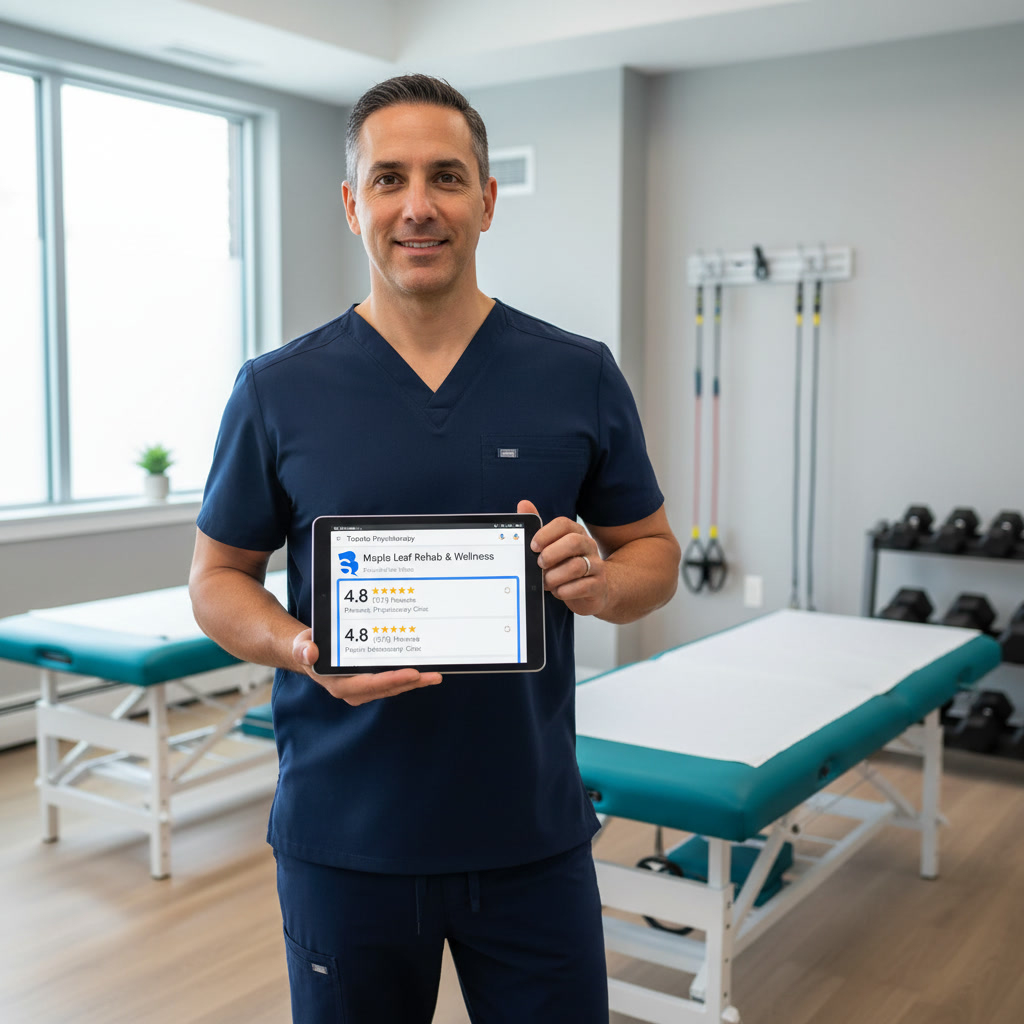
Your Google Business Profile is the single highest-ROI starting point for physiotherapy SEO in Toronto. It is free, produces results within 60–90 days of proper optimisation, and directly controls your visibility in the Maps Pack the three listings that appear above organic results for virtually every local physiotherapy search.
The Right Primary Category and Services Setup
Primary category: “Physical Therapist” or “Physical Therapy Clinic” not “Physiotherapist” (which is a less commonly used Google category) and not “Medical Clinic” (which is too broad). The primary category is the single most important ranking factor for Maps Pack placement.
For secondary categories, add: “Sports Medicine Clinic” if you treat athletes, “Rehabilitation Center” if you handle post-surgical rehab, “Occupational Therapist” if you have OTs on staff. Only add categories for services you genuinely provide.
In the Services section, list every condition you treat individually not just ‘physiotherapy.’ List: back pain, neck pain, sports injuries, ACL rehabilitation, rotator cuff treatment, post-surgical rehabilitation, pelvic floor physiotherapy, concussion management, vestibular rehabilitation, and any other conditions your RPTs treat. Each service listing is independently searchable.
Direct Billing Your Highest-Converting GBP Signal
Add your direct billing partners explicitly in your GBP description and attributes. ‘Direct billing available for Green Shield, Blue Cross, Manulife, Sun Life, and most major insurers’ is one of the most searched phrases by Ontario physio patients. A clinic with direct billing prominently stated in their GBP listing receives dramatically more clicks than an equivalent clinic that omits this information.
GBP Posts for Physiotherapy Clinics What to Publish
- Condition education posts: ‘5 Signs Your Knee Pain Needs Physiotherapy’ educational posts that address condition-specific searches and demonstrate clinical expertise.
- Seasonal injury prevention: ‘Preventing Running Injuries This Spring in Toronto’ seasonal relevance that Google rewards with Maps Pack boosts in the relevant period.
- Therapist spotlights: ‘Meet [RPT Name] Sports Injury Specialist at Our North York Clinic’ builds E-E-A-T signals and humanises the practice.
- Direct billing updates: ‘Now Direct Billing to Desjardins Insurance’ announces new insurance partnerships and drives immediate patient inquiries.
✓ Primary category: “Physical Therapist” or “Physical Therapy Clinic”
✓ All treated conditions listed individually in Services section
✓ Direct billing partners named explicitly in description and attributes
✓ “Accepting New Patients” attribute enabled
✓ 25+ clinic and team photos uploaded
✓ Minimum 2 GBP posts per week published
✓ All patient reviews responded to within 48 hours

Condition-Specific Keyword Strategy The Physio SEO Advantage
This is where Toronto physiotherapy clinics create the most significant SEO advantage over their competitors and where most clinics are leaving the most patient acquisition opportunity untouched.
Symptom and Condition Keywords vs Service Keywords
Most physiotherapy websites target service keywords: ‘physiotherapy Toronto,’ ‘physio clinic North York,’ ‘sports physiotherapy Scarborough.’ These are important but they are also the most competitive keywords in the space. Every clinic is targeting them.
Condition and symptom keywords are where the real opportunity lies. These keywords have lower competition, higher patient intent, and higher conversion rates because the patient has already decided they need physiotherapy. They just need to find the right clinic for their specific situation.
| Intent Type | Example Keywords (Toronto) | Relative Conversion |
| Service keywords | physiotherapy toronto, physio clinic north york | Moderate |
| Condition keywords | physio for lower back pain toronto, ACL recovery clinic scarborough | High |
| Symptom keywords | knee pain physiotherapist near me, shoulder pain physio toronto | Very High |
| Post-procedure | post knee replacement physio toronto, post surgical rehab north york | Very High |
| Direct billing | direct billing physiotherapy toronto, physio accepting manulife toronto | Very High |
| Neighbourhood | physiotherapist scarborough, physio clinic etobicoke accepting new patients | High |
The Keyword Framework for Toronto Physiotherapy Clinics
Build your SEO keyword architecture in four tiers:
- Tier 1 Core service pages (5–8 pages): ‘Physiotherapy Toronto,’ ‘Sports Physiotherapy Toronto,’ ‘Pelvic Floor Physiotherapy Toronto,’ ‘Concussion Management Toronto’ broad service categories each with their own dedicated page.
- Tier 2 Condition pages (10–20 pages): ‘Lower Back Pain Physiotherapy Toronto,’ ‘Rotator Cuff Treatment Scarborough,’ ‘ACL Recovery Physiotherapy North York,’ ‘Knee Replacement Rehabilitation Toronto’ one page per major condition you treat. These are your highest-converting pages.
- Tier 3 Neighbourhood pages (4–8 pages): ‘Physiotherapist in Scarborough,’ ‘Physiotherapy Clinic North York,’ ‘Physio Etobicoke Accepting New Patients’ location-specific pages targeting neighbourhood-level searches.
- Tier 4 Blog content (2–4 posts/month): ‘How Long Does ACL Recovery Take?’ ‘What to Expect at Your First Physiotherapy Appointment’ ‘Direct Billing Physiotherapy in Toronto: What’s Covered?’ educational content that captures long-tail searches and builds topical authority.
Direct Billing as a High-Converting SEO Signal
‘Direct billing physiotherapy Toronto’ and related searches are among the highest-converting queries in the Toronto physiotherapy market. Patients who search for direct billing are ready to book they just need to know which clinic accepts their insurer. Create a dedicated page: ‘Direct Billing Physiotherapy Toronto Accepted Insurance Plans’ and list every insurer you bill directly. This page alone can generate significant monthly patient inquiries for clinics that rank for it.
Neighbourhood Content Strategy for GTA Clinics
Toronto is not one market. A physiotherapy clinic in Scarborough is competing against different practices, serving different patient demographics, and ranking for different neighbourhood-level searches than a clinic in The Annex or Etobicoke. Your SEO strategy must reflect this.
| GTA Area | Population | SEO Competition | Recommended Focus |
| Scarborough | 630,000 | Medium | Condition pages + multi-ethnic community focus |
| North York | 670,000 | High | GBP dominance + direct billing prominence |
| Etobicoke | 365,000 | Medium | Sports physio + neighbourhood location pages |
| East York | 115,000 | Low | GBP + 3–4 condition pages will dominate |
| Downtown Toronto | 280,000 | Very High | Hyper-specific condition + workplace injury niche |
| Markham / Richmond Hill | 400,000 | Medium | Multi-language content + direct billing focus |
| Mississauga | 720,000 | High | Sports physio + post-surgical rehab focus |
| Brampton | 660,000 | Medium | Family physio + community health content |
How to Build Neighbourhood Pages That Rank
A neighbourhood page is not simply your main service page with the neighbourhood name swapped in. Google can detect thin location pages instantly. A genuine neighbourhood page needs:
- Neighbourhood-specific H1: ‘Physiotherapy Clinic in Scarborough Accepting New Patients’
- Local context in the opening paragraph: Reference local landmarks, transit connections, nearby communities, and the specific patient population you serve in that neighbourhood.
- Neighbourhood-specific service mentions: ‘Our Scarborough physiotherapy team treats workplace injuries for employees across the Kennedy Road and Markham Road business corridors’ hyper-local content that generic competitors cannot replicate.
- Local testimonials: Patient reviews that mention the neighbourhood specifically ‘I live in Agincourt and this is the best physio clinic near me’ naturally incorporated.
- Embedded Google Map: Showing your clinic location within the neighbourhood context, confirming geographic relevance to Google.
PHIPA-Safe Patient Review System
Patient reviews are the strongest local ranking signal for Toronto physiotherapy clinics after GBP optimisation. A clinic with 80+ reviews and a 4.8 rating will consistently outrank a clinic with 20 reviews and a 4.9 rating because volume, recency, and response rate all contribute to your Maps Pack ranking.
Building a Consistent Review Velocity System
The most effective review generation system for physiotherapy clinics is automated, PHIPA-compliant post-appointment follow-up:
- Timing: Send the review request 2–4 hours after the patient’s appointment while the experience is fresh and positive. Not the next day. Not at the end of the treatment cycle.
- Channel: Text message outperforms email for physiotherapy patients by 3:1. Short message: ‘Thank you for visiting [Clinic Name] today. If you’d like to share your experience, we’d appreciate a Google review: [link].’ Nothing more.
- PHIPA compliance: The message must not reference the appointment type, treatment received, or any health-related information. Simply thank them for their visit and provide the review link.
- Automation: Connect your practice management software (Jane App, Cliniko, Owl Practice) to a PHIPA-compliant CRM. BizStori’s CRM automation services include compliant physiotherapy patient follow-up workflows that generate review velocity without manual effort.
Responding to Reviews PHIPA-Safe Protocol
Never confirm in a review response that the reviewer is a patient, reference their treatment or condition, or acknowledge any health-related detail they may have mentioned. Respond warmly and generally: ‘Thank you so much for taking the time to share your experience. We’re so glad you felt well cared for at our [Neighbourhood] clinic. We look forward to supporting your recovery.’
For full PHIPA-compliant review strategy guidance, see our Healthcare SEO Toronto guide which covers compliant vs non-compliant review responses side by side.
CPO-Compliant Content Strategy and E-E-A-T
The College of Physiotherapists of Ontario (CPO) regulates how physiotherapists may represent their services, outcomes, and qualifications in advertising and public communications. For SEO purposes, CPO compliance and Google’s E-E-A-T standards overlap significantly content that violates CPO advertising guidelines typically also violates Google’s YMYL quality standards.
What the College of Physiotherapists of Ontario Requires
- No guaranteed outcomes: CPO prohibits claims that guarantee specific treatment results. ‘We guarantee you’ll be pain-free in 6 sessions’ is a CPO violation. ‘Our evidence-based approach helps most patients see significant improvement within 4–8 sessions’ is compliant.
- Accurate scope of practice: Content must not imply that physiotherapists can diagnose medical conditions, prescribe medications, or perform procedures outside their regulated scope.
- Testimonial limitations: Testimonials that attribute cure or guarantee-level outcomes to treatment are restricted. Patient stories that describe their experience and recovery journey without promising the same result for others are compliant.
- Credential accuracy: All therapist credentials listed on the website must be current and accurate. Listing a credential that has lapsed is a CPO violation.
E-E-A-T for Physiotherapy Websites The Google Standard
Google applies its highest quality standards to physiotherapy content because it falls under YMYL. Here is what E-E-A-T looks like in practice for a Toronto physio clinic:
- Experience: First-person clinical observations from your registered physiotherapists ‘In our North York clinic, we frequently see patients with recurring hamstring injuries from running on the Don Valley Trail system’ add credibility that generic health content cannot match.
- Expertise: Every service and condition page must be authored or reviewed by a named, credentialled RPT. ‘Written by [Name], RPT, with 12 years specialising in sports rehabilitation’ visible on every page.
- Authoritativeness: Citations from the College of Physiotherapists of Ontario, Canadian Physiotherapy Association, peer-reviewed rehabilitation research, and Ontario health authorities. These citations signal to Google that your content meets regulated professional standards.
- Trustworthiness: CPO registration number visible on the website, PHIPA compliance statement in the footer, professional liability insurance disclosure, current professional headshots for all practitioners.
Local Link Building for Toronto Physiotherapy Clinics
Backlinks other websites linking to yours are one of Google’s strongest ranking signals for organic search results. For physiotherapy clinics, the best links come from health directories, professional associations, community organisations, and complementary health providers. Here are the most accessible and impactful link sources for Toronto physio clinics:
| Link Source | Type | Difficulty | SEO Impact |
| College of Physiotherapists of Ontario | Directory listing | Low | Very High |
| Canadian Physiotherapy Association | Professional directory | Low | Very High |
| Ontario Sport Medicine & Physio Assoc. | Industry association | Low | High |
| RateMDs / Healthgrades Canada | Health review platforms | Low | High |
| Local orthotics/sports medicine clinics | Cross-referral partner | Low | High |
| Toronto community sports clubs/teams | Sponsorship / clinic partner | Medium | High |
| Local Toronto health & wellness blogs | Guest posts / expert quotes | Medium | Medium |
| Toronto neighbourhood business directories | Local business listings | Low | Medium |
| Doctor and GP clinic websites | Referral partner pages | Medium | Very High |
| Toronto hospital physiotherapy departments | Academic / hospital affiliation | High | Very High |

The Most Underutilised Link Opportunity for Toronto Physio Clinics
Cross-referral partnerships with non-competing local health providers are the easiest high-quality links available to most Toronto physiotherapy clinics and almost no one is actively building them. A physiotherapy clinic and an orthotics provider, a massage therapy clinic, a sports medicine physician, or an occupational therapist can mutually link their websites under a ‘Trusted Partners’ or ‘Referral Network’ section.
These links are highly relevant (same health ecosystem), locally trusted (Google values local relationship signals), and completely free. They also tend to generate actual patient referrals making them doubly valuable. Our healthcare SEO services include local link building outreach as part of every physiotherapy SEO engagement.
Technical SEO and Website Foundations
A physiotherapy clinic’s SEO strategy is only as strong as the website it sits on. Technical issues slow load times, poor mobile performance, missing schema markup, thin content suppress even the best content and link profiles. Our Toronto SEO services and website design services address these technical foundations as a prerequisite to all other SEO work.
The Technical Checklist for Physiotherapy Clinic Websites
✓ Mobile-first design: 55%+ of physiotherapy searches happen on mobile. Site must be fully navigable on a 375px screen with tap-to-call and tap-to-book functionality.
✓ Page speed under 2.5 seconds: Test with Google PageSpeed Insights. Target mobile score above 75. Compress all clinical photos to WebP format.
✓ Schema markup: MedicalBusiness schema, PhysicalTherapist schema, Service schema on each condition page, FAQPage schema on all FAQ sections, AggregateRating schema for review display.
✓ HTTPS and secure forms: All pages served over HTTPS. All patient contact forms use PHIPA-compliant processing infrastructure.
✓ One page per condition: Each major condition and service has its own URL, H1, meta title, and content not lumped into a generic ‘Services’ page.
✓ Internal linking: Condition pages link to related condition pages, service pages, neighbourhood pages, and blog content. No orphan pages.
✓ Google Search Console verified: Track indexing status, crawl errors, and keyword performance data monthly.
Should You Also Run Google Ads for Your Physio Clinic?
SEO is the primary long-term investment for most Toronto physiotherapy clinics and for good reason. SEO compounds over time, builds a lasting patient acquisition asset, and generates leads at decreasing cost per acquisition. The full comparison is covered in our PPC vs SEO Toronto guide, but here is the physiotherapy-specific summary:
- New clinic opening: Run Google Ads immediately to generate patient flow while SEO builds. A new Scarborough physio clinic cannot wait 6 months for organic rankings. Begin SEO in parallel expect it to become your dominant channel by month 9–12.
- Established clinic with 2+ years of history: SEO should be your primary investment. Condition-specific content and GBP optimisation generate compounding returns that paid ads cannot match on a 12-month horizon.
- High-value specialty services (post-surgical, vestibular, pelvic floor): Run both. Google Ads captures patients ready to book now for high-value conditions. SEO captures the larger pool of patients in the research phase.
- See our dedicated Healthcare PPC guide for PHIPA-compliant Google Ads strategy for physiotherapy and healthcare clinics.
How BizStori Helps Toronto Physiotherapy Clinics Dominate Local Search
BizStori’s physiotherapy SEO Toronto service is built specifically for Ontario physiotherapy clinics with CPO-compliant content practices, PHIPA-safe review systems, condition-specific keyword architecture, and local link building baked in from day one.
Our healthcare digital marketing services cover the full patient acquisition system from Google Business Profile and organic SEO to Google Ads and CRM automation so every channel works together rather than in isolation. We’ve helped Toronto healthcare clients including physiotherapy practices, dental clinics, and medical diagnostic centres grow their patient volume through systematic local SEO. See our healthcare case studies for real results.
If you’re comparing physiotherapy SEO with dental or chiropractic SEO strategies, our dental SEO Toronto guide and our broader healthcare SEO Toronto guide cover the shared principles and specialty-specific differences in depth.
| Ready to Fill Your Physiotherapy Appointment Calendar Through Google?
BizStori works with Toronto physio clinics to build SEO systems that consistently generate new patient bookings. Book a free strategy call to see what’s possible for your clinic. → Book a Free Physiotherapy SEO Strategy Call → bizstori.ca/contact-us |
FAQ SEO for Physiotherapists Toronto
What is SEO for physiotherapists?
SEO for physiotherapists is the process of optimising a physiotherapy clinic’s online presence website, Google Business Profile, local citations, and content so that patients in Toronto find the clinic when they search for physiotherapy services. It differs from general local SEO because it requires condition-specific keyword targeting, College of Physiotherapists of Ontario compliant content, PHIPA-safe patient review management, and E-E-A-T signals specific to regulated healthcare providers.
How long does SEO take to work for a physiotherapy clinic in Toronto?
Google Business Profile improvements and citation building typically show results within 60–90 days for Toronto physiotherapy clinics particularly for Maps Pack visibility. Organic content ranking for condition-specific keywords takes 4–6 months for initial movement and 9–12 months for full velocity. The investment compounds: a clinic that begins SEO today and maintains it consistently will have a patient acquisition asset in 12 months that costs significantly less per patient than Google Ads.
What keywords should a Toronto physiotherapy clinic target?
Toronto physiotherapy clinics should target keywords in four tiers: core service keywords (‘physiotherapy Toronto,’ ‘sports physiotherapy North York’), condition-specific keywords (‘ACL recovery physio Scarborough,’ ‘lower back pain physiotherapy Toronto’), neighbourhood-level keywords (‘physiotherapist in Etobicoke,’ ‘physio clinic Markham accepting new patients’), and direct billing keywords (‘direct billing physiotherapy Toronto,’ ‘physio accepting Manulife Toronto’). Condition and direct billing keywords are lower competition and higher conversion than generic service keywords.
Is direct billing important for physiotherapy SEO?
Yes significantly. ‘Direct billing physiotherapy Toronto’ and related searches are among the highest-converting queries in the Toronto physiotherapy market. Patients searching for direct billing are ready to book they just need to confirm which clinic accepts their insurer. Creating a dedicated ‘Direct Billing Physiotherapy Toronto’ page listing all accepted insurers, and prominently featuring direct billing in your GBP description and attributes, can generate substantial monthly patient inquiries for clinics that rank for these terms.
What is CPO compliance in physiotherapy marketing?
The College of Physiotherapists of Ontario regulates how physiotherapists may represent their services and outcomes in advertising. CPO-compliant marketing avoids guaranteed outcome claims, accurately represents scope of practice, uses patient testimonials that describe experience rather than promised results, and accurately represents current credentials. From an SEO perspective, CPO compliance and Google’s E-E-A-T standards align closely content that violates CPO guidelines typically also fails Google’s YMYL quality standards, suppressing rankings.
How many Google reviews does a Toronto physio clinic need to rank in the Maps Pack?
There is no fixed threshold, but Toronto physiotherapy clinics in the Maps Pack top 3 typically have 40–150+ reviews with ratings above 4.5. Volume and recency matter more than achieving a perfect rating a clinic with 100 reviews at 4.7 will nearly always outrank a clinic with 15 reviews at 5.0. The practical target: generate 3–5 new reviews per month consistently through a PHIPA-compliant automated follow-up system, and respond to every review within 48 hours.
Should a Toronto physio clinic use SEO or Google Ads?
For most established Toronto physiotherapy clinics, SEO is the better long-term investment it compounds over time and generates leads at decreasing cost per acquisition. Google Ads are most valuable when you need immediate patient flow (new clinic opening) or want to capture high-value specialty service patients alongside SEO. The full comparison is in our PPC vs SEO Toronto guide. For physiotherapy-specific paid advertising guidance, see our Healthcare PPC guide
