









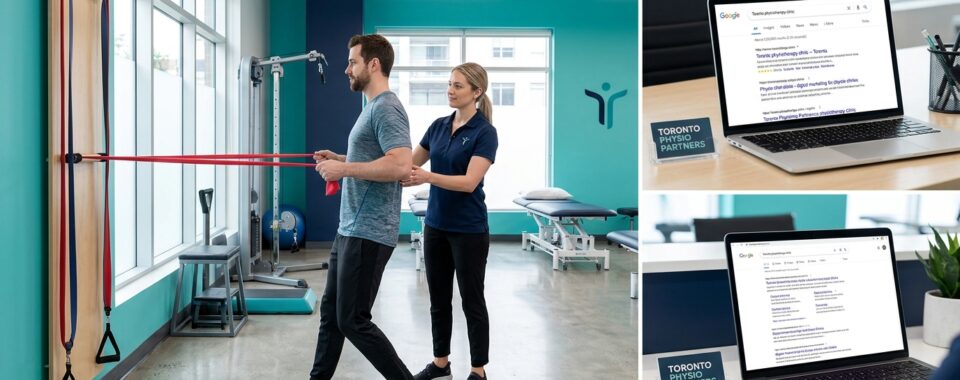
| 🤖 | Quick Answer What Google’s AI Overview Surfaces for This Search
Physiotherapy clinics in Toronto get more Ontario patients from Google by fixing five specific things: an optimised Google Business Profile using the “Physiotherapist” category, a dedicated page for each condition treated, Ontario-specific pages covering WSIB and MVA insurance pathways, CPO-compliant content that avoids unsubstantiated outcome claims, and a consistent review cadence of 1–3 new reviews per week. Clinics that address all five consistently outrank clinics that only address one or two. |
A physiotherapy clinic in Toronto should be one of the easiest healthcare businesses to rank on Google. Physiotherapy is one of the most searched healthcare categories in Ontario patients search for it after injuries, after surgery, after car accidents, and after being referred by their family physician. The search intent is clear, the urgency is real, and the booking rate is high.
Yet most GTA physio clinics are not ranking for the searches that would bring them new patients. Their Google Business Profiles are incomplete, their websites have one generic “Services” page, and they have no content targeting the specific conditions, insurance pathways, and neighbourhoods that Ontario patients search for. The result is consistent invisibility despite serving real demand.
This post explains why, what Ontario-specific factors separate the clinics that rank from those that don’t, and what a proper physiotherapy SEO strategy for Toronto looks like when it’s built correctly. There’s also a CPO compliance section because the College of Physiotherapists of Ontario updated its advertising and marketing standard in May 2025, and content that ignores those rules is both a regulatory and an SEO liability.
| 📍 | Who This Post Is Written For
You own or manage a physiotherapy clinic anywhere in the GTA Toronto, Scarborough, North York, Etobicoke, Mississauga, Brampton, or the surrounding 905 belt. You’re getting some patients from word-of-mouth or referrals, but your Google rankings aren’t generating consistent new-patient bookings from people who searched for “physiotherapy near me” or “physio clinic [neighbourhood].” This post addresses that gap. |
Why Toronto Physiotherapy Clinics Struggle to Rank on Google
The Ontario Physio Market Is More Competitive Than It Looks
There are more than 10,000 registered physiotherapists in Ontario, with a high concentration in the GTA. Unlike some healthcare specialties where patients accept a long wait for a preferred provider, physiotherapy patients typically book with whoever is available, covered by their insurer, and easy to find online. Proximity and discoverability drive more bookings than reputation which means Google ranking is disproportionately important for physiotherapy clinics compared to other healthcare businesses.
The good news is that most competing physio clinics in Toronto are making the same five avoidable mistakes. Understanding those mistakes and how they differ from the broader healthcare SEO landscape in Ontario is what gives a well-optimised clinic a significant ranking advantage even in competitive neighbourhoods.
What Ontario Patients Actually Search For
The biggest mismatch between how physio clinics describe themselves and how patients search for them is specificity. Clinics market themselves as offering “comprehensive physiotherapy services.” Patients search for exactly what’s wrong with them.
The highest-volume, highest-intent searches in Ontario physiotherapy are condition-specific and location-specific. Patients search for “knee pain physiotherapy Toronto,” “back pain physio Scarborough,” “physiotherapy after knee surgery North York,” “MVA physiotherapy Toronto,” and “vestibular physio GTA” not for “physiotherapy clinic.” A clinic with one generic services page is competing for none of these searches. A clinic with a dedicated page for each condition is competing for all of them.
CPO Compliance: The Rule Change Every Ontario Physio Clinic Needs to Know
The College of Physiotherapists of Ontario Updated Its Advertising Standard in May 2025
The College of Physiotherapists of Ontario (CPO) released a revised Advertising and Marketing Standard effective May 1, 2025. This is not a minor update it changed the rules on what physiotherapists can say in their marketing materials, on their websites, and in their social media content. Clinics that haven’t reviewed their existing website content against the new standard face both regulatory risk and an SEO liability, because Google explicitly downgrades healthcare content that makes misleading or unverifiable claims.
What the New CPO Standard Prohibits
Under the May 2025 standard, Ontario physiotherapists and physio clinics cannot:
- Make unsubstantiated outcome claims “We’ll have you pain-free in 6 weeks” is a prohibited guarantee
- Claim superiority over other healthcare providers without verifiable evidence “Better than surgery” or “More effective than medication” are prohibited
- Use specialist titles without College authorisation “Orthopaedic Specialist” or “Sports Physio Expert” require formal credentials
- Offer promotional incentives that encourage unnecessary treatment discounted packages positioned as “you need more sessions” trigger compliance issues
- Advertise “free consultations” without clearly stating limitations if a free assessment leads to a paid treatment plan, this must be disclosed
- Allow marketing content created by others (including an SEO or marketing agency) to make claims the physiotherapist hasn’t verified the therapist is responsible for all content
What CPO-Compliant Content Looks Like in Practice
The standard does not prevent effective SEO content it just requires that content be accurate and verifiable. CPO-compliant physiotherapy website content:
- Describes conditions and treatment approaches factually, without promising specific outcomes
- Uses phrases like “physiotherapy may help with,” “many patients experience,” or “research supports” rather than “we guarantee” or “you will”
- States credentials accurately if a therapist has completed post-graduate training in a technique, that can be stated factually
- Prices and direct billing information published transparently, with named insurers and any coverage limitations clearly stated
- MVA and WSIB content focused on the process (how coverage works, what documentation is needed, how the clinic handles billing) rather than on promised outcomes
| ⚠️ | CPO Compliance Is Also an SEO Issue
Google’s Search Quality Evaluator Guidelines (used by human raters to assess ranking quality) specifically flag healthcare pages that make unverifiable or misleading claims as low-quality content. A physio clinic website with outcome guarantees “get back to running in 4 weeks” may trigger both a College complaint AND a Google quality downgrade. CPO-compliant content and high-ranking SEO content are the same content. |

The 5 Ranking Factors That Separate High-Visibility Physio Clinics from Invisible Ones
A properly built physiotherapy SEO campaign in Toronto addresses these five factors in sequence. Missing any one of them leaves ranking potential on the table.
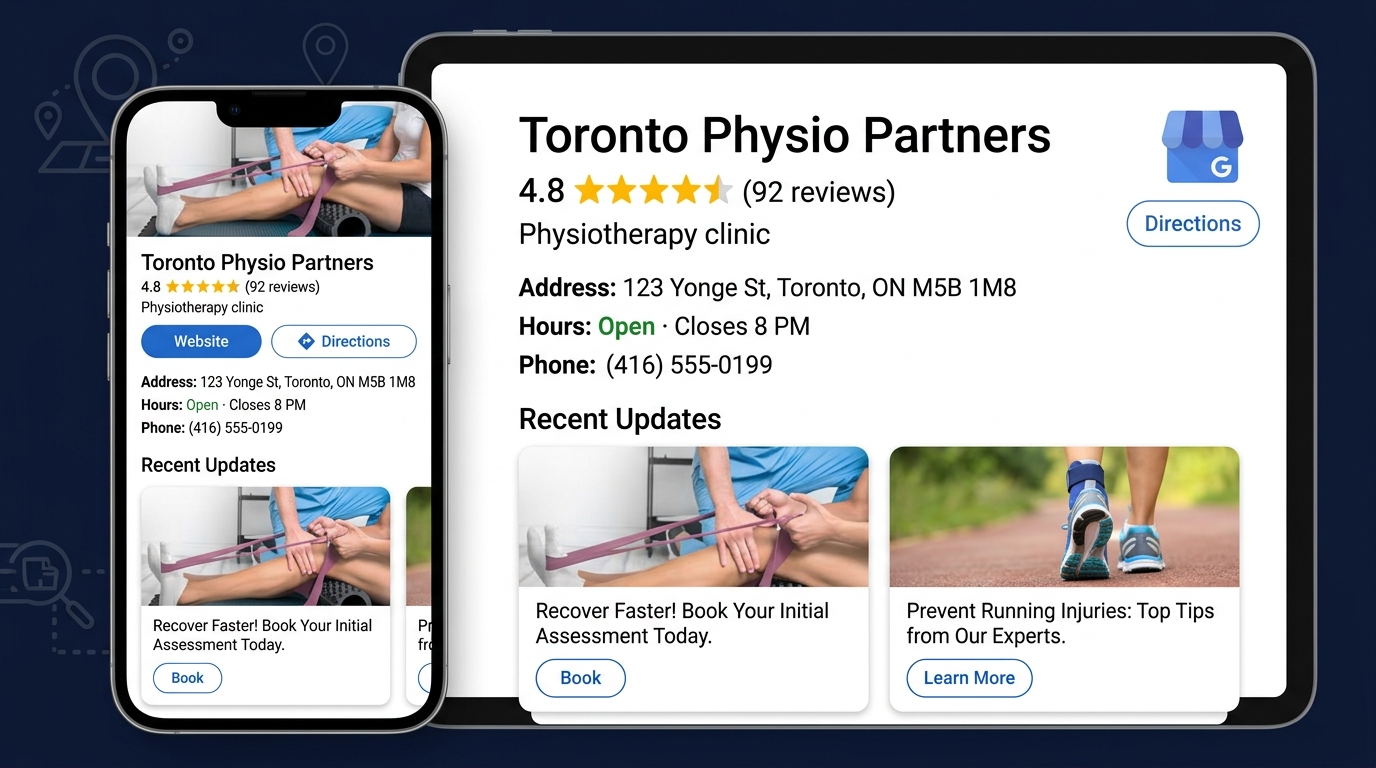
Factor 1 Google Business Profile: Set Up for Physio, Not Just Healthcare
The single most impactful change most Toronto physio clinics can make is fixing their Google Business Profile specifically, setting the primary category correctly. Clinics that use “Healthcare” or “Rehabilitation Centre” as their primary category are missing the “Physiotherapy Clinic” or “Physiotherapist” category that Google uses to match them to patient searches.
GBP Setup for Ontario Physiotherapy Clinics
- Primary category: “Physiotherapy Clinic” for multi-therapist practices, “Physiotherapist” for solo practitioners
- Secondary categories (if applicable): Sports Medicine, Rehabilitation Center, Massage Therapy, Occupational Therapy
- Services listed by condition, not just modality “Knee Pain Physiotherapy,” “Post-Surgical Rehab,” “MVA Recovery” rather than just “Manual Therapy,” “Acupuncture”
- Opening hours complete and accurate Google surfaces availability in search results; incomplete hours reduce click-through
- Photos refreshed every 90 days treatment rooms, equipment, therapist headshots, reception area. Clinics with 10+ photos get significantly more direction requests
- Google Posts every 7–14 days injury-season content works well (winter slip-and-fall, spring running injuries, summer sports)
- Q&A section seeded with the 10 most common patient questions “Do I need a referral?”, “Does OHIP cover physiotherapy?”, “Do you direct bill?”
| 70% | of physiotherapy patients choose their clinic based on proximity and online reviews not referrals. For new patient acquisition, Google visibility outperforms word-of-mouth for GTA physio clinics. |
Factor 2 Condition-Specific Pages: One Page Per Condition, Not One for All
This is the most direct and predictable ranking improvement available to a Toronto physio clinic. Creating a dedicated page for each condition treated rather than listing everything on one Services page gives Google a clear, focused page to rank for each specific patient search query.
Each condition page should target a specific patient problem combined with a Toronto or GTA location signal. The page opens with a direct patient-facing answer (what causes this, how physio helps, what to expect at the clinic), includes question-based subheadings that mirror how patients search, and ends with a clear booking call-to-action.
Priority Conditions for GTA Physio Clinic Pages
- Back pain and lumbar disc injuries consistently the highest-volume physio search category in Ontario
- Knee pain and post-surgical rehabilitation ACL recovery, knee replacement rehab, meniscus injury
- Neck pain and whiplash especially important with the MVA pathway, as neck injuries are among the most common car accident claims
- Shoulder injuries rotator cuff, frozen shoulder, shoulder impingement
- Sports injury rehabilitation running injuries, hockey injuries, soccer injuries (vary by season)
- Motor vehicle accident physiotherapy covered under Ontario auto insurance; high-value, often multi-session care pathway
- WSIB workplace injury rehabilitation a distinct content and intake process from standard private-pay physio
- Post-surgical rehabilitation hip replacement, knee replacement, rotator cuff repair, spinal surgery
- Vestibular physiotherapy and concussion care a growing sub-specialty that generates strong local search volume
- Pelvic health physiotherapy frequently searched, under-served by most clinic websites
- Prenatal and postpartum physiotherapy specific to women’s health, very bookable search intent
What Each Condition Page Must Include
- Opening paragraph that answers the patient question directly condition causes, how physio helps, what to expect
- FAQ section with question-based H3 headings matching how patients search “How many sessions will I need?”, “Is OHIP covered?”, “Do you direct bill my insurance?”
- Direct billing block: name the insurers you bill directly this is both a CPO-compliant disclosure and a ranking signal
- FAQPage schema markup on every condition page triggers FAQ rich results in Google and increases AI Overview eligibility
- Internal link to the main physiotherapy SEO service page and to related condition pages
Factor 3 Ontario Insurance Pages: WSIB, MVA, and Extended Health Benefits
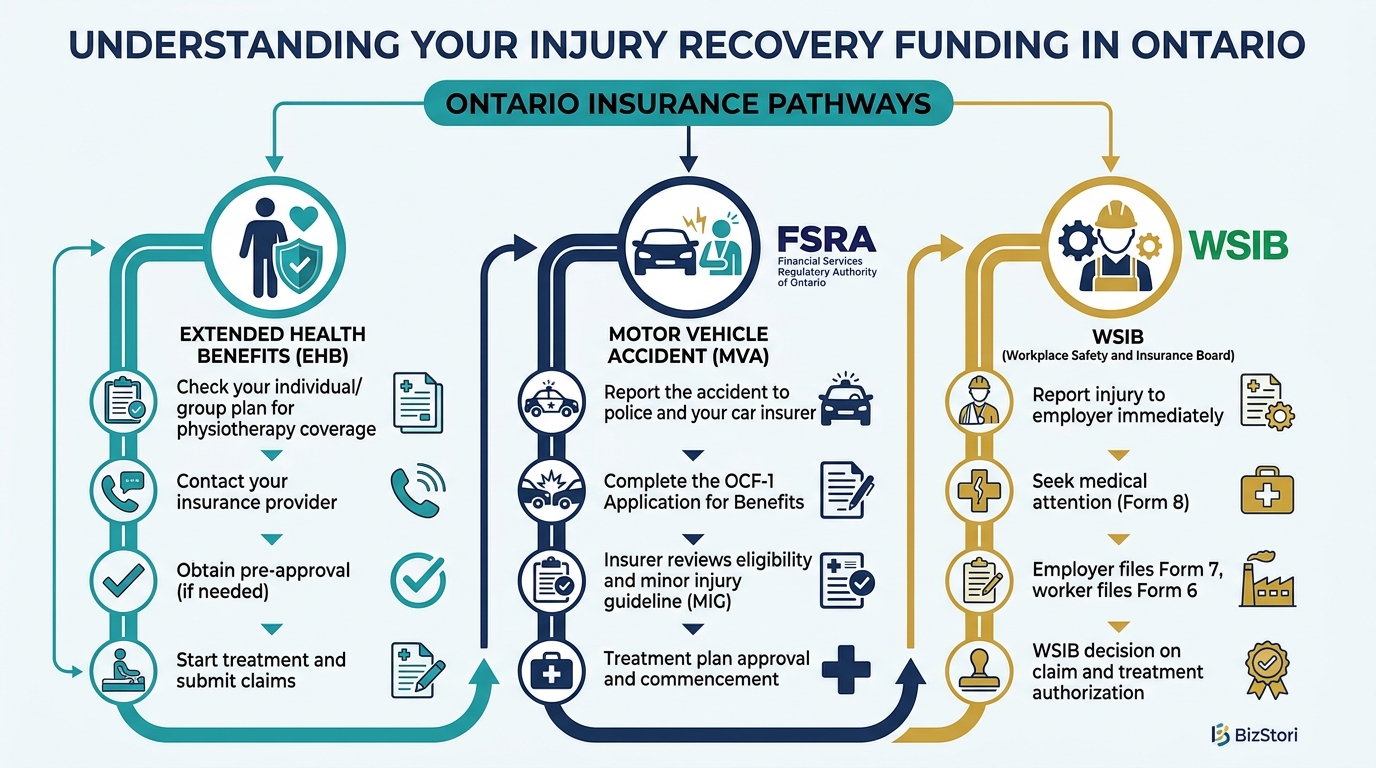
This is the single most underutilised content opportunity for Toronto physiotherapy clinics. Ontario has three distinct physiotherapy patient pathways that each generate specific, high-intent Google searches and most physio clinic websites address none of them with dedicated content.
The three Ontario insurance pathways that every GTA physio clinic should have dedicated pages for:
Motor Vehicle Accident (MVA) Physiotherapy Page
Ontario auto insurance covers physiotherapy as part of Statutory Accident Benefits (SABs). Patients who have been in a car accident and who need physiotherapy often don’t know the claims process or whether their insurance covers it. A dedicated MVA page that explains the process builds trust, answers the questions patients are already Googling, and positions the clinic as experienced with MVA claims.
- Explain Ontario’s auto insurance coverage for physio without making outcome guarantees (CPO-compliant framing)
- Describe the paperwork and intake process the clinic handles on the patient’s behalf
- State clearly which insurers you have experience working with
- “Motor vehicle accident physiotherapy Toronto” is a high-value keyword it takes 5–10 minutes to build a page targeting it, and most clinics haven’t bothered
WSIB (Workplace Safety and Insurance Board) Physiotherapy Page
WSIB covers physiotherapy for workplace injury rehabilitation in Ontario. WSIB-approved clinics get a consistent referral stream from case managers and injured workers but only if they can be found. A dedicated WSIB page that explains eligibility, the referral process, and the clinic’s experience with WSIB claims captures both the organic search traffic and the institutional referral.
- Confirm whether the clinic is a WSIB-approved provider if yes, this must be stated prominently
- Explain the WSIB referral process and what an injured worker needs to bring to their first appointment
- List the types of workplace injuries the clinic commonly treats
Extended Health Benefits (EHB) Page
Most Ontario employees have extended health benefits through their employer that include physiotherapy coverage typically $500 to $1,500 per year. Many patients don’t know their coverage amount, whether the clinic direct bills, or that their benefits reset on December 31. A direct billing information page addresses all three, and the December benefits-expiry angle generates consistent late-year search traffic.
- Name the insurers you direct bill Sun Life, Manulife, Great-West Life, Green Shield, Blue Cross, etc.
- Explain what direct billing means and how it works at the clinic
- Add a December reminder post for patients with unused annual benefits high-intent seasonal traffic
| 💡 | The Ontario Direct-Access Advantage
Ontario patients do NOT need a doctor’s referral to see a physiotherapist. This is a frequently searched question “Do I need a referral for physiotherapy Ontario?” and most physio clinic websites don’t answer it. A clear statement on your homepage and services pages that “no referral is required” removes a common patient barrier and answers a real Google search query. Note: some insurance plans still require a referral for reimbursement this distinction should be stated clearly and accurately per CPO standards. |
Factor 4 Technical SEO: The Foundation That Makes Everything Else Work
Technical SEO is not optional for Ontario physiotherapy clinics it’s the foundation that determines whether all the other work (GBP, content, reviews) can actually rank. A website that loads slowly on mobile, has no schema markup, or has inconsistent NAP data across directories will underperform regardless of content quality.
The Technical SEO Checklist for Toronto Physio Clinics
- Page load speed under 3 seconds on mobile Core Web Vitals: LCP (Largest Contentful Paint) under 2.5 seconds
- HTTPS throughout the site SSL certificate valid and auto-renewing
- LocalBusiness schema with Physiotherapy Clinic type name, address, phone, hours, geo-coordinates
- MedicalWebPage schema on condition pages signals healthcare content to Google
- FAQPage schema on every condition page and blog post required for FAQ rich results and AI Overview eligibility
- NAP consistency: clinic name, address, and phone must match exactly across Google Business Profile, website, Yelp, RateMDs, Healthgrades Canada, Yellow Pages Canada, Facebook, and all other directories
- XML sitemap submitted to Google Search Console verify all condition pages and location pages are indexed
- No duplicate content if the website was built from a template shared with other clinics, the content must be rewritten to be unique
Factor 5 Review Strategy: Building Trust Signals Google and Patients Both Read
Patient reviews influence both Google’s local ranking algorithm and the clinic’s conversion rate once a patient finds them in search results. A clinic with 75 recent reviews and a 4.7 star rating will rank above and book more patients than a clinic with 200 older reviews and a 4.9 star rating, because recency matters more than total volume.
CPO-Compliant Review Generation for Ontario Physio Clinics
The CPO advertising standard applies to testimonials and patient reviews as well as to paid advertising. Physiotherapists cannot solicit reviews that contain specific outcome claims (“fixed my back in 4 weeks”), nor can they offer incentives for reviews. What is compliant and effective:
- Ask patients for a review at discharge or after a positive session timing drives response rate more than any other variable
- Send a review request via text or email within 24 hours of a positive visit include a direct Google review link to reduce friction
- Target 1–3 new reviews per week consistently not bursts of 20 followed by months of silence
- Respond to all reviews within 48 hours professionally, without including clinical details that would breach patient privacy
- Never offer discounts, free sessions, or other incentives for reviews this violates both CPO standards and Google’s review policies\
Ontario Keyword Strategy for Physiotherapy Clinics
Starting With the Right Keywords
A Toronto physiotherapy clinic should not start its SEO strategy by targeting “physiotherapy Toronto.” That keyword is dominated by multi-location chains, directories (RateMDs, Healthgrades), and well-funded competitors who have been building domain authority for years. A single-location clinic’s fastest path to page-1 rankings is neighbourhood-first and condition-first keywords with lower competition and higher booking intent that can realistically rank within 90–180 days.
Neighbourhood Keywords Rank First
- “Physiotherapy clinic [neighbourhood]” Scarborough, North York, Etobicoke, Mississauga, Brampton, Oakville, Richmond Hill
- “Physiotherapist near [landmark or transit]” near Square One, near Yonge and Eglinton, near Scarborough Town Centre
- “Physio clinic open Saturday Toronto” and availability-specific searches underserved by most clinic websites
Condition Keywords Rank Next
- “Back pain physiotherapy Toronto” and “[neighbourhood]” variants
- “MVA physiotherapy Toronto” high value, insurance-covered, often multi-month care pathway
- “Knee pain physio North York,” “shoulder pain physiotherapy Scarborough,” “vestibular therapy GTA”
- “Post-surgical physiotherapy Toronto” referral-driven but also patient-searched, especially for knees and hips
Question Keywords Blog and FAQ Content
- “Does OHIP cover physiotherapy Ontario?” one of the highest-volume physio search queries in Ontario
- “Do I need a referral for physiotherapy Ontario?” direct-access education content
- “How many physiotherapy sessions do I need?” research-stage query, pre-booking
- “Physiotherapy vs chiropractic for back pain” high-value comparison content for patients deciding between providers
- “How does WSIB physiotherapy work in Ontario?” institutional + patient search query
The Internal Link Quick Win: How One Edit Can Push a Page to Page 1
What an Internal Link Quick Win Is
Google Search Console reveals pages that are ranking between position 8 and 20 close enough to page 1 to be worth targeting, but not quite there. One of the most effective tactics in SEO is adding a strong internal link from a well-trafficked page to a near-win page passing authority and relevance from one URL to another within the same site. For BizStori’s own physio content, the existing blog post SEO for Physiotherapists: How to Get More Patients from Google in Toronto ranks at approximately position 13 a near-win for the main physiotherapy SEO Toronto service page. Adding a targeted internal link from the blog post to the service page, anchored to the keyword phrase “physiotherapy SEO Toronto,” can provide a measurable push toward page 1 at zero cost and in under 15 minutes of work.
How to Apply This Tactic to Your Own Clinic’s Website
The same internal link logic applies to any physiotherapy clinic’s website. If you have existing blog posts or secondary pages, check Google Search Console for pages ranking between positions 8–20. Then identify a high-traffic page on your site your homepage, your most-visited condition page and add a contextual internal link from that page to the near-win page, anchored to the keyword phrase the near-win page is targeting.
- Log in to Google Search Console → Performance → Pages
- Sort by Position and filter to positions 8–20 these are your near-win pages
- Identify a high-authority page on your site (homepage, top-traffic condition page) that doesn’t currently link to the near-win page
- Add one sentence with a contextual internal link to the near-win page use the target keyword as anchor text, not generic text like “click here”
- Submit the linking page for re-indexing in Google Search Console → URL Inspection → Request Indexing
- Monitor position changes over 2–4 weeks
| ⚡ | This Tactic Takes 15 Minutes Do It the Day the New Blog Post Goes Live
When this new post (bizstori.ca/blog/physiotherapy-seo-toronto-ontario-patients) goes live, the same day: go to the existing post at /seo-for-physiotherapists-how-to-get-more-patients-from-google-in-toronto/ and add a sentence that links to /physiotherapy-seo-toronto/ anchored to the phrase “physiotherapy SEO Toronto.” Then submit both pages for re-indexing. Combined, the new post’s content authority and the existing post’s established ranking signal will push the service page measurably toward position 10 and below. |
What a Physio SEO Campaign Looks Like Month by Month
Month 1 Fix What’s Already Suppressing Your Rankings
Before publishing a single new blog post or running any ads, a properly structured physio SEO campaign begins with an audit and fix of the issues that are actively suppressing the clinic’s existing pages.
- Google Business Profile audit: correct category, complete NAP, 20+ photos, Q&A seeded, services listed by condition
- Technical SEO audit: Core Web Vitals report, SSL status, schema markup check, duplicate content identification
- NAP citation audit: compare clinic name, address, and phone across top 10 directories and correct inconsistencies
- On-page optimisation: title tags and meta descriptions rewritten for every existing service page using targeted condition + location keywords
- Internal link audit: identify all near-win pages in GSC (positions 8–20) and build internal links from high-authority pages
Month 2–3 Build the Content That Ranks for Patient Searches
With the foundation in place, the content build begins. Each piece targets a specific patient search query that the clinic’s current website doesn’t rank for. This mirrors the approach across all healthcare SEO in Toronto speciality-specific content built on a clean technical foundation compounds faster than content built on a broken one.
- One dedicated condition page per treatment area minimum 8 pages for a general physio clinic
- One neighbourhood location page per service area each page geo-targeted with local landmarks, transit references, and area-specific context
- MVA physiotherapy page process-focused, CPO-compliant, targeting “motor vehicle accident physiotherapy Toronto”
- WSIB page if the clinic is a WSIB-approved provider, this page is mandatory for capturing institutional referrals
- Extended health benefits and direct billing page name insurers, explain coverage, add December benefits-expiry angle
- Blog content targeting question keywords: “Does OHIP cover physiotherapy?”, “Do I need a referral for physio in Ontario?”, “How many sessions will I need?” each post structured for AI Overview visibility with a direct answer in the opening paragraph and FAQPage schema
Month 4+ Build Authority and Compound Rankings
With technical SEO and condition-specific content in place, the final phase focuses on the external authority signals citations, backlinks, and review velocity that push established pages from position 8–15 to page 1.
- Local citation building: claim and verify listings on Ontario physiotherapy directories, health directories, and local business associations
- Backlink outreach: Ontario health publications, local neighbourhood blogs, community health centres that link to physio resources
- Consistent review generation: 1–3 new Google reviews per week through automated post-visit follow-up CPO-compliant framing, no incentives
- Quarterly content refresh: update condition pages with new clinical information, new internal links, refreshed schema Google rewards regularly maintained pages
Should Your Physio Clinic Run Google Ads While Building Organic Rankings?
The Case for Parallel PPC and SEO
Physiotherapy SEO takes 3–6 months to produce meaningful results. For a clinic that needs new patients before then, running Google Ads for healthcare clinics in parallel with the SEO build fills the gap and shares keyword data that improves the organic strategy. Conditions that convert well in paid search (MVA recovery, post-surgical rehab, sports injuries) are exactly the condition pages to prioritise in the organic content build.
The ideal budget split for a new physio SEO and PPC launch is approximately 60/40 in favour of SEO in month 1 (heavy audit and foundation work), shifting toward 40/60 SEO-to-PPC in months 2–3 as content builds and paid search begins producing bookings, then reverting to SEO-dominant spend from month 4 onward as organic rankings start to compound.
Frequently Asked Questions
Does OHIP cover physiotherapy in Ontario?
OHIP (Ontario Health Insurance Plan) does not cover physiotherapy for most patients as of 2026. Exceptions include some services for seniors 65+ at specific publicly funded clinics, and some home-visit physiotherapy through LHIN (Local Health Integration Network) programs. The vast majority of physiotherapy in Ontario is funded through extended health benefits (employer insurance), motor vehicle accident insurance, WSIB (for workplace injuries), or private pay. This is one of the highest-volume physiotherapy search queries in Ontario every physio clinic website should have a clear, accurate answer to it.
Do Ontario patients need a referral to see a physiotherapist?
No in Ontario, patients can see a registered physiotherapist without a doctor’s referral. This is called “direct access” and has been the standard in Ontario for years. However, some extended health insurance plans require a physician’s referral before they will reimburse physiotherapy costs this is an insurer requirement, not a regulatory one. Motor vehicle accident claims typically require documentation from a healthcare provider. CPO-compliant messaging states this distinction clearly rather than an unqualified “no referral needed.”
How long does physiotherapy SEO take to show results in Toronto?
For neighbourhood-specific and condition-specific keywords with low competition, many Toronto physio clinics see measurable ranking improvements within 60–90 days of fixing their GBP and publishing dedicated condition pages. Broad city-wide keywords like “physiotherapy Toronto” typically take 6–12 months for a single-location clinic to challenge established competitors. The fastest results come from clinics that address technical SEO and GBP in month 1, before publishing new content because new content ranks faster on a technically clean site.
What makes physiotherapy SEO different from general healthcare SEO?
Physiotherapy SEO has several Ontario-specific dimensions that general healthcare SEO doesn’t: the CPO advertising standard governing what can and cannot be claimed in content, the three distinct patient pathways (private pay, MVA, WSIB) that each require their own dedicated pages, the direct-access model that affects how patients search and book, and the extended health benefits angle that generates recurring seasonal search volume (especially in November–December as benefit years end). A healthcare SEO agency that doesn’t understand Ontario physio regulations specifically will produce content that either makes prohibited claims or misses the Ontario-specific angles that rank.
How should a Toronto physio clinic handle negative Google reviews under CPO rules?
A physiotherapist must not disclose any patient-specific clinical information in a public review response doing so would breach patient privacy under PHIPA (Personal Health Information Protection Act) regardless of what the patient said in their review. The compliant approach is to acknowledge the review, express that the clinic takes all feedback seriously, and invite the patient to contact the clinic directly to discuss their experience without confirming or denying they were a patient, and without referencing any clinical details. This approach also happens to be the best SEO practice: prospective patients read how clinics respond to criticism as a signal of professionalism.
The Bottom Line: What Your Toronto Physio Clinic Needs to Rank in 2026
The physiotherapy clinics ranking in the Google Maps 3-pack and on page 1 of organic results in Toronto have five things in common: a properly configured Google Business Profile, condition-specific pages targeting how Ontario patients actually search, Ontario insurance pathway pages for MVA and WSIB, CPO-compliant content that avoids prohibited claims, and a consistent review cadence.
The clinics that don’t rank are missing at least two of those five most often the condition-specific content and the Ontario insurance pages. A properly built physiotherapy SEO strategy for Toronto addresses all five in sequence, and the compounding effect typically shows measurable results within 90–120 days of the foundation being in place.
The same framework applies across healthcare specialties in the GTA. Whether you operate a chiropractic clinic or a medical practice, the five ranking factors are structurally the same what changes are the regulatory body (CPO for physio, CPSO for physicians), the insurance pathways, and the condition-specific keyword landscape.
| 📌 | Your Next Step
BizStori offers a free physiotherapy SEO audit for Toronto and GTA clinics a full review of your Google Business Profile, technical SEO health, CPO compliance gaps, content coverage, and citation consistency. No retainer required to see the findings. Book directly at bizstori.ca/physiotherapy-seo-toronto/ |
