









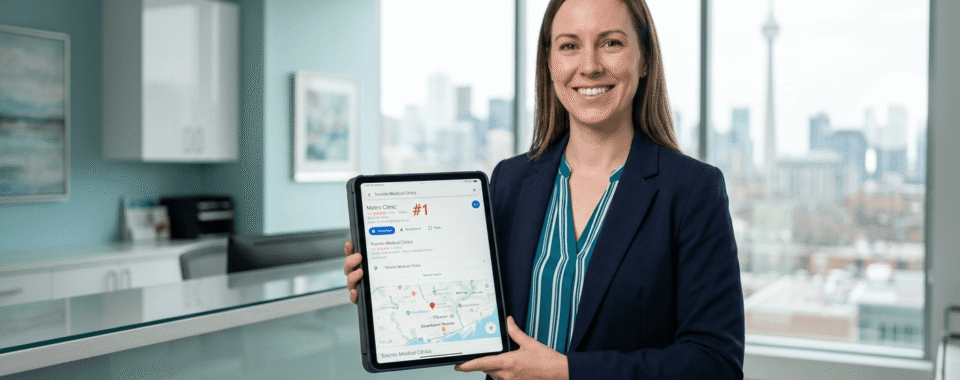
Healthcare SEO is the process of optimising a medical clinic’s online presence — website, Google Business Profile, local citations, and content — so that patients in Toronto find your practice when they search for the care you provide. In 2026, it is the single most cost-effective patient acquisition channel available to Toronto clinic owners.
But healthcare SEO is not the same as general SEO. Google classifies all medical content under YMYL — Your Money or Your Life — which means it holds your website to a significantly higher standard of accuracy, expertise, and trustworthiness than it applies to a restaurant or a clothing retailer. Add Ontario’s PHIPA legislation, Canadian advertising standards, and the rise of AI-powered search results, and you have a specialised discipline that most generic SEO agencies are not equipped to handle.
This guide is written specifically for Toronto clinic owners and dentists who want to grow patient bookings through local search. For BizStori’s full healthcare digital marketing services, visit our healthcare SEO Toronto service page — or read on for the complete tactical playbook.
What Is Healthcare SEO and Why Is It Different?
Healthcare SEO is the strategic optimisation of medical websites to rank higher in search results for patient queries. It combines technical website performance, E-E-A-T compliance, local search optimisation, and AI-ready content formatting to help patients find your practice when searching for symptoms, treatments, or specialists.
What makes it fundamentally different from standard SEO:
- YMYL classification: Google treats all health content as high-stakes. A factual error on a dental website carries far more consequence than an error on a travel blog. Google’s quality raters scrutinise medical content at a level applied to almost no other industry.
- PHIPA compliance in Ontario: Ontario’s Personal Health Information Protection Act governs how patient data is collected, stored, and used. This affects your website forms, call tracking setup, analytics configuration, and review management — not just your clinical operations.
- E-E-A-T requirements: Experience, Expertise, Authoritativeness, and Trustworthiness are not quality improvement factors in healthcare — they are the minimum entry requirement. Pages without named practitioners, credentials, and verifiable clinical accuracy simply will not rank.
- Local competition intensity: Toronto is home to thousands of registered physicians, specialists, walk-in clinics, and allied health providers. In this market, the difference between page one and page two is the difference between a full appointment calendar and a quiet waiting room.
| 📊 The Numbers That Make Healthcare SEO Non-Optional
Over 80% of patients search online before booking a healthcare provider. Clinics with optimised Google Business Profiles generate more than twice the patient inquiries of those without. And 77% of patients trust online reviews as much as a personal recommendation when choosing a doctor. In Toronto’s competitive healthcare market, SEO is not a marketing expense — it is patient acquisition infrastructure. |
How Google Ranks Toronto Healthcare Clinics
Google’s local ranking algorithm for healthcare clinics works across two surfaces: the Google Maps Pack (the three listings that appear above organic results) and traditional organic blue-link results. Both matter — and they respond to different optimisation levers.
| Ranking Factor | Maps Pack Impact | Organic Impact |
| Google Business Profile | Very High — #1 Maps factor | Medium |
| Patient reviews (volume + rating) | Very High | High (trust signal) |
| NAP consistency across directories | High | Medium |
| Website E-E-A-T signals | Medium | Very High |
| Local content & keywords | High | Very High |
| Technical SEO (speed, mobile) | Medium | High |
| Backlinks from Canadian health sources | Low–Medium | Very High |
| Schema markup (MedicalBusiness) | Medium | High (AI Overviews) |
1. Google Business Profile Optimisation for Medical Clinics
Your Google Business Profile (GBP) is the single most important local SEO asset for any Toronto healthcare clinic. It controls whether you appear in the Maps Pack — those top three listings that dominate mobile search results for queries like “dentist near me” or “physiotherapy North York.” Getting into the Maps Pack can increase patient calls by 50% or more overnight.
Choosing the Right Primary and Secondary Categories
This is where most Toronto clinics make their first mistake. Your primary category must be as specific as possible to your practice type:
- Dental clinic → “Dentist” (not “Dental Clinic” or “Dental Office”)
- Physiotherapy → “Physical Therapist” or “Physical Therapy Clinic”
- Chiropractic → “Chiropractor”
- General practice → “Medical Clinic” or “Family Practice Physician”
- Specialist → Use your specialty directly: “Cardiologist”, “Dermatologist”, “Orthodontist”
For secondary categories, add up to 9 that accurately reflect services you genuinely provide. A family practice might add “Walk-in Clinic”, “Women’s Health Clinic”, and “Pediatrician” as secondary categories. Only add categories for services you actually provide — Google can penalise profiles that use misleading categories.
Services, Photos, Posts and Attributes
Every section of your GBP must be completed. Incomplete profiles rank lower and convert fewer patients. Here is what matters most:
✓ Services: List every service individually with a 1–2 sentence description. Use the language patients search — “teeth whitening” not “bleaching therapy.”
✓ Photos: Upload exterior, reception, treatment rooms, and team photos. Profiles with photos receive 42% more direction requests. Aim for 25+ photos minimum.
✓ Attributes: Mark “Accepting New Patients”, “Wheelchair Accessible”, “Telehealth Available” and any other applicable attributes — these filter patient searches.
✓ GBP Posts: Publish at least two posts per week — seasonal health tips, service spotlights, team introductions. Weekly posting signals to Google that your business is active and engaged.
✓ Q&A section: Pre-populate with your own questions and answers. “Are you accepting new patients?” “Do you offer same-day appointments?” — patients search these phrases.
How to Dominate the Google Maps Pack in Toronto
The Maps Pack is won primarily through GBP completeness and review velocity — not through your website. A fully optimised GBP with 80+ reviews and a 4.7+ rating, maintained with weekly posts, will outrank a competitor with a better website but a neglected GBP almost every time in Toronto’s local healthcare market.
| 💡 The Single Fastest Win in Healthcare Local SEO
If you do nothing else this week: open your Google Business Profile, add your top 5 services with descriptions, upload 10 new photos, and publish a post. These four actions take under an hour and will improve your Maps Pack visibility within 2–4 weeks — faster than any other SEO tactic. |
2. Local Citations for Toronto Healthcare Clinics
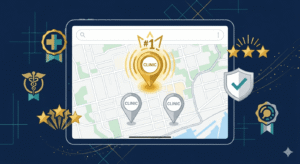
Local citations are online mentions of your clinic’s Name, Address, and Phone number (NAP) across directories, health platforms, and local websites. For Google, citations act as location validation signals — the more consistently your clinic’s information appears across trusted sources, the more confident Google is that your practice is legitimate, established, and worth ranking.
The Essential Citation Directories for Ontario Clinics
Not all citation sources are equal. For Toronto healthcare clinics, these directories carry the most authority with Google:
| Directory / Platform | Type | Priority |
| Google Business Profile | Search + Maps | Essential |
| RateMDs | Canadian health review platform | Essential |
| Healthgrades Canada | Medical directory | Essential |
| Yellow Pages Canada (YP.ca) | General business directory | Essential |
| Yelp Canada | Review platform | High |
| Canadian Dental Association | Dental-specific | High |
| Ontario Physiotherapy Assoc. | Physiotherapy-specific | High |
| Canada 411 | National directory | High |
| Foursquare | Location platform | High |
| Apple Maps | Mobile search | High |
| Bing Places | Microsoft search | High |
| Better Business Bureau (BBB) | Trust signal | Medium |
| Zocdoc Canada | Online booking platform | Medium |
| 1-800-Dentist | Dental-specific | Medium |
| Local Toronto health publications | Editorial citations | Medium |
NAP Consistency — The Rule That Breaks Most Clinics
NAP consistency means your clinic’s Name, Address, and Phone number must be letter-for-letter identical across every platform. “305 Milner Avenue” and “305 Milner Ave” are different to Google’s citation validation system. “Suite 700” vs “#700” vs “Unit 700” — all treated as inconsistencies. These discrepancies erode Google’s confidence in your listing and suppress your local rankings.
Audit your NAP across every platform before building new citations. Correct existing inconsistencies first. Then build new citations using one standardised format that you document and apply everywhere going forward.
3. PHIPA-Compliant Content Strategy
Ontario’s Personal Health Information Protection Act (PHIPA) is not just a clinical compliance requirement — it directly shapes what your website can and cannot do. Most Toronto clinic websites are inadvertently collecting or processing personal health information without proper consent structures, which creates both legal exposure and SEO risk.
What PHIPA Means for Your Website Content
Three areas where PHIPA intersects with your SEO content strategy:
- Contact and booking forms: Any form that collects a patient’s name alongside a health concern, symptom, or appointment reason is collecting Personal Health Information under PHIPA. These forms require explicit consent language, a clearly linked privacy policy, and PHIPA-compliant form processing infrastructure — not a standard WordPress plugin.
- Patient testimonials and case studies: Publishing patient testimonials that identify a person and reference their health condition or treatment requires explicit written consent. Before/after photos, treatment outcomes, and named patient stories all fall under PHIPA’s consent requirements.
- Analytics and tracking: Standard Google Analytics implementations on healthcare websites can create PHIPA exposure if they track identifiable users browsing condition-specific or treatment pages. A PHIPA-safe analytics stack uses consent-mode integration and server-side processing — not the default client-side tag.
E-E-A-T for Medical Websites — What Google Actually Checks
E-E-A-T (Experience, Expertise, Authoritativeness, Trustworthiness) is Google’s framework for evaluating whether content from a healthcare provider deserves to rank. Here is what it looks like in practice for a Toronto clinic:
- Experience: First-hand clinical observations — “In our North York clinic, we see patients who…” — add texture and credibility that generic health content cannot provide. This is your competitive advantage over WebMD and Healthline.
- Expertise: Every service page and blog post should have a named licensed practitioner in the byline or a clear “Reviewed by” attribution with credentials visible. Dr. Jane Smith, DDS, FICD — not “The BizStori Team.”
- Authoritativeness: Links and citations from trusted Canadian health organisations — Ontario Medical Association, Canadian Dental Association, provincial physiotherapy colleges — are among the highest-authority signals available to a Toronto clinic.
- Trustworthiness: A clearly visible privacy policy, PHIPA compliance statement, college registration numbers, professional association logos, malpractice insurance disclosure, and secure HTTPS across every page.
How to Write Content That Ranks AND Stays Compliant
The safest and most effective content framework for Toronto healthcare SEO:
- Service pages — one per service: Each major service needs its own dedicated page. “Dental Implants in Scarborough,” “Physiotherapy for Lower Back Pain in North York.” Minimum 1,200 words, practitioner-reviewed, with a FAQ section structured for AI Overview extraction.
- Condition and symptom pages: Patients search by symptom before they search by treatment. “Chronic knee pain treatment Toronto” gets more searches than “physiotherapy Toronto” for patients in acute need. These pages drive the highest-converting traffic.
- Neighbourhood location pages: A dedicated page for each Toronto neighbourhood you serve — Scarborough, North York, Etobicoke, East York, Markham. Target neighbourhood-level keywords that have less competition and higher local intent.
- FAQ and educational blog content: 2–3 articles per month answering the exact questions your patients ask. Structure each with a direct answer in the first two sentences — this is the format Google’s AI Overview pulls from most reliably.
BizStori’s healthcare content and SEO services are built around this framework — every piece of content we produce for clinic clients is practitioner-reviewed before publication.
4. Patient Review Strategy (PHIPA-Safe)
Patient reviews are simultaneously your strongest local ranking signal and your highest-risk content area from a compliance perspective. A 4.8-star Toronto clinic at position 3 in the Maps Pack routinely books more patients than a 3.9-star practice at position 1. Review velocity, rating, and recency all directly influence your Maps Pack ranking.
How to Ask for Reviews Without Violating PHIPA
The compliant approach to review collection: send an automated post-appointment text or email that says nothing more than “Thank you for your visit today — if you’d like to share your experience, we’d appreciate a Google review.” Include a direct link to your Google review page. The message must not reference the appointment type, the treatment received, or any health-related detail.
Automate this with a PHIPA-safe CRM system — BizStori’s CRM automation services include compliant patient follow-up workflows that generate consistent review velocity without creating PHIPA exposure.
How to Respond to Reviews in a PHIPA-Compliant Way
This is where many Toronto clinics unknowingly create legal risk. When responding to patient reviews — positive or negative — you must never confirm that the reviewer is a patient, reference any details about their visit, care, condition, or treatment, or acknowledge any health-related information they may have shared in their review, even if they shared it themselves
| 🚫 Non-Compliant Response | ✅ PHIPA-Safe Response |
| “Thank you for sharing your experience with your root canal — we’re so glad the procedure went smoothly for you!” | “Thank you so much for taking the time to share your experience. We’re glad you felt comfortable and well cared for. We look forward to welcoming you back.” |

5. Technical SEO for Healthcare Websites
A technically sound website is the foundation that all other healthcare SEO sits on. Google cannot rank pages it cannot crawl — and patients will not stay on a site that loads slowly or is hard to navigate on a phone.
Mobile Performance
63% of healthcare searches occur on mobile devices. Your clinic website must load in under 3 seconds on mobile, be fully navigable with a thumb, have click-to-call buttons on every page, and display correctly on all screen sizes. Test with Google’s PageSpeed Insights — aim for a score above 75 on mobile. Below 60 is actively suppressing your rankings.
Schema Markup for Healthcare Clinics
Schema markup is structured data added to your website code that helps Google — and AI systems — understand exactly what your clinic offers. For a Toronto healthcare website, implement:
- MedicalBusiness schema: On your homepage — includes clinic name, address, phone, hours, medical specialty, and whether you accept new patients.
- Physician schema: On each practitioner’s bio page — name, credentials, specialty, languages spoken, and hospital affiliations.
- Service schema: On each service page — what the service is, who it’s for, and what the process involves.
- FAQPage schema: On any page with a FAQ section — this feeds Google’s AI Overviews directly for health queries. Every service page should have one.
- AggregateRating schema: Displays your star rating in search results — this alone can increase click-through rates by 15–20%.
HTTPS, Privacy Policy and Consent
HTTPS is non-negotiable — any healthcare website still serving over HTTP is both a security violation and an active ranking penalty. Your privacy policy must be current, accessible from every page footer, and specific to PHIPA (not a generic US-style privacy policy). Every form must include a consent checkbox with a clear statement of how the information will be used. BizStori’s website design services include PHIPA-compliant form architecture and consent frameworks for all healthcare clinic clients.

6. AI Overview Optimisation for Healthcare Clinics
In 2026, Google’s AI Overviews are reshaping how patients discover healthcare providers. An AI-generated summary now appears at the top of many health-related searches — above the Maps Pack and above traditional organic results. The clinics and agencies whose content is cited in these summaries gain a significant trust and visibility advantage.
AI Overviews do not pull from paid ads. They pull exclusively from organic content that Google’s AI considers authoritative, well-structured, and directly responsive to the patient’s query. This is a major opportunity for Toronto healthcare clinics that invest in quality content — and a major risk for those that don’t.
How to Structure Content for AI Overview Extraction
- Answer-first formatting: Every H2 section should open with a direct 1–2 sentence answer to the question implied by the heading. “What is a dental implant? A dental implant is a titanium post surgically placed in the jawbone to support an artificial tooth.” Google’s AI pulls this format reliably.
- FAQ schema on every service page: Structure your FAQ sections with proper FAQPage schema markup. These are the most common AI Overview source for healthcare queries.
- Condition and symptom content: AI systems surface content that addresses the patient’s actual experience — “chronic knee pain,” “tooth sensitivity after whitening,” “lower back pain physiotherapy” — not just clinical service names.
- Named practitioner content: AI platforms are beginning to surface specific practitioners, not just clinics. Content published under a named, credentialled practitioner’s byline is more likely to be cited in AI-generated answers than anonymous clinic content.
- Local specificity: Include Toronto neighbourhood names, local landmarks, transit references, and community context throughout your content. AI systems use geographic signals to determine local relevance.
| 🤖 The AI Overview Opportunity Most Toronto Clinics Are Missing
Google processes roughly 70,000 health-related searches every minute. AI Overviews now appear for a growing share of these queries — and Toronto healthcare clinics that publish properly structured, practitioner-reviewed, PHIPA-compliant content are in the best position to be cited. This is the new front page of healthcare search, and almost no local Toronto clinic is optimised for it yet. |
| Want to Know How Your Clinic Scores on Healthcare SEO?
BizStori offers a free healthcare SEO audit for Toronto clinics — we review your GBP, citations, content, and technical setup and show you exactly what to fix first. → Get Your Free Healthcare SEO Audit → bizstori.ca/contact-us |
Specialty-Specific SEO Priorities
Healthcare SEO strategy shifts meaningfully by clinic type. Here are the priority focus areas and fastest wins for the four most common Toronto healthcare niches:
| Specialty | Primary SEO Focus | Fastest Win |
| Dental Clinics | Service pages per treatment + GBP optimisation | Dedicated Invisalign and implants pages with neighbourhood targeting |
| Physiotherapy | Condition/symptom pages + GBP posts | “Lower back pain physiotherapy [neighbourhood]” landing pages |
| Chiropractic | Local citations + review velocity | 50+ Google reviews + weekly GBP posts |
| GP / Walk-In | “Accepting new patients” signals everywhere | GBP attribute + homepage H1 + dedicated accepting-patients page |
| Orthodontics | Invisalign and braces service pages | Neighbourhood-targeted Invisalign page + before/after gallery |
| Mental Health / Counselling | Condition pages + PHIPA-safe content | Anxiety, depression, trauma condition pages with compliant testimonials |
For dental clinics specifically, our dedicated Dental SEO Toronto guide covers every tactic in depth — from GBP setup to patient review strategy and service page optimisation. For healthcare clinics running paid advertising alongside SEO, see our Healthcare PPC guide for Toronto clinics.
Healthcare SEO vs Google Ads — Which Should You Invest in First?
The full comparison between SEO and paid advertising is covered in detail in our PPC vs SEO Toronto ROI guide. For healthcare clinics specifically, here is the summary:
- New clinic opening: Start with Google Ads for immediate patient flow. Begin SEO in parallel. Expect SEO to become your dominant channel by month 9–12.
- Established clinic (2+ years): SEO should be your primary long-term investment. Toronto SEO services build compounding returns that paid ads cannot match on a 12+ month horizon.
- High-value services (implants, Invisalign, specialist consultations): Run both. Google Ads captures patients ready to book now. SEO captures the larger research-phase audience.
- Limited budget (under $1,500/month): Prioritise SEO and GBP optimisation. PPC at low budgets rarely generates sufficient volume in competitive Toronto healthcare markets.
| Ready to Dominate Local Search in Your Healthcare Niche?
BizStori works with Toronto dental clinics, physiotherapy practices, and medical clinics to build SEO systems that fill appointment calendars. See our case studies at bizstori.ca/case-studies → Book a Free Healthcare SEO Strategy Call → bizstori.ca/contact-us |
FAQ — Healthcare SEO Toronto
What is healthcare SEO?
Healthcare SEO is the process of optimising a medical clinic’s online presence — website, Google Business Profile, local citations, and content — so that patients find your practice when searching for the care you provide. It differs from standard SEO because Google applies stricter quality standards (YMYL) to all medical content, requiring demonstrable clinical expertise, regulatory compliance with Canadian standards like PHIPA, and consistent local authority signals.
How long does healthcare SEO take to show results in Toronto?
Local SEO improvements — particularly Google Business Profile and citation building — typically show results within 2–4 months. Organic content ranking takes 4–6 months for meaningful movement and 9–12 months for full velocity. In a competitive Toronto market with thousands of healthcare providers, consistent investment over 12+ months is what separates clinics that dominate local search from those that struggle to appear on page one.
What is PHIPA and how does it affect my clinic’s SEO?
PHIPA is Ontario’s Personal Health Information Protection Act — the provincial law governing how personal health information is collected, used, and disclosed. For your website and SEO, it affects your contact form structure (which must not collect health details without proper consent), your analytics configuration (which must not track identifiable patients browsing health-condition pages), your review response protocol (which must never acknowledge that a reviewer is a patient), and your patient testimonial strategy (which requires explicit written consent).
Is HIPAA the same as PHIPA for Canadian clinics?
No. HIPAA is an American law (Health Insurance Portability and Accountability Act) that applies to US healthcare providers. Canadian clinics in Ontario are governed by PHIPA at the provincial level and PIPEDA at the federal level. Many SEO guides and agency websites reference HIPAA when discussing healthcare SEO — this is a signal that the content is US-focused and may not apply accurately to your Toronto or Ontario clinic. BizStori builds all healthcare SEO strategies to Canadian regulatory standards from the ground up.
How many Google reviews does my Toronto clinic need to rank in the Maps Pack?
There is no fixed number — but volume, rating, and recency all matter together. In most Toronto healthcare categories, clinics in the Maps Pack top 3 have 50–200+ reviews with ratings above 4.5. A clinic with 150 reviews and a 4.7 rating will almost always outrank a clinic with 20 reviews and a 4.9 rating — because Google weights review volume and recency heavily alongside rating. The practical target: generate 3–5 new reviews per month consistently, and respond to every review within 48 hours in a PHIPA-compliant way.
Can my healthcare clinic appear in Google’s AI Overviews?
Yes — and this is one of the most significant opportunities in healthcare SEO right now. Google’s AI Overviews pull exclusively from organic content, not from paid ads. To appear in AI-generated summaries for health queries, your content needs to be structured with answer-first formatting under each heading, include FAQ sections with FAQPage schema markup, be authored or reviewed by named licensed practitioners, and be sufficiently comprehensive and locally specific. BizStori builds all healthcare content to these AI Overview optimisation standards.
What’s the difference between local SEO and healthcare SEO?
Local SEO is the broader discipline of optimising any business for location-based search results. Healthcare SEO is local SEO with four additional layers: YMYL content standards that require clinical accuracy and practitioner review; PHIPA/PIPEDA compliance that governs data collection and patient privacy; E-E-A-T signals specific to medical providers (credentials, college registrations, hospital affiliations); and reputation management protocols that must follow healthcare privacy rules. For BizStori’s full healthcare SEO service, visit bizstori.ca/healthcare-seo-toronto.
