










Three words separate a dental patient who is still thinking about booking from one who is ready to pick up the phone right now: “dentist near me.” Those three words, along with close variants like “dental clinic near me,” “emergency dentist near me,” and “dental SEO near me,” represent the highest-intent, highest-converting segment of dental search traffic on Google. And in the GTA, the practices that show up for them are booked out weeks in advance.
This post explains exactly why near-me dental searches convert at rates that standard organic keywords cannot match, how Google decides which practices appear for them, and what your clinic needs to do technically and content-wise to capture a larger share of them across Toronto, Scarborough, Mississauga, Brampton, and the surrounding GTA suburbs. If you want to go straight to the strategy, our dental SEO Toronto service is built around this exact framework.
| 7× | More clicks and calls: fully optimised dental Google Business Profiles receive 7 times more patient actions than average profiles the biggest single lever in near-me search performance (Practiwrite, Q1 2026, study of 2,000+ dental GBP profiles). |
What ‘Near Me’ Actually Means in Google’s Algorithm
Most dental practice owners think of near-me searches as a single keyword. They are not. ‘Near me’ is a search intent modifier, and understanding how Google interprets it is the foundation of capturing this traffic.
The Three Layers of a Near-Me Search
When a patient types ‘dentist near me’ into Google on their phone, the algorithm is simultaneously processing three signals:
- Geographic proximity: Google uses the device’s GPS location (or the IP address location on desktop) to determine which dental practices are physically closest to the searcher. A practice 400 metres away will outrank a practice 4 kilometres away, all else being equal.
- Relevance: Google matches the search to your Google Business Profile categories, services listed, and website content. A profile listing only ‘Dentist’ as a category will be less relevant than one listing ‘Cosmetic Dentist,’ ‘Orthodontist,’ and ‘Emergency Dental Service.’
- Prominence: Google’s measure of how credible and active your practice appears, driven by review count, review recency, backlink profile, GBP engagement, and the consistency of your practice information across the web.
These three factors proximity, relevance, and prominence are the same three ranking pillars Google has publicly identified for local search. The key insight is that you can only control relevance and prominence. Proximity is a physical fact. This means your near-me SEO strategy must be exceptionally strong on the two variables you can actually move. That is why a clinic in East York can outrank a clinic 200 metres closer to the searcher, if the East York clinic’s GBP is fully optimised and the closer clinic’s is half-completed.
Why ‘Near Me’ Is Not the Same as Location Keywords
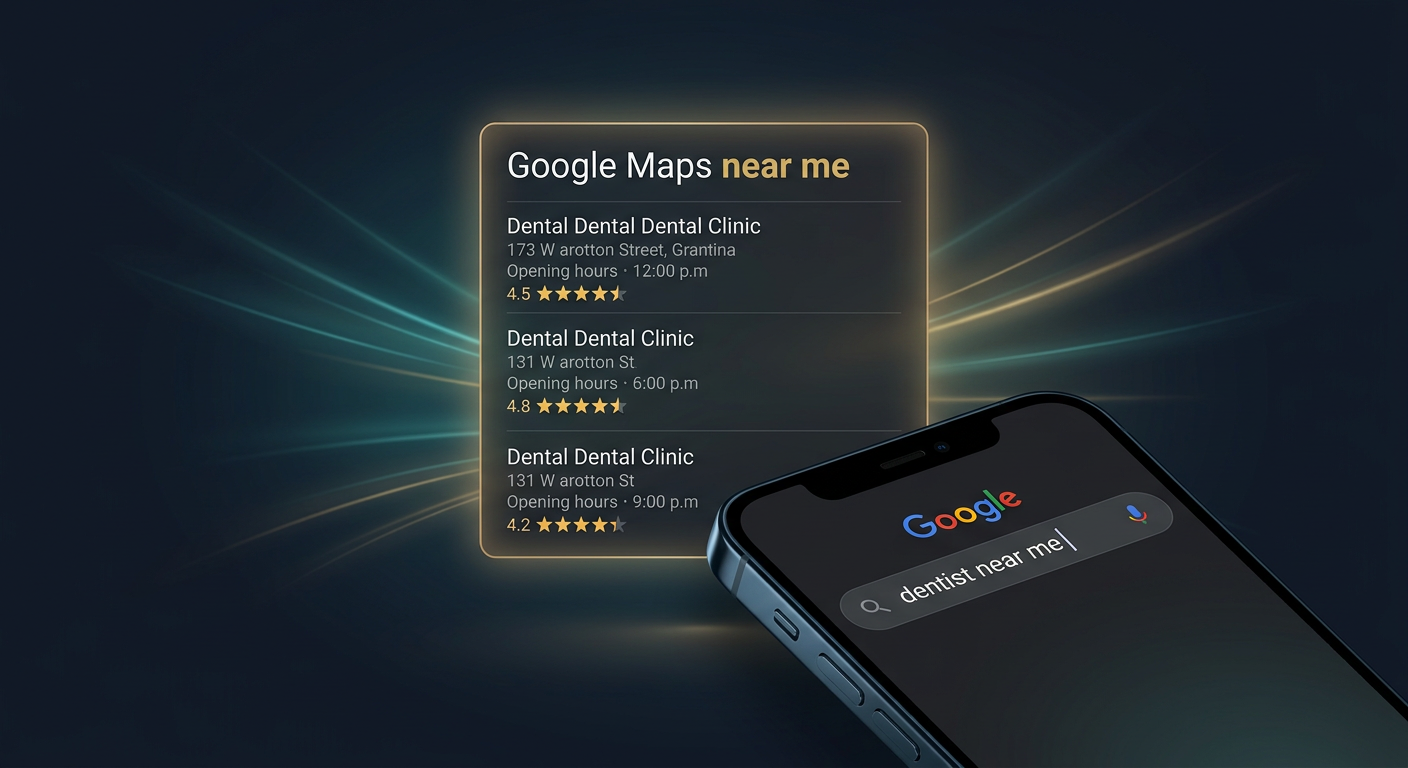
There is an important distinction between ‘dentist near me’ and ‘dentist Scarborough.’ Both are local searches, but they behave differently. ‘Dentist near me’ is almost entirely driven by the Local Pack, the three GBP listings that appear at the top of the results page with a map. ‘Dentist Scarborough’ has a mixed results page with both organic listings and the Local Pack.
Near-me searches are more mobile-dominant (over 60% of dental website traffic comes from mobile, per Click-Vision, 2026), more urgent in intent, and statistically more likely to result in a same-day call or booking. This is why the GBP-centric approach to dental SEO Toronto is so important: a practice that dominates the Local Pack for near-me searches is capturing patients at the moment they decide to act, not while they are still researching.
| 💡 | The Near-Me Conversion Window
Patients who search ‘dentist near me’ or ‘dental clinic near me’ are in active decision mode; they have already decided to book. The question is only which practice they will call. Ranking in the top 3 of the Local Pack for these terms is not a branding exercise; it is a direct patient acquisition channel. |
Why Near-Me Searches Convert at a Higher Rate Than Any Other Dental Query
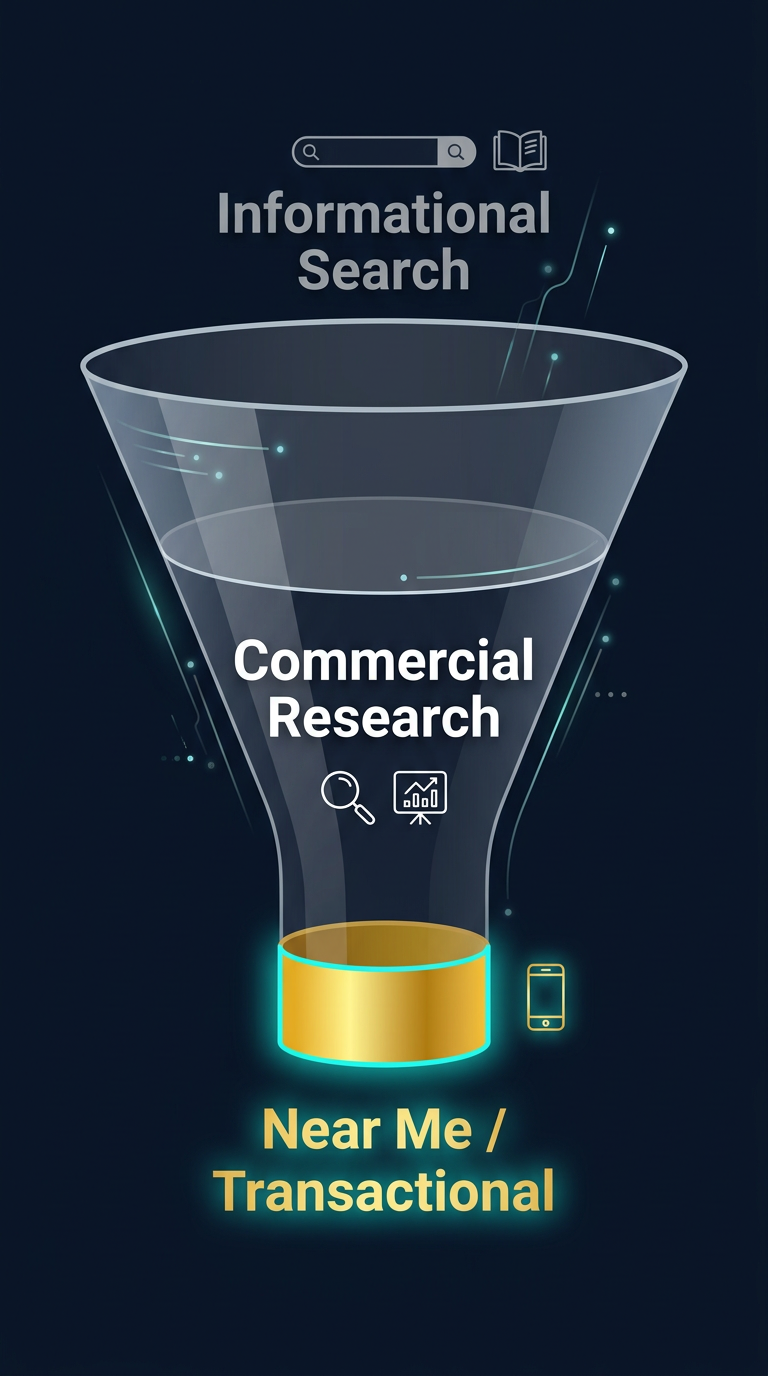
Search intent exists on a spectrum. At one end, you have informational queries like ‘how often should I get a dental cleaning,’ where the patient is gathering information and is weeks or months away from booking. At the other end, you have near-me and emergency searches, where the patient needs a provider immediately. Understanding where near-me sits on this spectrum explains why capturing it matters more than almost any other SEO goal.
The Intent Hierarchy in Dental Search
Google categorises search intent into four types. For dental practices, the hierarchy maps as follows:
- Informational (lowest conversion): ‘What causes tooth sensitivity,’ ‘How long does a root canal take ‘- educational content, valuable for SEO authority but rarely converts to a same-week booking.
- Navigational: ‘Dr. Ahmed Family Dentistry Toronto’ the patient is looking for a specific practice they already know. High conversion, but only for your existing brand awareness.
- Commercial investigation: ‘Best dentist in Mississauga,’ ‘dental implants cost Toronto ‘- the patient is comparing options. Moderate conversion timeline of days to weeks.
- Transactional / near-me (highest conversion): ‘Dentist near me,’ ‘dental clinic open now near me,’ ’emergency dentist near me Brampton ‘- the patient is ready to call. Conversion timeline is minutes to hours.
Near-me dental searches sit at the very top of the conversion hierarchy. Patients who append “near me” to a dental search are not researching; they are choosing. Every position you move up in the Local Pack for these terms translates directly into calls and booked appointments, not just traffic.
The Mobile Urgency Factor
Over 60% of dental website traffic comes from mobile devices (Click-Vision, 2026), and the vast majority of near-me searches originate on phones. Mobile near-me searchers have a lower tolerance for friction; they want to click, call, and book in under two minutes. A practice that has a well-designed healthcare website with click-to-call enabled, fast mobile load times, and a prominent online booking link will convert Local Pack clicks into appointments at significantly higher rates than a practice whose mobile site loads slowly or buries the phone number.
Emergency Dental Searches: The Highest-Converting Near-Me Variant
‘Emergency dentist near me’ and ’emergency dental clinic near me’ are the highest-converting searches in all of dental SEO. A patient with a broken tooth, dental abscess, or severe toothache is not comparison shopping; they will call the first credible result that answers. Practices that add ‘Emergency Dental Service’ as a GBP secondary category, and publish a dedicated emergency dental page on their website, routinely capture this traffic without any additional budget.
For GTA dental practices managing both organic growth and paid acquisition simultaneously, emergency dental is also one of the most effective healthcare PPC targets; the high intent justifies the click cost, and the conversion rate keeps the cost-per-new-patient competitive.
| 32% | of Local Pack ranking weight comes from Google Business Profile signals, the single largest factor in near-me dental search rankings (BrightLocal, 2026). GBP optimisation is not optional; it is the primary ranking lever. |
Google Business Profile: The Engine of Near-Me Rankings
Since GBP signals account for 32% of Local Pack ranking weight (BrightLocal, 2026), your Google Business Profile is the single highest-leverage asset in your near-me SEO strategy. Yet the average GTA dental practice has a partially completed profile missing categories, outdated hours, no services listed, and fewer than 30 reviews. Our dental SEO Toronto audits consistently find that GBP optimisation alone moves practices from outside the Local Pack to within the top 3 for their primary neighbourhood terms within 8–12 weeks (Webtonic, 2026).
Primary and Secondary Category Selection
Your primary GBP category should be ‘Dentist.’ Beyond that, every additional service your practice offers should be mapped to a GBP secondary category. Common secondary categories for GTA dental practices include:
- Cosmetic Dentist is essential if you offer veneers, teeth whitening, or smile makeovers.
- Orthodontist if you provide Invisalign or braces.
- Emergency Dental Service captures the highest-converting near-me variant.
- Dental Implants Periodontist if implants are a practice focus.
- Pediatric Dentist if you treat children, essential for ‘kids dentist near me’ searches.
- Oral Surgeon if you perform extractions or surgical procedures.
Each secondary category expands the pool of near-me searches your listing is eligible to appear for. A practice with only the ‘Dentist’ primary category is invisible to patients searching for emergency dental, pediatric, or cosmetic services even if the practice offers all of those services.
Services Section: The Underused Near-Me Multiplier
The GBP Services section allows you to list every individual service your practice offers, with a name, description, and optional price. Most dental practices leave this section empty or list only two or three items. This is a significant missed opportunity.
Populate the Services section with every procedure your clinic offers: general dentistry, cleaning and hygiene, fillings, crowns, root canal therapy, tooth extraction, dental implants, Invisalign, veneers, teeth whitening, night guards, sleep apnea appliances, and emergency dental care. Each service listing is an additional relevance signal that helps Google match your profile to the full range of near-me searches patients are performing, including highly specific ones like ‘Invisalign near me’ or ‘dental implants near me Etobicoke.’
GBP Posts: Weekly Signals That Boost Proximity Relevance
Google Business Profile posts function like a social feed for your listing. They disappear after seven days if not updated, and their recency is a ranking signal. Publishing at least one GBP post per week does two things: it signals to Google that your practice is active, and it gives you a recurring opportunity to inject neighbourhood-specific language into your listing.
An effective GBP post for near-me ranking includes the neighbourhood or suburb by name (‘Serving patients in North York and Willowdale’), references a specific service (‘accepting new patients for teeth whitening and Invisalign consultations’), and includes a call-to-action linking to your booking page. These posts are indexed by Google and contribute to the relevance score that determines whether your listing appears for near-me searches in those specific areas.
Hours, Accessibility, and Appointment Attributes
Keep your GBP hours absolutely current. Google penalises profiles where listed hours differ from the actual practice hours, and patients who arrive at a closed practice based on incorrect GBP hours leave negative reviews that damage your Local Pack position. Beyond hours, complete every available attribute:
- ‘Accepting new patients’ actively updated; patients filter on this.
- ‘Wheelchair accessible entrance and restrooms’ required for ADA/AODA compliance signalling.
- ‘Online appointments’ link directly to your booking system.
- ‘Payment methods accepted’ list Visa, Mastercard, direct billing to ODA insurance plans.
- ‘Languages spoken’ is critical for GTA practices in multilingual neighbourhoods.
| ⚙ | GBP Completeness Check
95% of dental practices ranking in the Local Pack have a fully completed GBP profile (Webtonic, 2026). If your profile has empty sections, missing services, no secondary categories, fewer than 25 photos, or no Q&A seeded, fixing those gaps is the fastest path to near-me ranking improvement. |

Reviews: The Prominence Signal That Makes or Breaks Near-Me Rankings
Google’s Local Pack algorithm weighs review count, average rating, and review recency as major prominence signals. For near-me dental searches, where patients make fast decisions, reviews are also a conversion signal, not just a ranking signal. A practice with 200 reviews rated 4.8 will convert Local Pack clicks at a higher rate than a practice with 20 reviews rated 5.0, because volume signals trustworthiness.
Review Volume Benchmarks for GTA Dental Practices
According to Webtonic’s 2026 analysis of dental GBP profiles, competitive dental practices aiming for the top 3 Local Pack positions typically need:
- 100–200 Google reviews minimum to be competitive in mid-tier GTA neighbourhoods.
- 200+ reviews to hold a top-3 position in high-competition urban cores (downtown Toronto, Mississauga city centre).
- A minimum of 10 new reviews per month to maintain review recency signals.
- Respond to 100% of all reviews, positive and negative, within 72 hours.
77% of new dental patients check online reviews before choosing a provider (BrightLocal 2025 Healthcare Consumer Survey). This means your review profile is doing double duty: it is a Google ranking signal and a patient conversion tool. Every review you collect improves both your Local Pack position and your click-to-call rate.
Building a Review Velocity System
The most effective review generation strategy for dental practices is a post-appointment automated sequence. The request should go out 24–48 hours after the appointment, not immediately, when the patient is still in transit, and not a week later, when the visit is a fading memory. The message should be short, direct, and link to the exact Google review submission form for your practice.
When responding to reviews on Google, include the neighbourhood name and a specific treatment in your reply: ‘Thank you for visiting our Danforth Avenue clinic for your dental cleaning. We appreciate you choosing us.’ These keyword-embedded responses are indexed by Google and contribute to your local relevance signals for near-me searches in that specific neighbourhood.
Responding to Negative Reviews: A Near-Me Ranking Tactic
Negative reviews cannot be deleted, but they can be managed in a way that limits their ranking and conversion damage. A professional, empathetic response to a negative review one that does not disclose patient information (PHIPA requirement in Ontario), acknowledges the concern, and invites the patient to contact the practice directly signals to both Google and prospective patients that your practice takes service quality seriously. Practices that ignore negative reviews see both ranking erosion and lower conversion rates from their Local Pack position.
| 77% | of new dental patients check online reviews before choosing a provider, meaning your Google review profile is both a Local Pack ranking signal and a direct patient conversion tool (BrightLocal 2025 Healthcare Consumer Survey). |
Website Signals That Reinforce Near-Me Rankings
Your GBP ranking does not exist in isolation; Google cross-references your Google Business Profile with your website when assessing Local Pack eligibility. A fully optimised GBP pointing to a slow, poorly structured website will underperform against a moderately optimised GBP pointing to a well-built, locally-targeted site. Our healthcare web design Toronto team builds dental clinic sites with near-me SEO architecture built in; here is what that means in practice.
NAP Consistency: The Non-Negotiable Foundation
NAP stands for Name, Address, Phone number. Your practice’s NAP must be identical character-for-character across your GBP, your website footer, your website contact page, and every online directory listing. A discrepancy as minor as ‘St.’ versus ‘Street,’ or a different phone number format, creates a citation inconsistency that actively suppresses your Local Pack ranking.
Practices with consistent NAP across their top 25 directories rank 2.4 positions higher in the Local Pack than practices with five or more discrepancies (Flento, 2026). Run a citation audit using BrightLocal or Moz Local before investing in any other near-me SEO tactic; inconsistent citations will limit the impact of everything else you do.
LocalBusiness Schema for Dental Practices
Implement DentalClinic or MedicalClinic schema markup on your homepage and location pages. The schema should include your full NAP, your GBP URL, your accepted payment methods, your opening hours, and the services you offer. Schema markup does not directly change your ranking, but it helps Google match your website to the Local Pack listing and to the specific near-me queries you want to rank for.
Location and Neighbourhood Pages
If your practice has a single location, your homepage and contact page should contain explicit neighbourhood-level language: the name of your street, your neighbourhood (not just the city), nearby transit landmarks, and the specific communities you serve. ‘Serving patients in Scarborough, including Agincourt, Malvern, West Hill, and Woburn’ is a far stronger near-me signal than ‘located in Toronto.’ For multi-location practices, each location needs its own dedicated page as covered in our broader healthcare local SEO guide.
Mobile Page Speed and Core Web Vitals
Since near-me searches are predominantly mobile, your site’s mobile performance is a direct near-me ranking factor. Google’s Core Web Vitals Largest Contentful Paint (LCP), Cumulative Layout Shift (CLS), and Interaction to Next Paint (INP) must pass on mobile. An LCP above 2.5 seconds on mobile is being penalised in Local Pack rankings regardless of how strong your GBP and review profile are. Test at pagespeed.web.dev and address every flagged Opportunity before spending budget on other near-me SEO tactics.
| ⚠ | Citation Inconsistency: The Silent Near-Me Killer
Practices with five or more NAP discrepancies across online directories rank 2.4 positions lower in the Local Pack than practices with consistent citations (Flento, 2026). Before any other near-me SEO investment, audit your citations on BrightLocal or Moz Local. A mismatched phone number on Yelp or a differently formatted address on Yellow Pages can cost you the top-3 position even with a perfect GBP. |
Near-Me Keyword Variants: Expanding Your Capture Beyond “Dentist Near Me”
‘Dentist near me’ is the primary near-me dental query, but it is only one of dozens of near-me variants that GTA patients search every day. A comprehensive dental SEO strategy for Toronto practices targets the full near-me keyword tree, not just the primary term.
High-Volume Near-Me Variants to Target
These near-me variants each carry meaningful search volume across the GTA and have lower keyword difficulty than the primary “dentist near me” term:
- Emergency dental: “emergency dentist near me,” “emergency dental clinic near me,” and “dentist open now near me” are the highest-converting near-me cluster.
- Service-specific: “dental implants near me,” “Invisalign dentist near me,” “teeth whitening near me,” “dental cleaning near me” each maps to a specific GBP secondary category and service page.
- Patient segment: “kids dentist near me,” “pediatric dentist near me,” “dentist accepting new patients near me,” “dentist that takes benefits near me.”
- Cost and insurance: “affordable dentist near me,” “dentist direct billing near me,” “dentist that accepts OHIP near me” are high intent, often overlooked.
- Neighbourhood + near me: “dentist near me Scarborough,” “dental clinic near me Etobicoke,” “dentist near me North York.” The Local Pack shows these even without “near me,” but these explicit variants confirm location intent to Google.
How to Capture Near-Me Variants Without Keyword Stuffing
Each near-me variant is best captured through a combination of GBP optimisation and a dedicated website page. The GBP secondary categories handle the query-matching side; the website pages provide the content depth that Google uses to confirm relevance. A dedicated ‘Emergency Dental Care’ page on your site with a clear headline, your emergency hours, an explanation of what constitutes a dental emergency, and a prominent phone number is the content asset that backs up your ‘Emergency Dental Service’ GBP category.
For practices that are just starting to build this page infrastructure, the fastest approach is to prioritise the near-me variants that match your existing highest-volume services. If implants are your most profitable procedure, build the ‘dental implants near me’ capture stack first. See our guide on how to vet a dental SEO company in Toronto to understand how an agency should approach this prioritisation on your behalf.
| 60%+ | of dental website traffic now comes from mobile devices and the vast majority of near-me dental searches originate on phones. A slow or poorly structured mobile site costs you conversions even when your Local Pack position is strong (Click-Vision, 2026). |
Tracking Near-Me Performance: What to Measure and How
Near-me SEO success is measurable, but it requires tracking the right metrics. Standard website analytics (sessions, pageviews, bounce rate) do not tell you how your Local Pack position is performing. Here is the measurement framework used for dental practices receiving our dental SEO services in Toronto.
Google Business Profile Insights
Your GBP dashboard provides data that no other tool can give you; it shows exactly how patients found your listing and what they did next. The key metrics to track monthly:
- Search queries: Which search terms are triggering your GBP listing. This is where you confirm whether near-me queries are reaching you or bypassing you.
- Profile views (Search vs. Maps): Separate your Maps views (near-me, local intent) from Search views. A declining Maps view count means your Local Pack position is slipping.
- Customer actions: Calls, direction requests, and website clicks from your GBP listing. The top 10% of dental practices receive approximately 600 profile actions per month; the average is about 200 (Practiwrite, Q1 2026).
- Direction requests by neighbourhood: Direction requests show you exactly where your patients are searching from. This data tells you which catchment areas are generating near-me traffic and whether your neighbourhood targeting is working.
Google Search Console for Near-Me Queries
Google Search Console shows you which queries are driving impressions and clicks to your website. Filter for queries containing ‘near me’ to see exactly how much near-me traffic you are currently capturing and at what average position. A practice sitting at position 5.8 for ‘dental SEO near me’ (as BizStori’s own analytics show) is within striking distance of the top 3; a few targeted GBP improvements and review pushes can close that gap.
Call Tracking for Local Pack Attribution
Standard Google Analytics cannot attribute a phone call from a GBP listing back to a specific search query. For practices running dental Google Ads campaigns alongside organic near-me SEO, call tracking software (CallRail, WhatConverts, or similar) is essential for correctly attributing new patient calls to their source GBP, organic web, or paid ad. Without call tracking, near-me SEO improvements will show up as ‘direct’ traffic in your analytics and will appear to have no ROI even when they are your highest-performing channel.
| 📊 | 5 Near-Me KPIs to Track Monthly
1. GBP search queries containing “near me” (GBP Insights) · 2. GBP Maps views month-over-month trend · 3. GBP customer actions (calls + directions + website clicks) target 200+ per location · 4. Google Search Console average position for near-me query variants · 5. New patient calls attributed to local/GBP source (call tracking software) |
The Near-Me SEO Action Plan: 60 Days to a Stronger Local Pack Position
Here is the 60-day near-me SEO sequence we recommend for GTA dental practices that are not yet ranking in the top 3 of the Local Pack for their primary neighbourhood terms. For a practice-specific roadmap, see our dental SEO consultant guide, which covers how a consultant approaches this assessment and what deliverables you should expect at each stage.
Week 1–2: Audit and Fix
- Run a GBP completeness audit: all categories filled, services populated, 25+ photos uploaded, hours current.
- Run a citation audit (BrightLocal or Moz Local): identify and correct NAP inconsistencies across top 25 directories.
- Test mobile page speed on PageSpeed Insights: fix any LCP issues flagged as Opportunities.
- Implement DentalClinic LocalBusiness schema on homepage and location pages.
- Set up Google Search Console if not already active.
Week 3–4: Visibility Expansion
- Add all relevant secondary GBP categories, including ‘Emergency Dental Service’ if applicable.
- Populate the full GBP Services section with every procedure the practice offers.
- Seed GBP Q&A with the 10 most common patient questions: hours, new patients, insurance billing, emergency availability, parking.
- Launch automated review request sequence through your booking or practice management software.
- Add neighbourhood-specific language to your homepage and contact page; name the neighbourhoods you serve explicitly.
Week 5–8: Content and Authority Building
- Publish or update an Emergency Dental Care page on your website with hours, services, and a prominent click-to-call button.
- Publish service-specific pages for your highest-value near-me variants: ‘dental implants near me,’ ‘Invisalign dentist near me,’ ‘teeth whitening near me.’
- Begin a weekly GBP posting schedule with at least one post per week referencing the neighbourhood by name.
- Build 2–3 local citations on Ontario-specific directories (ODA directory, HealthLink BC Ontario equivalent, local business directories).
- Review your full dental SEO strategy against the framework in our healthcare SEO Toronto guide to ensure near-me tactics are integrated with your broader organic strategy.
By the end of 60 days, a practice that executes this sequence consistently should see measurable improvements in GBP Maps views, profile actions, and Local Pack position for its primary neighbourhood near-me terms. The practices that see the fastest results are those that combine this organic near-me strategy with a targeted paid search campaign capturing near-me searchers both through the Local Pack and through paid ads while organic rankings build.
| 8–12 wk | Dental practices that fully optimise their GBP and fix citation inconsistencies typically see Local Pack improvements within 8–12 weeks, faster than any organic website ranking improvement (Webtonic, 2026). |
Ready to Capture GTA ‘Near Me’ Dental Searches?
BizStori builds near-me SEO strategies for Toronto-area dental practices GBP optimisation, citation audits, neighbourhood content, and review generation systems that put you in the top 3 Local Pack.
