










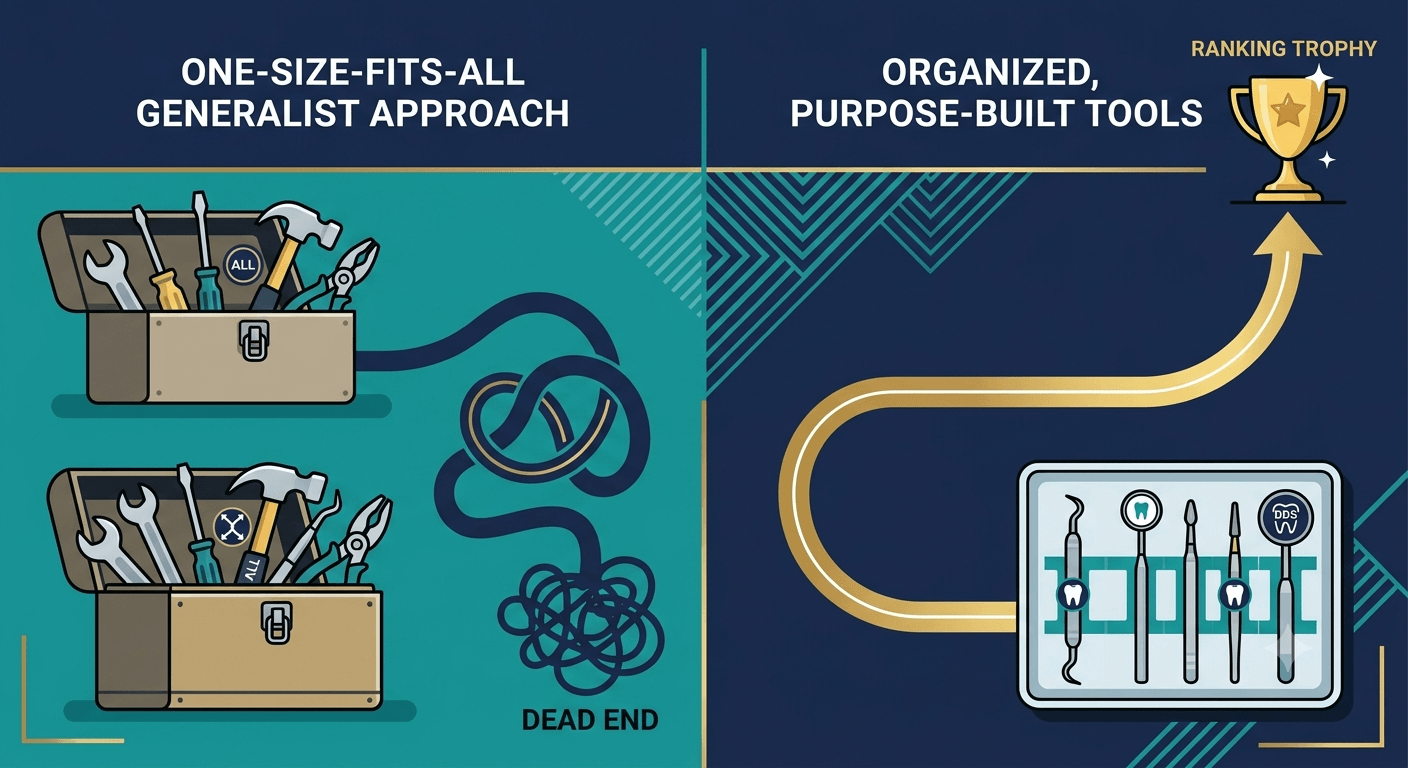
A dental SEO expert is a specialist who understands dental-specific patient search behaviour, RCDSO advertising compliance, and the local competitive structure of the GTA dental market fundamentally different skills from a generalist SEO agency applying the same playbook it uses for retail stores or law firms.
If you’ve ever compared SEO proposals and noticed they all sound nearly identical “we’ll improve your rankings,” “we’ll get you more patients” that’s usually the tell. A genuine dental SEO specialist talks about your practice differently from day one, because the problems dental practices actually have are not the same problems a generalist agency is trained to solve.
This guide breaks down exactly what separates real dental SEO expertise from a relabelled general SEO service and gives you a vendor-neutral way to tell which one you’re actually talking to. For BizStori’s full dental SEO approach, see our Dental SEO Toronto guide.
Why “SEO Is SEO” Is a Costly Myth for Dental Practices
A roofing company, a law firm, and a dental clinic all want the same thing from SEO more qualified leads from Google. But the path to get there is genuinely different for each, because the patient acquisition funnel, the regulatory environment, and the search intent patterns are all fundamentally different.
This is not a criticism of general SEO agencies they’re often excellent for ecommerce stores, B2B software companies, or local trades. The problem only shows up when that same generic process gets applied to a locally competitive, regulated, patient-facing healthcare business like a dental practice. Three failure patterns repeat constantly when this happens, and they’re worth understanding in detail before you hire anyone.
| 📊 Why This Matters in the Toronto Market Specifically
The GTA has one of the highest densities of dental practices in North America, and over 65% of patients now research a dentist online before ever calling. In a market this saturated, the difference between a specialist and a generalist isn’t a marginal improvement it’s frequently the difference between a full schedule and an empty one. |
Pattern 1 Generalists Chase Keywords They Can Never Win
A generic SEO agency, unfamiliar with the dental competitive landscape, will often get excited about ranking for broad terms like “dental services Canada” or “dentist Toronto.” These look attractive in a keyword research tool because of their high search volume. The problem: both terms are dominated by national directory aggregators and multi-location DSO chains with a decade of accumulated domain authority that a new SEO campaign cannot realistically out-rank within any reasonable timeframe.
Meanwhile, specific terms like “Invisalign consultation Scarborough” or “same-day emergency dental North York” sit wide open real patient intent, almost no serious competition, and a realistic path to page one within months rather than years. A generalist agency optimizing for volume alone will miss this distinction entirely, then point to rising impressions in Search Console as proof of progress while your actual phone stays just as quiet as before.
Pattern 2 Generalists Don’t Know the RCDSO Rules
The Royal College of Dental Surgeons of Ontario (RCDSO) governs how dental practices in Ontario are permitted to advertise their services. This isn’t a minor detail it directly restricts how price is advertised, how before-and-after photos can be used, what kind of treatment guarantees can be implied, and how patient testimonials may be presented.
A generalist agency that has never worked specifically in dental healthcare will frequently produce content, ad copy, or landing pages that without any intent to mislead technically violate these advertising guidelines. The agency isn’t being careless; they genuinely don’t know the rules exist, because nothing in standard SEO training covers professional college advertising standards.
What RCDSO-Aware Content Actually Looks Like
- Outcome language: “Most patients see significant improvement” instead of “guaranteed results in 6 sessions” language that informs without implying a guaranteed clinical outcome.
- Before/after presentation: Documented patient consent, standardised photo conditions, and explicit disclaimers that individual results vary not flattering “after” lighting paired with unflattering “before” shots.
- Pricing references: General ranges or “starting from” framing rather than specific price claims that could be read as binding quotes or comparative superiority claims against named competitors.
- Testimonials: Patient experience descriptions rather than outcome guarantees “I felt comfortable and well cared for” rather than “this treatment will fix your smile in 3 visits.”
Pattern 3 Generalists Treat Google Business Profile as an Afterthought
For most other industries, organic website rankings are the primary SEO objective and Google Business Profile is a secondary nice-to-have. For dental practices, this priority is reversed. An estimated 60 to 70 percent of new patient discovery happens through Google Maps and the local pack not through scrolling past the map to find organic blue links.
A generalist agency trained on traditional SEO will default to treating GBP as a checkbox item claim the listing, fill in the basics, move on to “real” SEO work on the website. A dental SEO specialist treats GBP as a primary, ongoing asset: category accuracy, individual service listings, weekly posts, photo volume, and review velocity all receive the same level of strategic attention as the website itself, because that’s genuinely where most of the patient discovery is actually happening.
| 💡 A Quick Way to Test This
Ask any SEO consultant you’re evaluating: “Walk me through your Google Business Profile strategy specifically not your website SEO, your GBP strategy.” A dental SEO specialist will have a detailed, specific answer involving categories, posting cadence, and review systems. A generalist will often give a vague answer about “optimizing your listing” with no further detail. |
How Patient Search Behaviour Differs From Every Other Industry
Someone searching “emergency dentist Toronto” is in a completely different psychological state than someone searching “family dentist Etobicoke.” One needs action within the hour. The other is comparison shopping over days or weeks, reading reviews, checking insurance compatibility, and weighing several options before ever picking up the phone.
A dental SEO expert structures content, landing pages, and even your Google Business Profile around this distinction emergency-intent pages built for immediate action with a phone number above the fold and minimal friction, versus consideration-phase pages built to build trust, answer detailed questions, and showcase credentials. A generalist agency, unaware this distinction even exists, builds every page the same way regardless of where the patient actually is in their decision process.
This same logic extends to procedure-specific search behaviour. Someone searching “Invisalign cost Toronto” has different needs than someone searching “pediatric dentist North York” and a true specialist maps content to these distinct patient journeys rather than writing one generic version of every page. For more on how this translates into actual page structure, see our Dental Website Design Toronto guide.
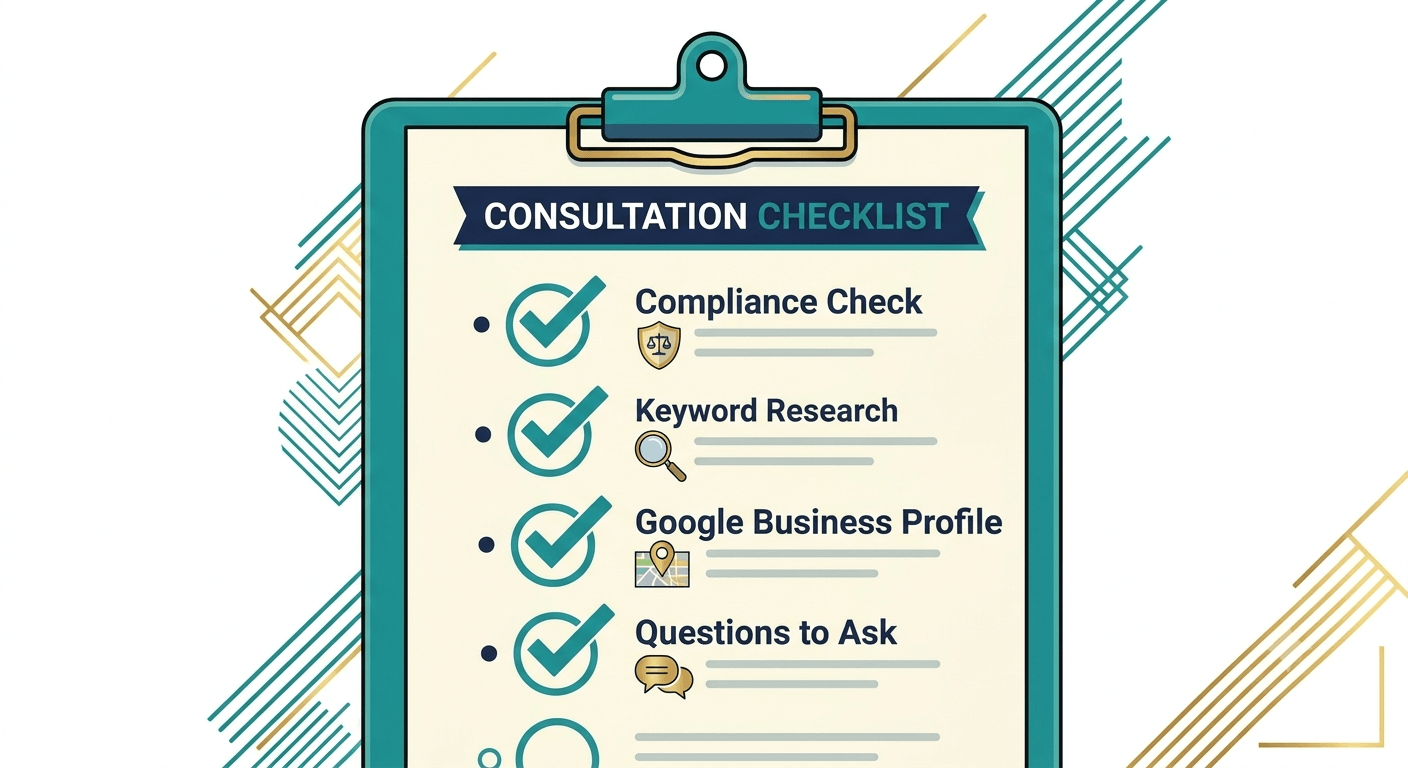
A Vendor-Neutral Checklist: 7 Questions to Ask Any Dental SEO Expert
Use this checklist with any agency you’re evaluating including BizStori. The goal isn’t to find a “correct” answer to memorize; it’s to see whether the person across the table actually has dental-specific experience or is improvising from general SEO knowledge.
| # | Question to Ask | Why It Matters |
| 1 | “How does the RCDSO’s advertising guidelines affect the content you write for me?” | Tests whether they even know this regulatory body exists, let alone what it restricts. |
| 2 | “Can you show me examples of dental-specific keyword strategy you’ve built not just general local SEO?” | Separates real dental experience from a portfolio of unrelated local businesses. |
| 3 | “What’s your specific strategy for my Google Business Profile, separate from website SEO?” | A vague answer here signals GBP is being treated as an afterthought, not a primary asset. |
| 4 | “How do you structure content differently for emergency-intent vs. consideration-phase patients?” | Tests whether they understand dental search intent at all, or treat every page the same. |
| 5 | “What’s a keyword you’d avoid targeting for my practice, and why?” | A specialist can name unwinnable broad terms immediately. A generalist usually can’t. |
| 6 | “Who specifically will be working on my account, and how many other dental clients do they manage?” | Determines whether you get genuine attention or are one of sixty undifferentiated accounts. |
| 7 | “Can I see real before/after ranking data from another Toronto-area dental practice?” | Verified, specific results beat generic claims of “we get great results” every time. |
What Real Dental SEO Expertise Costs in Toronto
Dental SEO pricing in the Toronto market varies by competition level, the number of services you want to rank for, and how comprehensive the engagement is. Most genuine dental SEO specialists fall into these ranges:
| Tier | Monthly Range (CAD) | Realistic Fit |
| Starter | $800–$1,500 | New or small practices (1–2 chairs), suburban locations with lower competition, GBP + foundational SEO focus |
| Standard | $1,500–$2,500 | Established practices ready to compete on procedure-specific keywords across multiple services |
| Aggressive Growth | $2,500–$4,000+ | Multi-location practices or specialists (orthodontists, periodontists, cosmetic dentists) targeting high-value, competitive procedures |
Be cautious of pricing that seems unusually low relative to these ranges it often signals a generalist applying a templated process rather than genuine dental-specific strategy work. For a broader picture of how SEO investment compares to paid advertising for dental practices, see our PPC vs SEO Toronto guide.
| Want an Honest Second Opinion on a Dental SEO Proposal?
BizStori will review any SEO proposal you’ve received including from other agencies and tell you honestly whether it reflects genuine dental-specific strategy or a relabelled generic process. |
How BizStori Approaches Dental SEO Differently
BizStori builds every dental SEO engagement around the three patterns covered in this guide winnable, procedure-specific keyword targeting rather than broad unwinnable terms; RCDSO-aware content and before/after presentation built into every page from the start; and Google Business Profile treated as a primary patient-acquisition asset, not an afterthought.
Our full Dental SEO Toronto strategy covers the complete tactical framework, and our Dental Website Design guide shows how website structure and patient search intent connect directly to conversion. If you’re also evaluating paid advertising alongside SEO, our Healthcare PPC guide covers PHIPA-compliant Google Ads strategy for dental and healthcare clinics specifically.
See our case studies for real results from Toronto dental and healthcare clients, including Hwy 7 Family Dentistry.
FAQ Dental SEO Expert Toronto
What makes someone a dental SEO expert rather than just an SEO generalist?
A dental SEO expert understands RCDSO advertising compliance, dental-specific patient search behaviour (emergency vs. consideration-phase intent), procedure-specific keyword strategy, and treats Google Business Profile as a primary patient-acquisition asset rather than a secondary item. A generalist applies the same SEO process used for any local business, without this dental-specific context.
Why do generalist SEO agencies struggle with dental practices specifically?
Generalist agencies often chase high-volume, broad keywords like “dentist Toronto” that are dominated by national directories and DSO chains, missing winnable procedure-specific terms. They frequently lack awareness of RCDSO advertising restrictions on pricing claims, before/after photos, and testimonials. And they tend to treat Google Business Profile as a checkbox rather than the primary discovery channel it actually is for dental patients.
What is the RCDSO and why does it matter for dental SEO content?
The Royal College of Dental Surgeons of Ontario (RCDSO) regulates how dental practices in Ontario may advertise their services, including restrictions on price claims, before/after photo presentation, treatment guarantees, and patient testimonials. Content created by an agency unfamiliar with these guidelines can unintentionally violate them, creating compliance risk for the practice.
How much does genuine dental SEO expertise cost in Toronto?
Most legitimate dental SEO specialists in Toronto charge $800–$1,500/month for smaller or new practices, $1,500–$2,500/month for established practices targeting multiple procedures, and $2,500–$4,000+/month for multi-location practices or specialists targeting high-value, competitive procedures like implants or orthodontics. Pricing significantly below these ranges often signals a generalist process rather than dental-specific strategy.
How important is Google Business Profile for dental patient acquisition?
Extremely important an estimated 60 to 70 percent of new dental patient discovery happens through Google Maps and the local pack rather than traditional organic website rankings. A genuine dental SEO specialist treats GBP category accuracy, individual service listings, posting cadence, and review generation as primary, ongoing strategic work not a one-time setup task.
What questions should I ask before hiring a dental SEO agency?
Ask how RCDSO advertising guidelines affect their content process, request examples of dental-specific (not just general local) keyword strategy, ask about their specific Google Business Profile strategy separate from website SEO, ask which keywords they’d avoid targeting and why, and ask exactly who will work on your account and how many other dental clients they manage. Vague or generic answers to these questions are a reliable signal of a relabelled general SEO process.
