










| 💡 | Direct Answer
Local SEO for chiropractors in Ontario requires five things working together: a correctly configured Google Business Profile, consistent NAP citations across Canadian and health-specific directories, a review velocity system that generates steady new ratings each month, CCO-compliant content that avoids outcome guarantees and testimonials, and condition/service pages that match how Ontario patients actually search. Done right, this checklist gets most Ontario chiro clinics into the local map pack within 90 days. |
Most Ontario chiropractors lose new patients to better-ranked competitors not because those competitors are better clinicians, but because they’ve done the local SEO fundamentals that this checklist covers. The search behaviour is consistent: a patient in Brampton, Mississauga, or Scarborough types “chiropractor near me” or “back pain relief [neighbourhood],” looks at the map pack, and books one of the top three listings. If your clinic isn’t there, it doesn’t exist for that patient.
This is the complete 2026 checklist for local SEO for chiropractors in Toronto and across Ontario. It covers every element that moves the needle for map pack rankings GBP setup, citation building, review strategy, CCO-compliant content, and local link building in order of priority.
| 48% | Of all local map pack clicks go to the top three listings split roughly 17.6%, 15.4%, and 15.1% across position 1, 2, and 3 (Source: Local SEO industry data, 2026) |
Section 1: The CCO Compliance Foundation
Before any technical SEO or content work, Ontario chiropractors need to understand the College of Chiropractors of Ontario (CCO) advertising framework. The CCO governs what registered chiropractors can and cannot say in public-facing marketing and non-compliant content doesn’t just create regulatory risk, it also undermines Google’s quality signals for healthcare SEO in Toronto. Google’s Quality Rater Guidelines classify chiropractic content as YMYL (Your Money or Your Life) meaning accuracy, accountability, and authoritative sourcing are ranking factors, not optional extras.
What the CCO Prohibits in Advertising
The CCO and the Canadian Chiropractic Association (CCA) are aligned on these prohibitions. Violating any of them can result in a complaint, a caution posted publicly on the CCO website, or a formal investigation. These same elements also create problems with Google’s content quality systems.
Outcome Guarantees and Unjustified Expectations
Any language that guarantees results, suggests certain success, or creates an expectation of a favourable outcome is prohibited. In practice, this means you cannot say “back pain eliminated in 3 visits” or “95% of our patients report full recovery.” The prohibition includes implied guarantees as well as explicit ones. If a headline or tagline suggests a predictable outcome from care, it crosses the line.
Patient Testimonials
The CCA guidelines explicitly prohibit patient testimonials. This is broader than most Ontario chiro clinic owners realise: it applies to written case studies, before-and-after stories, and video testimonials on your website and social media. It also applies to testimonials embedded in third-party review platforms when used in your own marketing. Google reviews you didn’t solicit or use in ads are generally considered separate from this rule but featuring a patient’s testimonial in a Facebook ad, on your homepage, or in a blog post is non-compliant.
Superiority Claims
Claims of professional superiority over other chiropractors are prohibited. “Best chiropractor in Toronto,” “top-rated chiro clinic in Mississauga,” or “Ontario’s leading spinal care provider” all fall into this category. Superlatives of any kind including “state of the art,” “cutting edge,” and “world class” create problems. Describing your own clinic in neutral factual terms (years in practice, team size, services offered) is acceptable.
Unauthorized Specialist Titles
Chiropractors in Ontario cannot call themselves “specialists” unless they hold a designation formally recognized by the CCO or the CCA. Using “spinal specialist,” “sports injury specialist,” or “disc specialist” in advertising without the qualifying credential is non-compliant. Legitimate certifications and diplomate status awarded by recognized chiropractic bodies can be listed accurately.
Free Service Offers
The CCA guidelines describe offers of free examination, diagnostic, or treatment services as unprofessional. This includes “free initial consultation” promotions, free spinal screening events used to generate leads, and “first visit free” offers. This is an area where many Ontario clinics are currently non-compliant without realising it and where a regulatory complaint can arise from a competitor or a patient.
What CCO-Compliant Chiro Content Looks Like
Compliant chiropractic content focuses on conditions, mechanisms, and your qualifications not outcomes. A service page for low back pain should explain what low back pain is, what the assessment process involves, what treatment options chiropractors use, and what your practice offers without promising that patients will feel better, experience specific improvements, or recover in a set time. Condition education content, answers to common patient questions, and explanations of chiropractic techniques are all safe ground when written accurately and without outcome claims.
| ⚠ | CCO Complaints Are Public Record
A formal caution from the CCO is posted publicly on the College’s website and attaches to a chiropractor’s registration record. This is searchable by patients, insurers, and referral sources. Beyond the regulatory consequence, Google’s quality systems increasingly reward regulated health professionals who demonstrate accountability and penalise content that makes unverifiable health claims. CCO compliance and SEO quality are the same goal. |
Section 2: Google Business Profile Optimisation Checklist
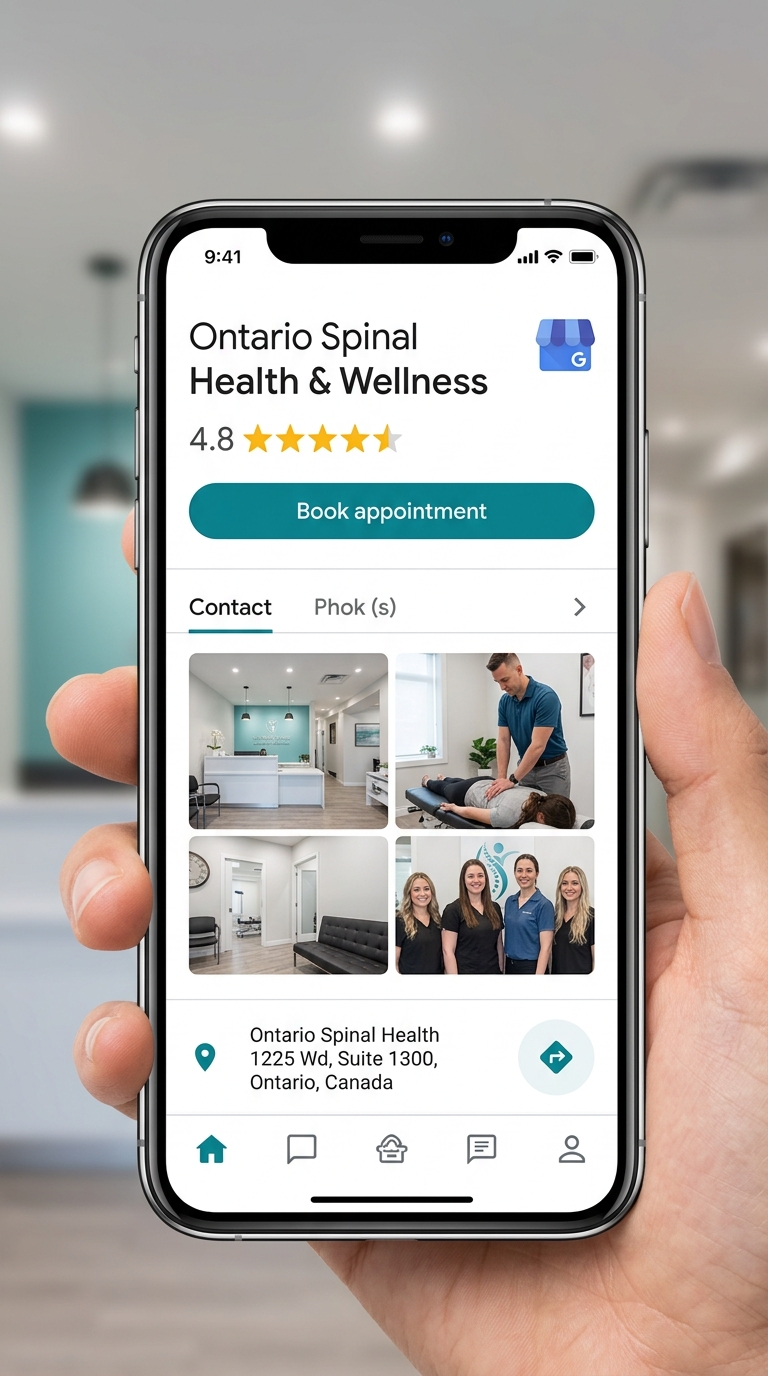
Your Google Business Profile (GBP) is the single highest-impact local SEO asset for an Ontario chiro clinic. In most suburban GTA markets, a well-optimised GBP with strong review velocity will get a clinic into the map pack in 60–90 days. In central Toronto, where competition is denser, the same fundamentals apply but the review threshold is higher. Here is the complete GBP checklist for chiropractor SEO in Toronto and the GTA.
GBP Setup and Category
- Set the primary category to “Chiropractor” not “Health Consultant,” “Wellness Centre,” or any broader category. Wrong primary categories are the single most common GBP error for Ontario chiro clinics.
- Add relevant secondary categories: “Physical Therapy Clinic” and “Sports Medicine Clinic” are the most common secondary categories for chiropractic practices with a broader service mix.
- Verify your business through Google’s postcard or phone verification an unverified profile does not rank.
- Set your service area accurately list the specific cities and neighbourhoods you serve, not all of Ontario. Over-broad service areas dilute local relevance.
- Confirm your practice name exactly matches your legal business name and your website. Do not keyword-stuff the business name field (e.g., “Toronto Chiro Back Pain Clinic”) this violates GBP guidelines and can result in a listing suspension.
Profile Completeness
- Fill the business description to its character limit. Use your top 3–5 keywords naturally do not repeat them. Include your neighbourhood, primary conditions treated, and a professional positioning statement.
- List every service separately with its own description and an approximate starting price. Google surfaces individual services in local search results, and this signals comprehensiveness.
- Upload a minimum of 30 photos, geo-tagged to your practice address. Photos should include the exterior (front entrance and parking), reception, treatment rooms, and your team. Practices with 30+ photos receive materially more profile views.
- Add 2–4 new photos every month. Freshness signals apply to photo uploads, and active profiles consistently outperform stale ones in the map pack.
- Enable messaging through GBP and respond within 24 hours. Unanswered messages over 7 days can trigger a warning from Google.
- Set accurate hours including holiday hours for Ontario statutory holidays. Inaccurate hours generate negative reviews and reduce trust signals.
- Link your booking directly to your online calendar (Jane App, Cliniko, or your platform), not to a contact form. Direct booking links reduce friction and improve the patient experience signal Google measures.
Google Posts Weekly Rotation
Google Posts have a 7-day display window and contribute to profile engagement signals. The most effective posting rotation for a chiropractic practice is a four-week cycle.
- Week 1: Condition education post explain a common complaint (lower back pain, sciatica, sports injuries) with accurate, non-outcome-claim language.
- Week 2: Team or practice post introduce a team member, highlight a training or certification, or show the practice environment.
- Week 3: Community post a local event sponsorship, a neighbourhood connection, or a relevant local story.
- Week 4: Service or offer post introduce a service, explain what a new patient appointment involves, or promote seasonal relevant content (e.g., winter posture, back-to-school ergonomics).
Keep posts under 250 words, include one photo, and end with a clear call to action a booking link, a phone number, or a link to a relevant service page.
| 📍 | GBP Quick Win
If you haven’t updated your GBP in the last 30 days, the highest-impact 30-minute action you can take today is: upload 10 new photos, write one Google Post, and verify that your service list matches the actual services page on your website. Each of these refreshes the activity signals Google uses to rank active businesses above dormant ones. |
Section 3: Citation Building and NAP Consistency
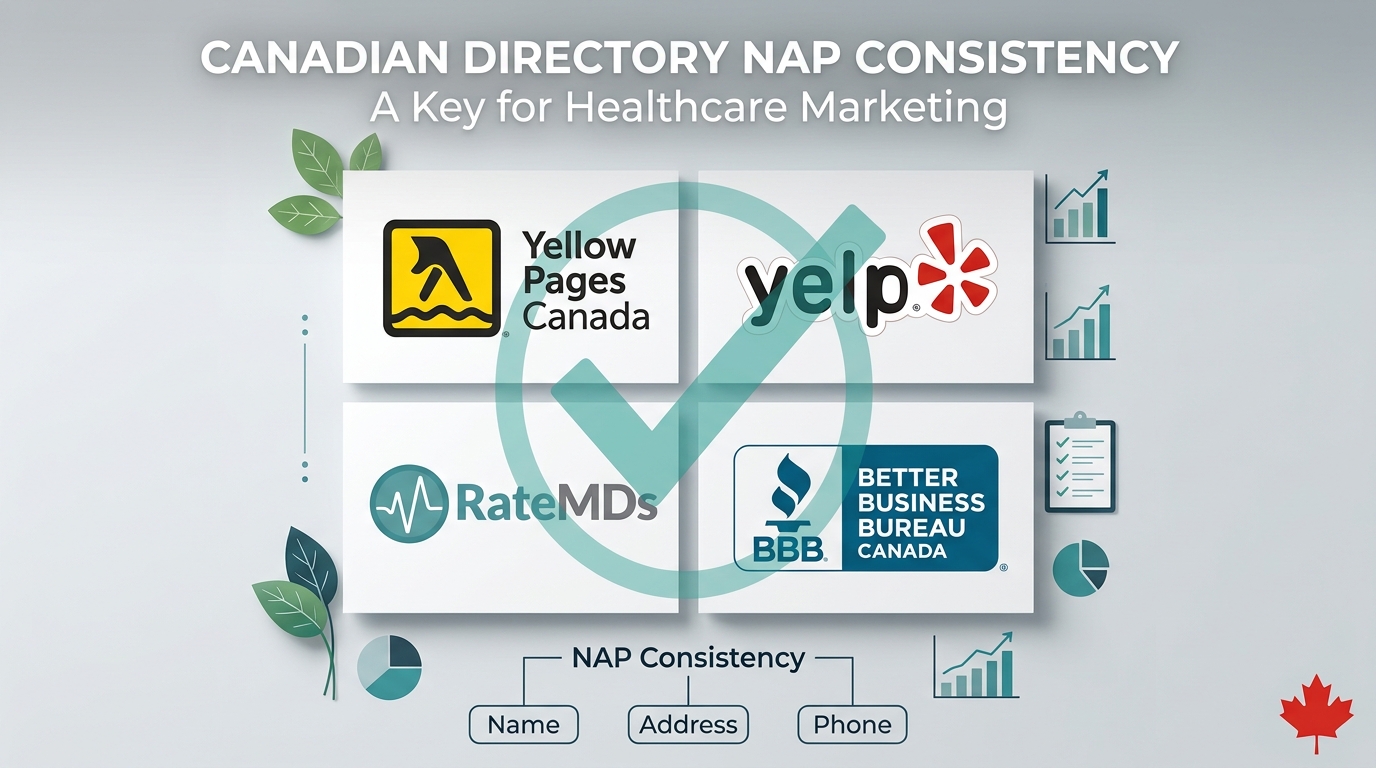
Citations are listings of your practice Name, Address, and Phone number (NAP) across directories, healthcare platforms, and local business sites. Google cross-references these listings when determining whether a business is legitimate, consistent, and authoritative in its location. For Ontario chiropractors, the citation audit almost always reveals 15–40 inconsistent or duplicate listings that are actively suppressing local rankings.
Priority Citation Directories for Ontario Chiro Clinics
Work through these tiers in order. Tier 1 is foundational these must be accurate before any other work matters. Tier 2 is healthcare-specific and signals professional credibility. Tier 3 is Canadian-specific and strengthens Ontario local relevance.
Tier 1 Core Directories (Fix These First)
- Google Business Profile (the map pack listing itself)
- Apple Maps iOS users find local businesses here; inaccurate listings lose iPhone traffic
- Bing Places for Business also feeds Cortana and Microsoft products
- Yelp Canada (yelp.ca) high-authority, patient-facing
- Facebook Business Page social signals and a second NAP source Google reads
- Yellow Pages Canada (yellowpages.ca)
- 411.ca major Canadian directory
Tier 2 Healthcare and Chiropractic Directories
- RateMDs.com the dominant Canadian patient review and directory platform for healthcare providers
- Healthgrades widely indexed; patients use it for provider research
- Vitals.com another major health provider directory
- WebMD Health (webmd.com/find-a-doctor) high domain authority, patient trust
- Psychology Today Directory relevant for practices offering pain and stress care
- ChiroDirectory.com chiropractic-specific
- FindAChiropractor.com condition-focused chiropractic directory
Tier 3 Canadian General and Local Directories
- Canpages.ca major Canadian business directory
- GoldBook.ca Canadian-specific business directory with strong local authority
- Brownbook.net international with strong Canadian indexing
- Better Business Bureau Canada (bbb.org) trust signal, especially for new patients
- Your local Ontario Chamber of Commerce listing local authority backlink as well as citation
- Ontario Chiropractic Association (OCA) member directory chiropractic authority signal
AP Consistency Rules
Every listing must use an identical format for your practice name, street address, and phone number. “Ave” versus “Avenue,” a suite number present in one listing and absent in another, or a different phone number format across listings all create inconsistency signals Google reads negatively. Agree on a single canonical format before building any new citations and use it everywhere.
- Choose one phone number and use it consistently do not mix a local number and a toll-free number across different directories.
- Use your legal business name exactly no keyword additions, no abbreviations that don’t appear on your signage.
- Use your physical address as it appears on Canada Post not a P.O. box, not a suite-number variation.
- Your website URL must be consistent always link to the same canonical version (www vs. non-www, https vs. http).
- Re-audit all citations quarterly directories update their data, and incorrect listings reappear.
How to Audit and Fix Citations
Use BrightLocal (approximately CAD $55/month) or Whitespark (approximately CAD $30/month) to scan your existing citation footprint and identify inconsistencies. Both tools surface your existing listings and flag the ones with wrong data. Whitespark’s Canadian Citation Finder is particularly useful for Ontario practices because it finds Canadian-specific directories that US-focused tools often miss. Expect the initial audit to surface 15–40 inconsistent listings. Most corrections can be pushed through the tool automatically; a handful will require manual login to the directory. For a broader view of how citation building fits within the overall healthcare SEO strategy in Toronto, that page covers the full multi-channel framework.
Section 4: Review Strategy for Ontario Chiropractors
Reviews are a primary ranking factor for the local map pack not just total count, but velocity (how many new reviews you’re generating each month) and recency (how recent your latest batch is). A clinic with 200 reviews, the last of which was from 2024, will often be outranked by a clinic with 60 reviews and 8 new ones this month. The system needs to be ongoing, not a one-time push.
The Review Velocity Target
In suburban GTA markets (Mississauga, Scarborough, Brampton, North York), the general benchmark for a top-three map pack position is 40–80 reviews with an average of 4.6 stars or higher, with consistent monthly additions. In central Toronto and highly competitive corridors, the threshold rises to 80–120 reviews. These are the clusters you’re competing against not the absolute counts in your market.
How to Build Review Velocity Without Violating CCO Rules
Requesting reviews from patients is permissible under CCO guidelines the prohibition is on using testimonials in your advertising, not on asking patients to leave a review on a third-party platform like Google. However, the request must be neutral: you cannot offer anything in exchange for a review, and you cannot ask patients to only leave positive reviews.
- Send a review request text 3–4 hours after each appointment, when the visit is still fresh. A simple direct link to your Google review form performs better than any other channel.
- The message should be brief: “Thanks for visiting us today if you’d like to share your experience on Google, here’s a quick link: [link]. Your feedback helps other patients find us.”
- Do not incentivise reviews no gift cards, discounts, or free services in exchange for a rating. This violates Google’s policies and CCO advertising rules simultaneously.
- Respond to every review within 48 hours. For negative reviews, acknowledge the experience, avoid sharing clinical details (patient confidentiality), and offer a direct contact to resolve concerns.
- Do not ask for 5-star reviews specifically ask for honest feedback. Soliciting positive-only reviews is a Google policy violation.
Review Distribution Don’t Neglect RateMDs
Google reviews are the priority, but RateMDs.com is the dominant healthcare-specific review platform in Canada and a significant trust signal for Ontario patients researching a new chiropractor. Build review velocity on both platforms. Your RateMDs profile should be claimed, completed, and linked to your website. Negative reviews on RateMDs without a response also surface in branded search results for your practice name monitor and respond. The review strategy is one component of a full Toronto chiropractor SEO programme it works alongside GBP and content, not independently.
| 205% | Increase in monthly appointments reported by a chiropractic clinic that completed GBP optimisation, citation cleanup across 40 directories, review automation, and 12 local content pages over 12 months |
Section 5: CCO-Compliant Content Strategy
Content is the layer of local SEO that compounds over time. GBP and citations get you into the map pack; content is what gets your website ranking in the organic results below the pack and what captures patients earlier in the decision journey, before they’ve even typed a provider name.
The Page Hierarchy for a Chiro Clinic Website
A well-structured chiropractic website for Ontario local SEO follows a clear page hierarchy. The homepage is the anchor. Service pages target your core treatment offerings. Condition pages target how patients actually search. Location pages capture neighbourhood-level searches.
Service Pages
You need a separate page for every service you offer not a single “Our Services” overview page. Common service pages for Ontario chiro clinics include: spinal manipulation, soft tissue therapy, custom orthotics, acupuncture (where applicable), sports injury care, motor vehicle accident (MVA) rehabilitation, and WSIB injury rehabilitation. Each page should be 600–1,000 words, explain the service in plain language, describe who it is appropriate for, and include a clear booking call to action. No outcome claims.
Condition Pages
Condition pages target how patients search before they know they need a chiropractor. They search for “lower back pain relief [city],” “sciatica treatment Toronto,” “neck pain after car accident,” and “shoulder pain chiropractor Mississauga.” Build a condition page for each of your top five presenting complaints. Structure each page: what this condition is, what causes it, how chiropractors assess it, what treatment options exist, and how to book an appointment at your clinic.
Location and Neighbourhood Pages
If your clinic serves patients from several neighbourhoods or nearby communities, location pages capture those searches. A Scarborough clinic might have separate pages for patients from Markham, Pickering, and North York. Each page must have genuinely unique content not a city-name swap on a template. Include neighbourhood-specific references: local landmarks, nearby transit, the surrounding community. Keyword-stuffed location pages with thin content now trigger Google’s spam systems. For the broader framework of how service area pages work within a Toronto SEO strategy, the approach is the same across healthcare verticals.
MVA and WSIB Pages
In Ontario, motor vehicle accident (MVA) rehabilitation and WSIB (Workplace Safety and Insurance Board) injury care are high-intent patient categories. Patients who have been in an accident or sustained a workplace injury are actively looking for a provider who accepts their coverage. A dedicated MVA page and a dedicated WSIB page each with their own keyword target (“MVA chiropractor Toronto,” “WSIB chiropractor Mississauga”) are often among the highest-converting pages on an Ontario chiro website.
Writing Compliant Condition and Service Content
The CCO compliance rules apply to all your web content, not just paid advertising. Apply these writing rules across every page.
- Describe what conditions chiropractors assess and treat do not promise specific outcomes for individual patients.
- Use language like “may help,” “is associated with,” “many patients find,” rather than “will eliminate,” “cures,” or “guaranteed relief.”
- Attribute clinical claims to peer-reviewed sources where possible link to CMAJ, the OCA, or the CCA for supporting evidence.
- Do not use patient case studies or before-and-after stories these function as testimonials under the CCO framework.
- Do not claim your clinic is “the best,” “the most trusted,” or “the leading provider” superiority claims are prohibited.
- Use your professional designations accurately if you hold a diplomate or a CCA fellowship, list it. Do not claim titles you do not hold.
Section 6: Local Link Building for Ontario Chiro Clinics
Backlinks from other Ontario websites signal to Google that your practice is a recognised part of the local community. For chiropractic clinics, the most effective and sustainable link-building approach is local partnerships not guest post farms or purchased links, which can trigger penalties. Here is how this fits into the broader picture of chiropractor SEO in Toronto and the GTA.
Local Partnership Links
Build relationships with complementary health and wellness businesses in your area. A physiotherapy clinic, a registered massage therapy practice, a yoga studio, a gym, or a personal training studio that serves the same patient demographic is a natural link partner. A simple arrangement: you link to them from your “complementary care” or “referral network” page, and they link to you from theirs. These bilateral links carry local authority because both domains serve the same geography.
- Aim for 5–10 new local partner links per month in the first six months of an SEO programme.
- Prioritise businesses with an existing web presence a Google-indexed website with their own organic traffic.
- Ontario Chiropractic Association member directory listing if you’re a member, ensure your listing links to your website.
- Local Chambers of Commerce in your municipality most Ontario chambers offer member listings with website links.
- Community event sponsorships local sports teams, charity runs, and community events often publish sponsor lists with links.
Healthcare Directory Links
The Tier 2 citation directories listed in Section 3 (RateMDs, Healthgrades, Vitals) also function as backlinks. A fully claimed and completed listing on each of these platforms provides both a citation signal and a link signal. These are passive wins you’re building the citation for NAP consistency, and the link authority comes as a secondary benefit.
Local Media and Community Coverage
A local news mention or a feature in a neighbourhood publication carries significant local authority. Angles that work for Ontario chiro clinics: opening a new location, launching a workplace wellness programme for a local employer, hosting a free community education event (note: free examination offers are CCO-non-compliant, but community education events that don’t include treatment are different). A media mention every 3–6 months is a realistic and sustainable target for most GTA practices.
Section 7: Tracking and Measuring Local SEO Performance
If you can’t measure it, you can’t manage it. Many Ontario chiro clinics run SEO campaigns for months without knowing whether they’re working because they’re tracking the wrong things. Here is the measurement framework.
What to Track
- Google Business Profile insights: profile views, search queries, click-to-call actions, booking clicks, direction requests all tracked weekly in GBP.
- Keyword rankings: track your top 20 target keywords monthly using a rank tracking tool. Include map pack positions (which are separate from organic positions) for your most important terms.
- Grid-based map pack rankings: BrightLocal and Whitespark both offer geo-grid ranking visualisations that show your map pack position at specific GPS points across your service area. This is the most accurate view of local visibility.
- Organic traffic by landing page: Google Search Console shows which pages are receiving search traffic and which queries are driving it. Check monthly.
- Phone call attribution: use a call tracking tool (CallRail or WhatConverts) with dynamic number insertion to attribute phone enquiries to their source organic search, GBP, paid ads, or referral.
- Review count and average rating: track monthly additions across Google and RateMDs.
Milestones to Expect
Local SEO is not a 30-day fix. Here is what a realistic timeline looks like for an Ontario chiro clinic starting from scratch.
- Month 1–2: GBP fully optimised, citations audited and corrections submitted, review request system in place. Map pack position improves from invisible to visible (top 10 in a 5km radius around the practice).
- Month 3–4: Review velocity generating 6–10 new Google reviews per month. Condition pages indexed and beginning to rank for long-tail queries. First map pack appearances in primary neighbourhood.
- Month 6: Consistent map pack presence for top 3–5 keywords in the primary service area. Organic traffic from condition and service pages beginning to contribute measurable booking volume.
- Month 12: Compounding organic traffic, stable map pack positioning across the full service area, and a review base strong enough to compete for the most competitive terms in the market.
The Chiropractor SEO Cluster Building Topical Authority
This post is the second in BizStori’s chiropractic SEO content cluster. The first post in the cluster the main chiropractor SEO Toronto guide service page currently sits at position 11.4 for its primary keyword. Adding this local SEO checklist post, with its internal link back to the service page, builds the topical authority signal Google needs to push that page onto page one.
The cluster strategy works because Google rewards sites that demonstrate depth of expertise on a topic. A single service page about chiropractor SEO is thin. A service page supported by a local SEO checklist, a compliance guide, a GBP optimisation walkthrough, and Ontario-specific keyword content signals comprehensive authority. Each post strengthens the main page through internal links anchored to target keywords, and the main page strengthens the cluster posts through its own page authority. For context on how this works at scale across dental, healthcare, and other clinic verticals the Toronto SEO company overview explains the full cluster architecture.
| 🔗 | Internal Link Quick Win Action Required Day of Publishing
On the day this post goes live: (1) Go to the /chiropractor-seo-toronto/ service page and add a sentence linking to this checklist: “For the step-by-step local SEO checklist for Ontario chiropractors GBP, citations, reviews, and CCO-compliant content see our complete 2026 checklist.” Anchor “complete 2026 checklist” to this URL. (2) Go to the /healthcare-seo-toronto/ page and add a line referencing this post from the chiropractor section. (3) Submit all three updated URLs in Google Search Console → URL Inspection → Request Indexing. |
Putting the Checklist to Work
This checklist is structured in priority order for a reason. Start with CCO compliance because non-compliant content creates regulatory risk and undermines Google’s quality signals before the rest of the work can function. Then build the GBP foundation, clean up citations, set up your review velocity system, and layer in content. Each component reinforces the others. A strong GBP with no content means the map pack but not the organic listings. Strong content with a weak GBP means organic traffic but no map pack. The full programme run consistently for 6–12 months is what produces the compounding result that makes an Ontario chiro clinic the default choice in its neighbourhood.
If you want BizStori to run this programme for your clinic, the chiropractor SEO Toronto service page explains exactly what the engagement looks like, what you get each month, and what a realistic timeline to map pack visibility looks like for a GTA practice.
| Get Your Free Chiro Local SEO Audit
See exactly where your Ontario chiropractic clinic ranks today, what’s holding back your map pack position, and what a 90-day local SEO programme looks like for your practice. → Request Your Free Audit at bizstori.ca/chiropractor-seo-toronto/ |
