









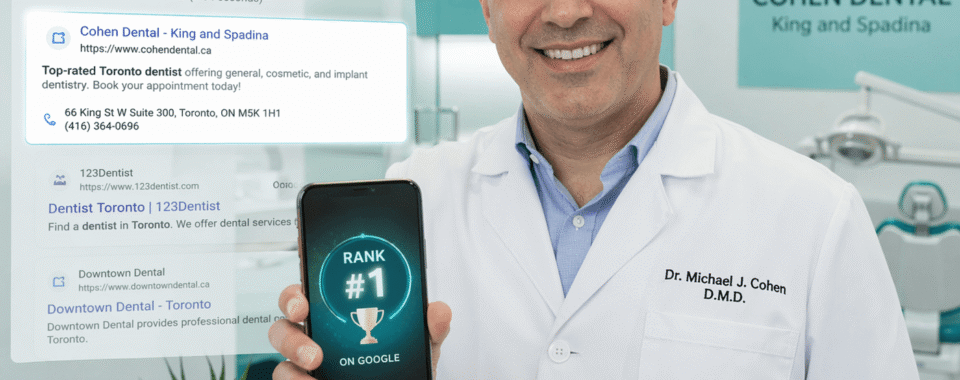
If you’re a dental practice owner or office manager in Toronto, here’s the uncomfortable truth: your next patient is already on Google right now — and if your clinic isn’t showing up on page one, they’re booking with someone else.
Dental SEO Toronto is the process of optimising your dental practice’s online presence so that it ranks higher on Google — in regular search results, in the Google Maps Pack, and increasingly in AI-generated answers — when local patients search for services like yours.
This guide walks you through exactly how to do it: from setting up your Google Business Profile correctly, to building a review strategy that compounds over time, to making sure each of your service pages is structured to convert. No fluff. Just what works in Toronto’s competitive dental market.
What Is Dental SEO and Why Does It Matter in Toronto?
Dental SEO is a specialised form of local search engine optimisation focused on helping dental practices appear at the top of Google when potential patients search for services nearby. It combines technical website improvements, local listing management, content creation, and reputation building — all with one goal: more booked appointments.
In Toronto, this matters more than in most Canadian cities. The GTA is home to over 3,000 registered dental practices. That means patients searching “dentist near me” or “dental implants Toronto” are faced with pages of options. The clinics that show up first get the call. The rest don’t.
| 📊 Why Dental SEO Beats Traditional Marketing in Toronto
Nearly 85% of patients begin their search for a new dentist online. Organic SEO traffic converts at roughly 5× the rate of paid ads — because the patient is already actively searching for exactly what you offer. In a city as competitive as Toronto, investing in SEO is no longer optional for practices that want consistent patient growth. |
How Google Ranks Dental Clinics Locally
Google’s local ranking algorithm weighs three core factors when deciding which dental clinics appear in the Maps Pack and local search results. Understanding these is the foundation of any dental SEO strategy.
1. Relevance
Does your listing and website clearly match what the patient is searching for? If someone searches “Invisalign Toronto” and your website doesn’t mention Invisalign specifically — with its own dedicated page — Google won’t consider you relevant for that query.
2. Distance
Google shows results that are geographically close to the searcher. This is why a clinic in Scarborough won’t rank for “dentist downtown Toronto” — and vice versa. Your SEO strategy should be built around your actual service area, not all of Toronto at once.
3. Prominence
How well-known and trusted is your practice online? Google measures this through the number and quality of your reviews, backlinks to your website, consistent citations across directories, and overall online activity. Prominence is the factor you can most actively build over time.
| Want to Know Where You Stand Right Now?
BizStori offers a free SEO audit for Toronto dental clinics — we’ll show you exactly where you’re losing patients to competitors. |
STEP 1 Optimise Your Google Business Profile
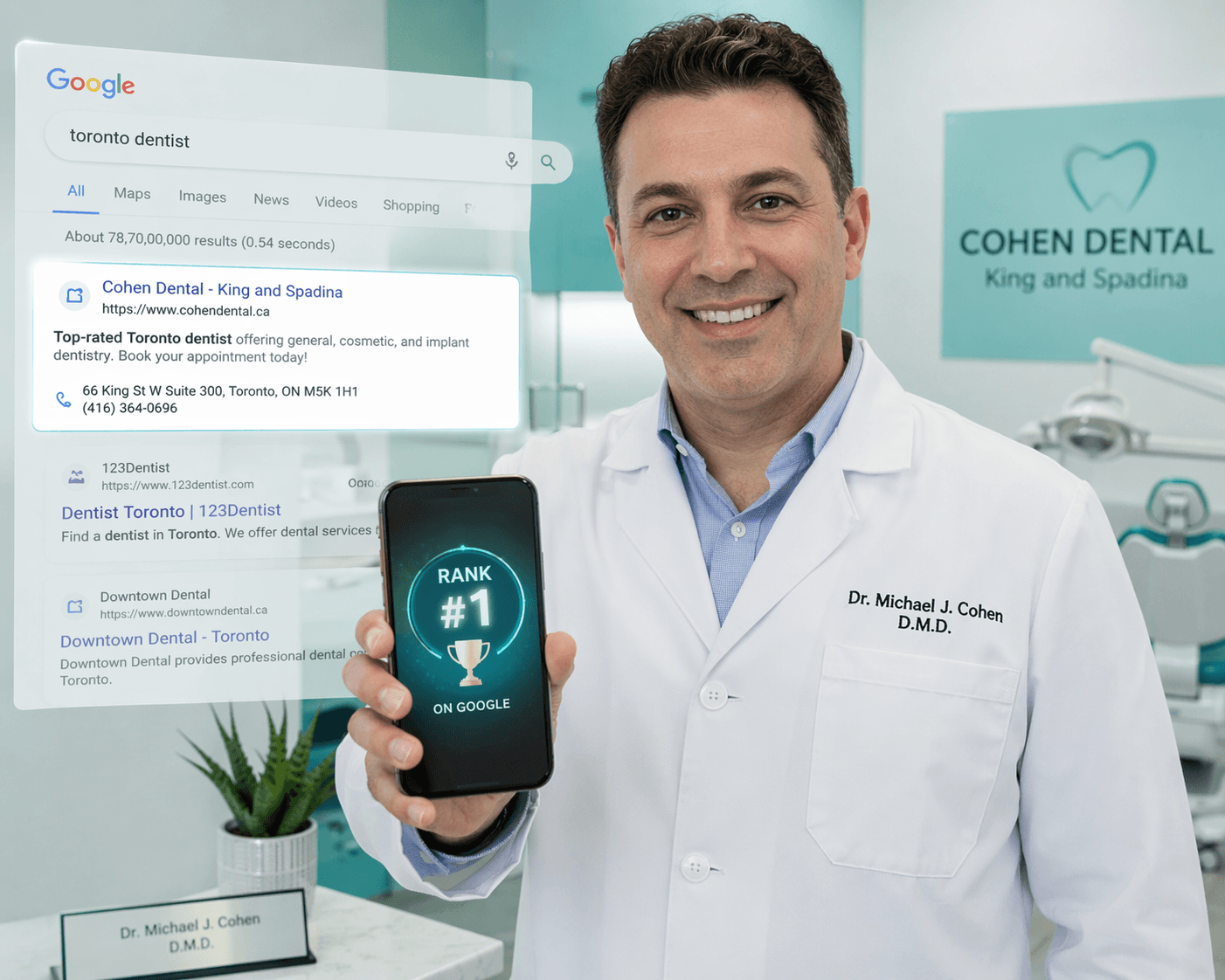
Your Google Business Profile (GBP) is the single most powerful tool in your local SEO arsenal. It’s what appears in the Maps Pack — those top three listings that appear before the organic results — and it’s often the first thing a potential patient sees before they ever visit your website.
Choose the Right Primary Category
This is a mistake many Toronto practices make. Your primary category should be “Dentist” — not “Dental Clinic” or “Dental Office.” Very few patients search the phrase “dental clinic.” If you’re a specialist, use your specialty as the primary. Add secondary categories only for services you genuinely provide: Cosmetic Dentist, Pediatric Dentist, Emergency Dental Service.
Complete Every Section
Google rewards completeness. Fill in every field available — business description, services list, hours, photos, website link, and phone number. For the services section, be specific. Don’t just write “dental cleaning” — write “professional teeth cleaning and polishing.” These service descriptions influence how Google matches your profile to patient searches.
Use GBP Posts Regularly
Most Toronto dental practices set up their GBP and never touch it again. Posting updates — whether it’s a new service, a seasonal offer, or a patient tip — signals to Google that your business is active. Aim for at least two posts per month. This is a low-effort, high-impact habit that most of your competitors are ignoring.
Add Photos That Build Trust
Clinics with more photos consistently receive more clicks and direction requests. Add photos of your reception area, treatment rooms, your team, and before/after results (with patient consent). Profiles with 100+ photos see dramatically higher engagement than those with fewer than 10.
GBP OPTIMISATION CHECKLIST
- Primary category set to “Dentist” (or your specialty)
- All services listed individually with descriptions
- Business description includes location and 2–3 core services
- At least 20 photos uploaded (clinic, team, treatment rooms)
- GBP posts published at least twice per month
- Responding to all patient reviews within 48 hours
STEP 2 Build a Patient Review Strategy That Works
Patient reviews are one of the strongest local ranking signals Google uses. A Toronto dental clinic with 150 reviews and a 4.8 rating will almost always outrank a clinic with 20 reviews and a 4.9 — because volume and recency both matter.
The challenge most practices face isn’t that patients are unwilling to leave reviews — it’s that no one asks them at the right moment.
When and How to Ask
The best moment to ask for a review is immediately after a successful appointment, while the patient is still in a positive emotional state. Train your front desk staff to say something natural, then automate with a short follow-up text or email sent 2–4 hours after the appointment. Include a direct link to your Google review page. Remove every possible barrier.
How to Respond to Reviews with SEO in Mind
Responding to reviews isn’t just good customer service — it’s an SEO tactic. When you respond, naturally include your location and the service mentioned. For example: “Thank you for trusting us with your teeth whitening in North York — we’re so glad you’re happy with the results!” This reinforces location and service keywords in a natural way that Google indexes from your review responses.
| ⚠️ One Thing to Avoid
Never offer incentives (discounts, free cleanings) in exchange for reviews. Google’s policies prohibit this, and it can result in your GBP being penalised or suspended. Reviews must be earned honestly. |
STEP 3 Optimise Your Dental Service Pages
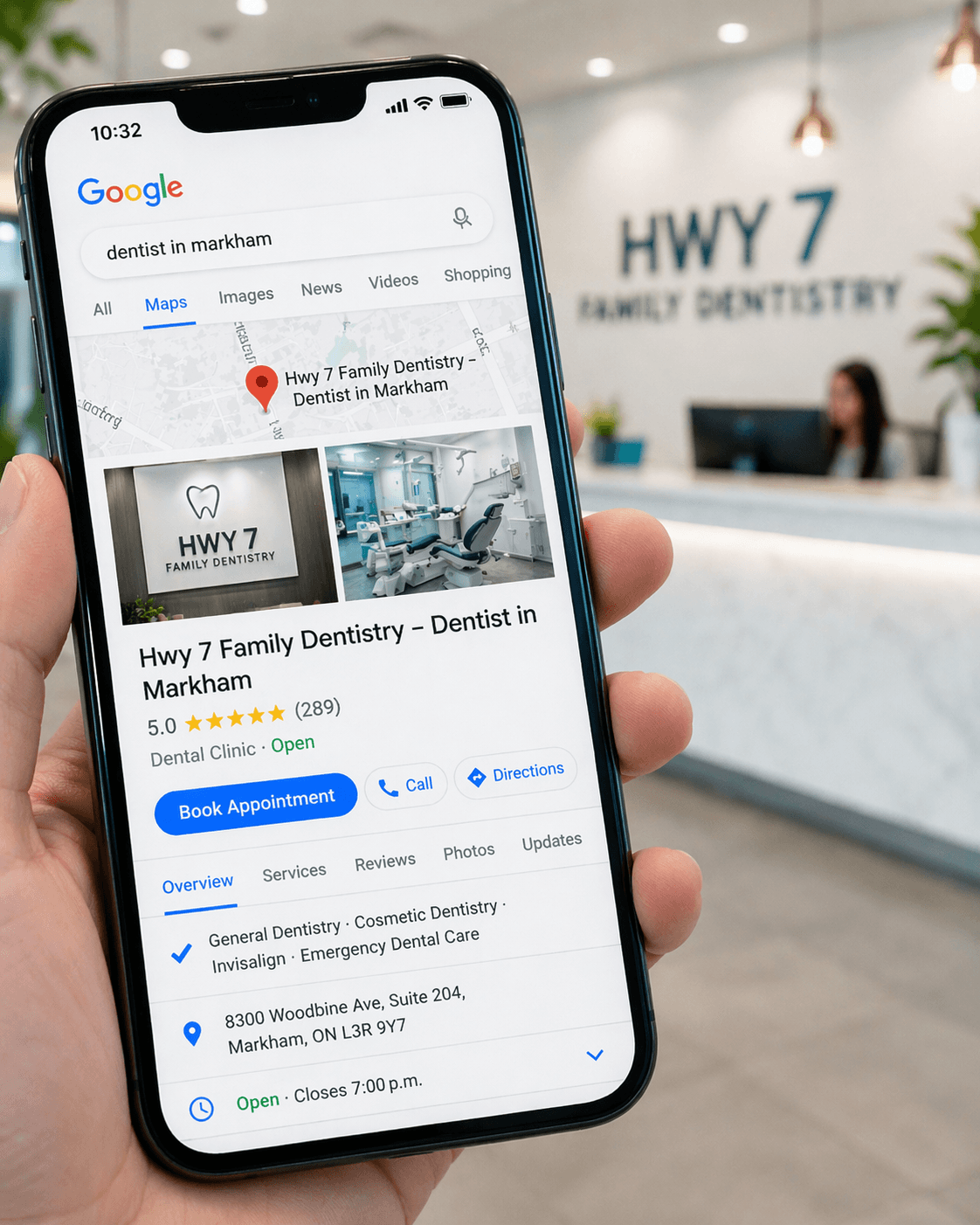
One of the biggest SEO mistakes Toronto dental clinics make is having a single “Services” page that lists everything in brief bullet points. This approach leaves enormous amounts of search traffic on the table.
Each major service should have its own dedicated page. When a patient searches “dental implants Toronto,” Google wants to show them a page that is specifically and deeply about dental implants in Toronto — not a generic services overview that mentions implants in a single sentence.
Which Services Deserve Their Own Page?
- General dentistry / family dentistry
- Dental implants
- Invisalign / clear aligners
- Teeth whitening / cosmetic dentistry
- Emergency dental care
- Pediatric dentistry
- Root canal treatment
- Dental veneers
- Orthodontics / braces
What Every Service Page Needs
A well-optimised service page should genuinely serve the patient who lands on it. Include: what the service is and who it’s for, what the treatment process involves, how long it takes and what recovery looks like, pricing or financing options (even a general range builds trust), patient testimonials related to that service, and a clear booking CTA.
Use your city and neighbourhood naturally throughout — “dental implants for patients across Toronto, including Scarborough, North York, and Etobicoke” — without forcing it.
STEP 4 Local SEO for Toronto Neighbourhoods
Toronto is not one market. It’s dozens of distinct micro-markets — and your dental SEO strategy should reflect that reality.
A clinic in Scarborough competes against different practices, ranks for different neighbourhood-specific searches, and serves a different patient demographic than a clinic in Leslieville or Rosedale. Generic “Toronto dental SEO” content will always underperform hyper-local content that speaks to where patients actually are.
Neighbourhood-Specific Content Strategy
If your practice is based in North York, create content that speaks directly to North York patients. Mention local landmarks, transit routes, and community references where natural. Create a dedicated location page (e.g., “Dentist in North York”) that targets neighbourhood-level searches — these often have less competition and higher conversion because the searcher intent is very specific.
NAP Consistency Across All Directories
Your practice’s Name, Address, and Phone Number (NAP) must be identical across every platform — Google, Yelp, Healthgrades, RateMDs, Yellow Pages, your website footer, and any other directory. Even small inconsistencies (e.g., “305 Milner Ave” vs. “305 Milner Avenue”) erode Google’s confidence in your listing and can suppress your local rankings.
| 🗺️ Key Toronto Neighbourhoods to Target
Depending on your clinic’s location, consider creating targeted content for: Scarborough, North York, Etobicoke, East York, Downtown Toronto, Mississauga, Brampton, Markham, Vaughan, and Richmond Hill. Each represents a distinct patient pool with its own search behaviour. |
STEP 5 Technical SEO Basics for Dental Websites
You don’t need to be a developer to understand whether your dental website is technically sound. Here are the non-negotiables that directly impact your Google rankings.
Mobile Performance
The majority of “dentist near me” searches happen on mobile phones. If your website loads slowly, is hard to navigate on a small screen, or requires zooming in to read — patients will bounce immediately. Google knows this and penalises slow, mobile-unfriendly sites. Run your site through Google’s PageSpeed Insights and aim for a score above 75 on mobile.
Schema Markup for Dental Practices
Schema markup is structured data that helps Google — and AI systems — better understand what your practice offers. At minimum, implement: LocalBusiness schema (with your address, phone, and hours), Dentist schema, Service schema on each service page, and FAQ schema on pages where you answer common patient questions. FAQ schema in particular is one of the most reliable ways to appear in Google’s AI Overviews.
HTTPS and Site Security
Your website must use HTTPS. This is a baseline trust signal and a confirmed Google ranking factor. If your site still shows “Not Secure” in the browser, patients will leave — and Google will rank you lower. Contact your hosting provider to install an SSL certificate if you haven’t already.
STEP 6 Blog Content That Builds Topical Authority
Publishing helpful blog content is how your dental website builds topical authority over time — the cumulative signal that tells Google your website is a trusted, comprehensive resource in the dental space for Toronto patients.
You don’t need to post daily. Two to four well-researched, genuinely helpful articles per month is enough to build meaningful momentum. Focus on questions your patients actually ask in the chair:
- “How long do dental implants last?”
- “What’s the difference between Invisalign and braces?”
- “How much does teeth whitening cost in Toronto?”
- “What should I do in a dental emergency?”
- “How often should I get a dental checkup?”
Each of these maps to real search queries with real patients behind them. A blog post that answers a specific question clearly and completely — with a direct answer in the opening paragraph — stands a strong chance of being pulled into Google’s AI Overview, giving your practice visibility even above traditional search results.
Dental SEO vs Google Ads — Which Should You Choose?
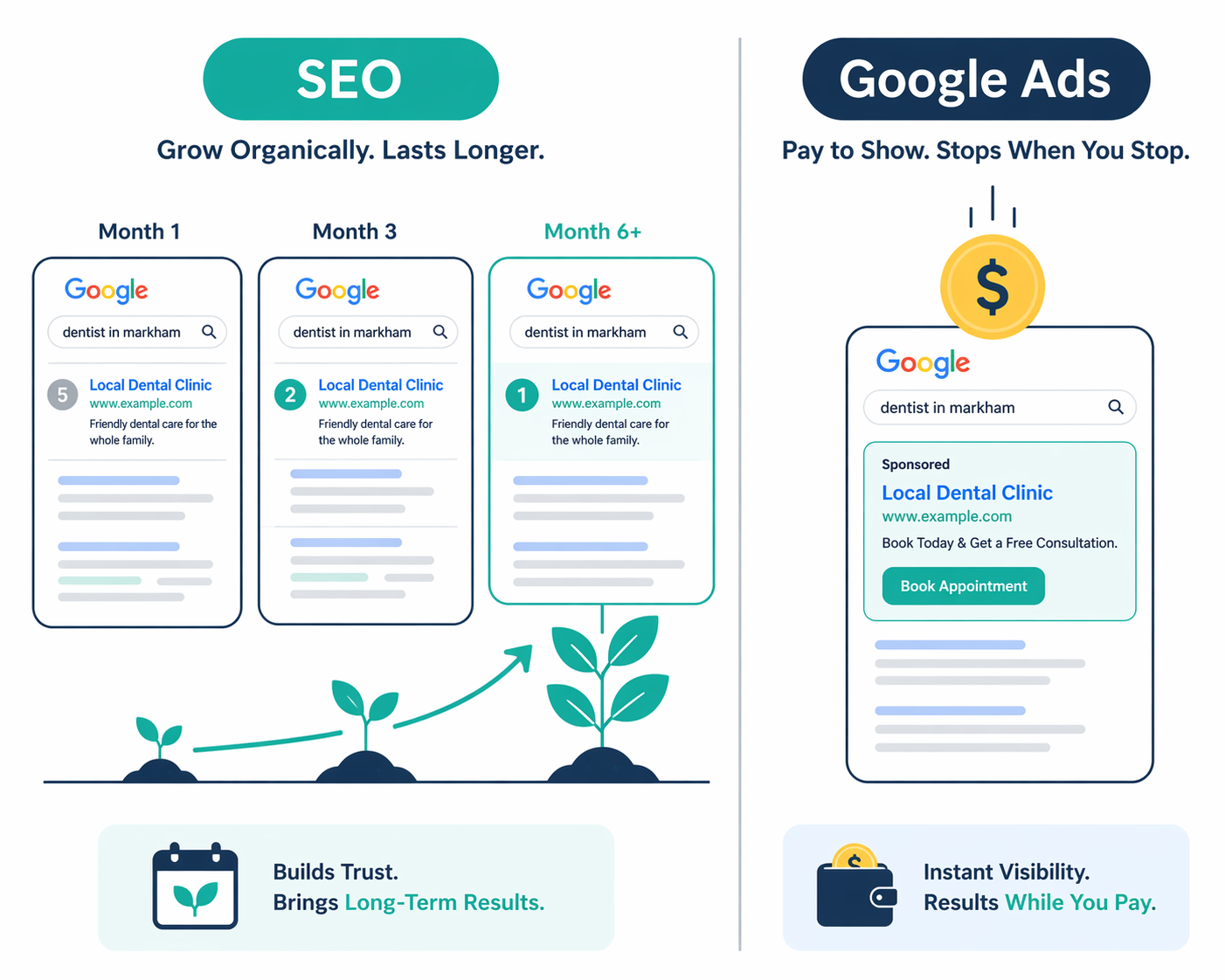
This is one of the most common questions Toronto dentists ask about digital marketing. The honest answer is that they serve different purposes — and the best-performing practices use both strategically.
| Factor | Dental SEO | Google Ads |
| Time to results | 3–6 months | Immediate |
| Cost over time | Decreases (compounds) | Ongoing — stops when paused |
| Patient trust | Higher (organic = credibility) | Lower (marked Sponsored) |
| Click-through rate | Higher for local searches | Lower (many skip ads) |
| Best for | Long-term patient growth | New clinics, promotions |
| Visibility in AI answers | Yes | No |
For a Toronto dental clinic that’s been operating for more than two years, SEO should be the primary long-term investment. Google Ads can complement it for high-value services like implants or Invisalign where you want immediate visibility while your SEO builds.
| Ready to Start Getting More Dental Patients From Google?
BizStori has worked with Toronto dental practices including Hwy 7 Family Dentistry to grow their online presence and fill their appointment calendars through strategic dental SEO. |
FAQ — Dental SEO Toronto
What is dental SEO?
Dental SEO is the process of optimising a dental practice’s online presence — including its website, Google Business Profile, and local citations — so that it ranks higher in Google search results when local patients search for dental services. The goal is to attract more qualified website visitors and convert them into booked appointments.
How long does dental SEO take in Toronto?
Most Toronto dental clinics begin to see ranking improvements within 60–90 days of consistent SEO work. Meaningful results — including increased patient calls and bookings from organic search — typically become visible within 4–6 months. SEO is a long-term investment: the results compound over time and don’t disappear the moment you stop paying, unlike paid ads.
How much does dental SEO cost in Toronto?
Dental SEO services in Toronto typically range from $800 to $3,000+ per month depending on the scope of work, competitiveness of your target area, and the number of services you want to rank for. BizStori offers customised pricing based on your practice’s specific goals — reach out at bizstori.ca/contact-us for a free audit and quote.
Can I do dental SEO myself?
You can handle the basics — setting up your Google Business Profile, collecting reviews, and publishing blog content. However, technical SEO, schema markup, competitive link building, and ongoing keyword tracking require time and expertise that most practice owners don’t have available. The opportunity cost of not ranking on page one often far exceeds the cost of professional SEO support.
What’s the difference between local SEO and dental SEO?
Local SEO is the broader discipline of optimising any business for location-based search results. Dental SEO is local SEO applied specifically to dental practices — with additional considerations around healthcare trust signals, YMYL content standards, patient review management, medical schema markup, and service-specific content.
Does my dental clinic need to be on social media for SEO?
Social media signals are not a direct Google ranking factor, but maintaining active social profiles supports your overall digital authority and helps patients find and trust you. Social media marketing and email marketing are powerful tools for patient retention and re-engagement — keeping your existing patients loyal while your SEO builds new patient volume.
What is Google’s AI Overview, and how do I appear in it?
Google’s AI Overview is the AI-generated summary box that appears at the top of certain search results. To appear in it, your content needs to directly and concisely answer specific questions, use clear heading structures (H2/H3), implement FAQ schema markup, and be seen as an authoritative source. Structured, educational content — exactly like well-optimised dental service pages and blog posts — is what Google pulls from most often.
