










| 🤖 | Quick Answer What Google’s AI Overview Shows for This Search
Chiropractor clinics in Toronto fail to show up on Google for four main reasons: an unmanaged or incomplete Google Business Profile, a technically weak website that loads slowly on mobile, generic content that doesn’t match how patients actually search, and inconsistent business information across online directories. Fixing all four not just one is what moves a Toronto chiro clinic from page 2 to the Google Maps 3-pack. |
If you own a chiropractic clinic in Toronto and your Google ranking isn’t where it should be, you’re not imagining the problem. The GTA has hundreds of chiropractors competing for a limited number of page-1 spots and the clinics that rank aren’t necessarily the best; they’re the ones that have fixed the right things.
Most Toronto chiro clinics are invisible on Google for one of four fixable reasons. This post breaks down each blocker clearly, explains what Google is actually looking for, and shows you what a properly optimised chiropractor SEO strategy in Toronto looks like in practice so you can compare it against what you’re currently doing and identify the gaps.
| 📍 | This Post Is For You If…
You own or manage a chiropractic clinic in Toronto, Scarborough, Etobicoke, North York, Mississauga, or anywhere in the GTA and your Google rankings aren’t generating consistent new patient enquiries. You may rank for your own clinic name but not for “chiropractor [your neighbourhood]” or “chiropractic care near me.” That’s the gap this post addresses. |
Why Toronto Chiropractors Struggle to Rank on Google
The Competition Is Higher Than It Looks
A search for “chiropractor Toronto” returns a Google Maps 3-pack and 10 organic results, roughly 13 visible spots. There are more than 400 registered chiropractors in the City of Toronto alone, plus hundreds more across the GTA. Even if only half of them have a website, that’s 200+ clinics competing for 13 spots on page 1.
The clinics that consistently appear aren’t doing anything exotic. They’ve fixed four specific things that most clinics overlook and those four fixes account for the majority of local ranking weight according to Google’s own documentation on how local search works.
Why “Just Having a Website” Stopped Working
In 2018, having a website was enough to show up in local search. In 2026, Google’s local algorithm weighs Google Business Profile signals, review velocity, content relevance, and technical performance all simultaneously. A clinic that built a website five years ago and hasn’t touched it since is effectively invisible to the algorithm that decides who appears in the Maps 3-pack.
This is the same challenge facing physiotherapy in Toronto and medical practices across the GTA the bar for ranking has moved significantly upward, and many healthcare practices haven’t kept pace.
The 4 Ranking Blockers Keeping Your Chiro Clinic Off Page 1
These four issues account for the vast majority of ranking underperformance across Toronto chiropractic clinics. Most clinics have at least two of them. Some have all four.
Blocker 1 Your Google Business Profile Is Treated as a One-Time Setup
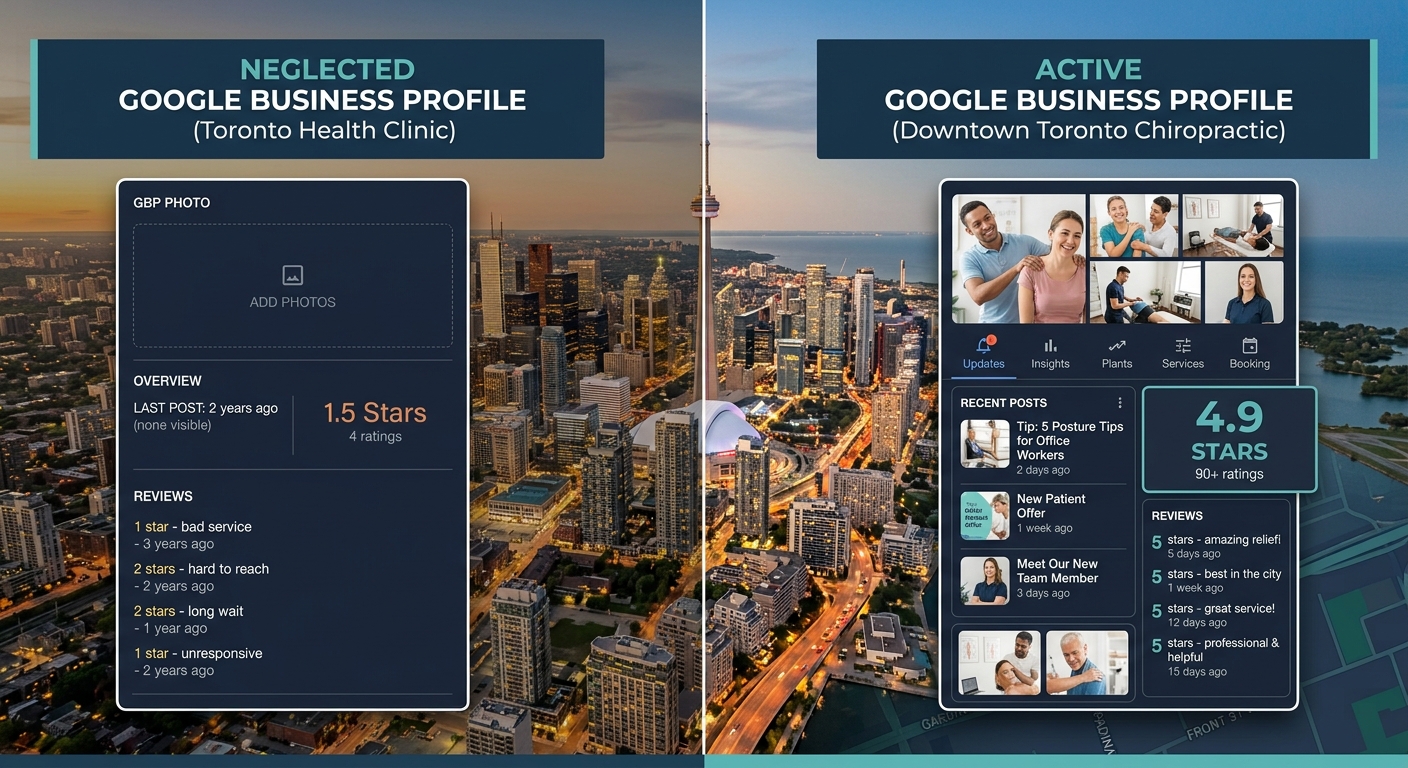
Your Google Business Profile (GBP) is not a form you fill in once and forget. Google explicitly rewards active, regularly updated profiles over dormant ones and for a chiropractic clinic, the GBP often drives more new patient enquiries than your website does.
Google’s local algorithm weighs your GBP across three signals: proximity to the searcher, relevance to their search query, and prominence which includes how active and complete your profile is. A clinic that set up their GBP in 2022 and hasn’t posted since is sending inactivity signals that suppress its ranking.
What an Unmanaged GBP Looks Like
- The primary category is set to “Wellness Center” instead of “Chiropractor” losing direct category relevance
- No Google Posts in the last 30+ days Google sees no recent activity
- Fewer than 10 photos profiles with 10+ images get significantly more direction requests
- Q&A section empty or unanswered missed opportunity for keyword-rich content Google indexes
- Review responses absent Google factors owner responsiveness into prominence scoring
What Active GBP Management Looks Like
- Primary category set to “Chiropractor” not Wellness, not Healthcare, not Physiotherapy
- New Google Posts every 7–14 days (clinic news, new patient offers, condition spotlights)
- 20+ photos across interior, exterior, team, and treatment areas
- All patient reviews responded to within 48 hours positive and negative
- Q&A section seeded with the 10 most common patient questions and clinic answers
- Services section populated with every condition treated: back pain, neck pain, sciatica, sports injuries, headaches
| 32% | of local search ranking weight comes from Google Business Profile signals more than any other single factor for chiropractic clinics in competitive markets like Toronto. |
Blocker 2 Your Website Has a Weak Technical Foundation
Google evaluates your website’s technical health before it evaluates your content. A slow, mobile-unfriendly, or technically misconfigured website limits how well even excellent content can rank regardless of how many blog posts you publish.
This applies across all healthcare specialties. The same technical issues that suppress chiropractic rankings also affect dental practices and healthcare web design across the GTA a fast, mobile-first website is the non-negotiable foundation.
The Technical Issues That Suppress Chiro Rankings Most
- Page load speed above 3 seconds on mobile Google’s Core Web Vitals threshold is LCP under 2.5 seconds
- No HTTPS (SSL certificate missing or expired) Google flags non-secure sites in search results
- No schema markup without LocalBusiness, Chiropractor, and FAQPage structured data, Google has to guess what your page is about
- Duplicate content many clinic websites use template content shared with dozens of other chiropractic sites, which Google devalues
- No XML sitemap or robots.txt Google can’t efficiently crawl and index your pages
- Broken links and 404 errors signals of an unmaintained, low-quality site
The Technical Fixes That Move Rankings
- Compress all images and serve them in WebP format typically cuts 40–60% off page load time
- Implement schema markup in JSON-LD: LocalBusiness type with your NAP data, service types, and opening hours
- Add FAQPage schema to every condition page and blog post this is what triggers FAQ rich results in Google
- Submit an XML sitemap to Google Search Console and verify your site is being crawled correctly
- Run a Core Web Vitals report in Search Console and resolve any pages marked “Poor” or “Needs Improvement”
Blocker 3 Your Content Doesn’t Match How Patients Actually Search
This is the most common and most damaging blocker for Toronto chiropractic clinics. Most clinic websites have one generic “Services” page listing every treatment they offer. Google sees this as one page competing for dozens of different search queries and ranks it for none of them.
Patients don’t search for “chiropractic services.” They search for what they’re experiencing: “lower back pain chiropractor Toronto,” “neck pain treatment Scarborough,” “sciatica relief near me,” “chiropractor for car accident injuries Toronto.” Each of these is a distinct search query that needs its own dedicated page to rank for it.
The Generic Content Problem
- One “Services” page trying to rank for 15 different conditions Google can’t determine the primary intent
- “What is chiropractic care?” content that no one searches for after the first visit to Wikipedia
- Location pages that say “we serve Toronto and surrounding areas” without naming specific neighbourhoods
- Blog posts written for other chiropractors (“5 Techniques We Use”) instead of for patients (“Back Pain Won’t Go Away? When to See a Chiropractor”)
- Content that mirrors competitors word-for-word Google identifies and devalues templated content
The Content Structure That Ranks in Toronto
- Dedicated page for each condition treated: back pain, neck pain, sciatica, headaches, sports injuries, car accident recovery, prenatal chiropractic
- Each condition page answers the patient question directly: what causes it, how chiropractic helps, what to expect at your clinic
- Neighbourhood location pages: “Chiropractor [Neighbourhood]” for every area your clinic serves Scarborough, North York, Etobicoke, Mississauga, etc.
- Blog content targeting patient search queries: “how long does chiropractic take to work,” “is chiropractic safe during pregnancy,” “chiropractic vs physiotherapy for back pain”
- Each blog post and condition page structured with a direct answer in the opening paragraph this is what gets cited in Google’s AI Overview
| 💡 | The AI Overview Opportunity for Toronto Chiro Clinics
When a patient searches “chiropractor for lower back pain Toronto” in 2026, Google’s AI Overview pulls a direct answer from whichever clinic’s page answers the question most clearly and completely. Clinics with condition-specific pages, direct answers in the opening paragraph, and FAQPage schema markup are the ones appearing in that AI Overview box before any blue links. This is a significant new patient acquisition channel that most Toronto chiro clinics are not optimising for yet. |
Blocker 4 Inconsistent Business Information Across the Web
Google’s local algorithm cross-references your clinic’s name, address, and phone number (NAP) across dozens of online directories, healthcare listings, and citation sources. When this information is inconsistent a different phone number on RateMDs than on your GBP, an old address on Yelp, a misspelled clinic name on a local directory Google loses confidence in your location data and suppresses your local ranking.
This is a mechanical issue, not a content or design issue. It doesn’t require creativity to fix it requires a systematic audit of every directory where your clinic appears and correction of any discrepancy.
Common NAP Inconsistency Sources for Toronto Chiro Clinics
- Old address still showing on Yelp, RateMDs, or Healthgrades Canada after a clinic move
- Phone number on Google Business Profile different from the number on the clinic website
- Clinic name listed differently across directories: “Back in Motion Chiropractic” vs “Back in Motion Chiro” vs “Back in Motion”
- Duplicate GBP listings from an old Google Maps pin that was never removed
- Yellow Pages and Canada411 listings not updated since the clinic was first registered
How to Fix NAP Inconsistency
- Run a citation audit using a tool like BrightLocal or Whitespark both cover Canadian directories effectively
- Set your canonical NAP (exactly how your clinic name, address, and phone should appear everywhere) and update every directory to match
- Claim and verify listings on the top 10 directories: Google, Apple Maps, Bing, Yelp, RateMDs, Healthgrades Canada, Facebook, Foursquare, Yellow Pages Canada, Canada411
- Identify and request removal of any duplicate GBP listings through Google’s duplicate listing report process
- Ensure your website’s footer and contact page match the GBP NAP exactly including formatting (Scarborough, ON vs Scarborough, Ontario)
The Review Factor: Why Google Rewards Some Chiro Clinics Over Others
Reviews Are Both a Ranking Signal and a Patient Conversion Tool
Google’s local algorithm weighs review volume, review recency, and review response rate as part of its prominence scoring. A clinic with 180 reviews and a 4.8 star rating ranks above a clinic with 30 reviews and a 4.9 star rating because volume and recency matter, not just the average score.
The review dynamic for Toronto chiro clinics is further complicated by patient behaviour: 84% of patients check online reviews before booking a healthcare appointment. A clinic that ranks well but has sparse or outdated reviews loses the booking to a competitor with more recent social proof.
The Wrong Way to Build Reviews
Most clinics collect reviews in bursts asking everyone after a successful treatment week, then going quiet for months. Google flags sudden spikes in review volume as suspicious and may suppress or remove the reviews. It also means your review page shows a cluster of reviews from one month and nothing for the past six months which looks odd to prospective patients.
The Right Review Cadence for a Toronto Chiro Clinic
- One to three new reviews per week, consistently not 20 in one month and zero for the next three
- Text or email review request sent to patients within 24 hours of a positive visit timing is the single biggest variable in review response rate
- A direct Google review link (shortened) used in every follow-up message reduce friction as much as possible
- All reviews responded to within 48 hours Google factors owner responsiveness into ranking; patients factor it into their booking decision
- A process for handling negative reviews: acknowledge, offer to resolve offline, never argue in the public response
| ⭐ | Review Velocity Beats Review Volume for New Clinics
A clinic that opened 18 months ago with 45 reviews and a steady rate of 2–3 new reviews per week will consistently outrank an established clinic with 200 reviews and no new reviews in the last 4 months. Google’s algorithm weights recency heavily in local search a review from last week carries more ranking weight than a review from two years ago. |
Keyword Strategy for Toronto Chiropractic Clinics
Why “Chiropractor Toronto” Is the Wrong Starting Keyword
The keyword “chiropractor Toronto” has high search volume and high competition. For a single-location clinic, it’s the worst keyword to target first because you’re competing with multi-location practices, well-funded clinic groups, and directories like RateMDs and Healthgrades that already dominate page 1.
The right starting strategy is neighbourhood-first and condition-first the keywords with lower competition and higher commercial intent that your clinic can realistically rank for within 90–180 days.
The Keyword Tiers for Toronto Chiro Clinics
Tier 1 Neighbourhood Keywords (Rank First)
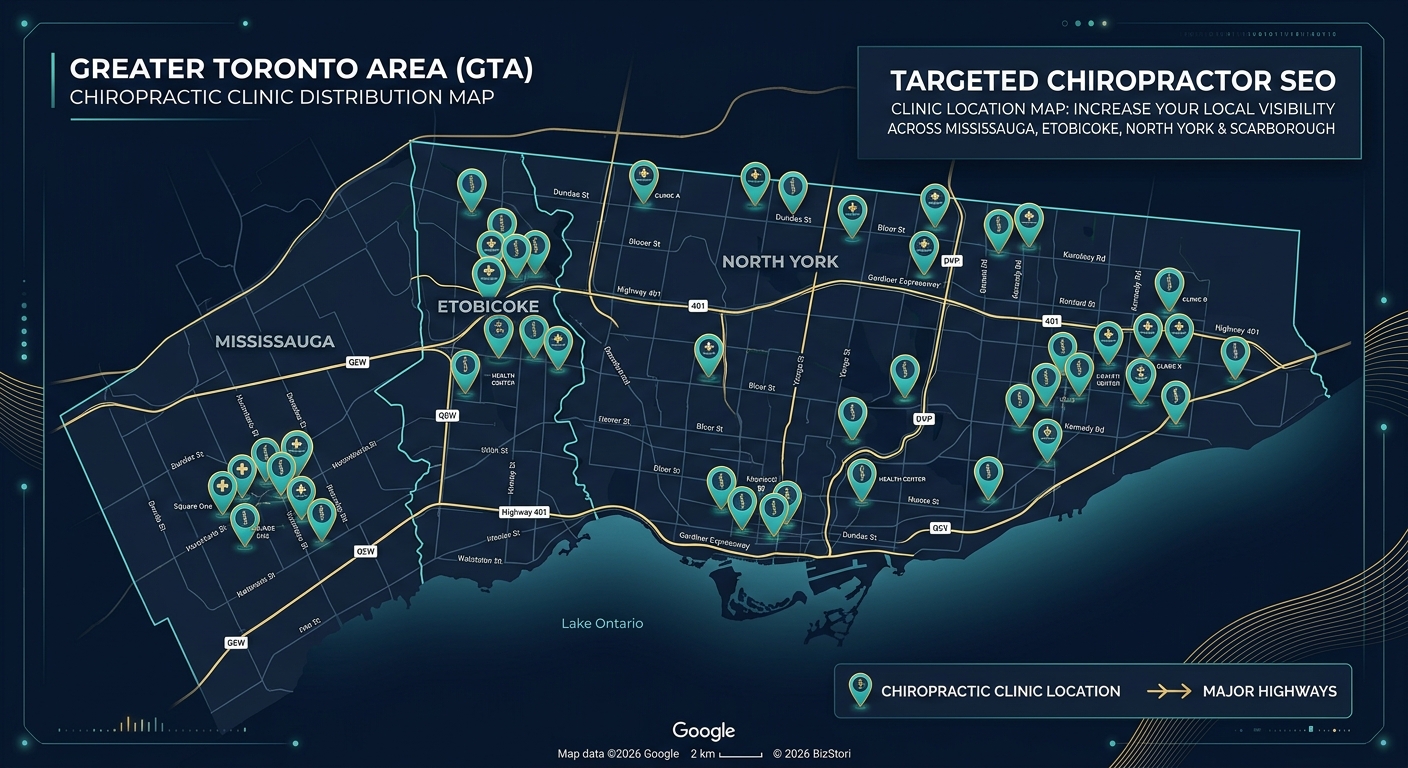
- “Chiropractor [neighbourhood]” Scarborough, North York, Etobicoke, Mississauga, Brampton, Oakville
- “Chiropractic clinic near [landmark]” near Scarborough Town Centre, near Yonge and Eglinton, near Square One
- “Chiropractor open Saturday Toronto” and similar availability-specific searches
Tier 2 Condition Keywords (Rank Next)
- “Back pain chiropractor Toronto” high intent, patients ready to book
- “Neck pain treatment [neighbourhood]” condition + location = very bookable traffic
- “Sciatica chiropractor GTA,” “headache specialist Toronto,” “sports injury chiropractor Toronto”
- “Chiropractor for car accident Toronto” high-value, insurance-covered visits
- “Pregnancy chiropractor Toronto” and “prenatal chiropractic care GTA”
Tier 3 Question Keywords (Blog Content)
- “How many chiropractic sessions do I need?” patient research stage
- “Is chiropractic covered by OHIP?” Ontario-specific, high-volume FAQ
- “Chiropractic vs physiotherapy for back pain” comparison content
- “How to choose a chiropractor in Toronto” awareness stage, pre-booking
What a Real Chiropractor SEO Strategy Looks Like in 2026
Month 1 Foundation
The first month of a proper chiropractor SEO engagement in Toronto is entirely foundational. No blog posts, no link-building campaigns, no social media. Month 1 is about fixing the things that are actively suppressing your ranking right now.
- Full technical SEO audit: Core Web Vitals, crawlability, schema markup, duplicate content check
- Google Business Profile audit and optimisation: correct categories, complete NAP, 20+ photos, services populated
- NAP citation audit: identify and begin correcting inconsistencies across top 10 directories
- Keyword research specific to your clinic’s neighbourhood and condition mix
- On-page optimisation of your existing service pages: title tags, meta descriptions, H1 headers, internal links
Month 2–3 Content Build
Once the foundation is in place, the content strategy begins. This is where condition-specific pages and neighbourhood location pages are built the pages that rank for the high-intent searches that book patients.
- One dedicated condition page per primary treatment: back pain, neck pain, sciatica, sports injuries, headaches, prenatal chiropractic
- One neighbourhood page per service area: each page geo-targeted with local landmarks, transit references, and neighbourhood-specific language
- Blog content targeting Tier 3 question keywords two to three posts per month, each structured for AI Overview visibility.
Month 4+ Authority Building
With technical SEO and content in place, month four onward focuses on building the external authority signals backlinks and citations that push rankings from page 2 to page 1. This is where a properly executed healthcare SEO strategy compounds: each new citation, backlink, and review adds to the authority that was built in months 1–3.
- Local backlink outreach: Chamber of Commerce listings, neighbourhood business associations, local health directories
- Guest content on Ontario health and wellness publications that link back to condition pages
- Structured review generation: consistent 2–3 new reviews per week through automated post-visit follow-up
- Quarterly content refresh: update condition pages and blog posts with new information, new internal links, and refreshed schema markup
Should You Run Google Ads While Waiting for SEO to Kick In?
The Case for Running Chiro PPC Alongside SEO
SEO takes 3–6 months to produce meaningful ranking improvements. For a Toronto chiropractic clinic that needs new patients now, Google Ads for chiropractors can fill the gap while the organic strategy builds. The two channels also share keyword data what converts in paid search tells you exactly which organic pages to prioritise.
The conditions with the highest paid search ROI for Toronto chiro clinics are those with clear treatment intent: back pain, car accident injuries, sports injuries, and sciatica. These patients are ready to book they need to find you, not be convinced of the service.
When to Use PPC vs. SEO for Your Chiro Clinic
- New clinic, less than 12 months old: lead with PPC to generate patients while SEO builds authority
- Established clinic, poor organic rankings: run PPC on your highest-value condition keywords while fixing the four blockers organically
- Seasonal demand (e.g. post-winter back pain surge): PPC for the spike, SEO for sustained year-round visibility
- New service launch (e.g. adding prenatal chiropractic): PPC immediately, SEO content to follow within 30 days
Frequently Asked Questions
How long does chiropractor SEO take to show results in Toronto?
Most Toronto chiropractic clinics see measurable ranking improvements within 3–4 months when the four main blockers are fixed simultaneously. Neighbourhood keywords and long-tail condition terms often move to page 1 within 60–90 days. Competitive city-wide terms like “chiropractor Toronto” take 6–12 months for a single-location clinic to challenge established practices. The clinics that see results fastest are the ones that start with the technical foundation and GBP optimisation in month 1, not blog content.
Is chiropractic covered by OHIP in Ontario?
No chiropractic care is not covered by OHIP (Ontario Health Insurance Plan) as of 2026. However, many extended health benefits plans through employers cover chiropractic visits, and some Motor Vehicle Accident insurance policies cover chiropractic treatment for injury recovery. This is a high-volume search query (“is chiropractic covered by OHIP”) that your clinic should have a clear, accurate page or FAQ entry answering both for patient information and for the organic search traffic it generates.
How many Google reviews does a Toronto chiro clinic need to rank in the 3-pack?
There’s no fixed number the threshold depends on your specific neighbourhood competition. In Scarborough or North York suburbs, 40–80 reviews with a 4.5+ rating and recent review activity may be enough to compete for the Maps 3-pack. In central Toronto or around downtown, you may need 150+ reviews to compete with established multi-location practices. What matters more than total volume is review recency a clinic with 50 reviews from the last 6 months will often outrank a clinic with 200 reviews from 2022.
What’s the difference between chiropractor SEO and healthcare SEO?
Healthcare SEO is the broader discipline covering all regulated health professions dentists, physiotherapists, medical clinics, optometrists, and chiropractors. Chiropractor SEO is a specialisation within that using condition-specific content (back pain, sciatica, sports injuries), chiropractic-specific directory citations (College of Chiropractors of Ontario listing, chiropractic association directories), and treatment-focused keyword targeting that differs significantly from, say, a dental or medical SEO strategy.
Can I do chiropractor SEO myself or do I need an agency?
The foundational elements GBP optimisation, NAP consistency, basic on-page SEO, and review generation can be managed by a clinic owner or practice manager with 4–6 hours per month of consistent effort. The more technical elements Core Web Vitals fixes, schema markup implementation, structured data auditing, and link acquisition typically require technical expertise most clinic owners don’t have in-house. The most effective model is a clinic-agency split: the agency handles technical SEO, content strategy, and link-building; the clinic team manages GBP posts and review responses on a weekly basis.
The Bottom Line: What’s Keeping Your Toronto Chiro Clinic Off Page 1
If your chiropractic clinic isn’t showing up on Google, it’s almost certainly one or several of the four blockers covered in this post: an unmanaged Google Business Profile, a technically weak website, generic content that doesn’t match patient search intent, or inconsistent NAP data across online directories.
Fixing all four simultaneously not just the easiest one is what produces page-1 results. A properly built chiropractor SEO strategy in Toronto addresses all four in a sequenced way: technical foundation and GBP in month 1, condition and neighbourhood content in months 2–3, and authority building from month 4 onward.
The same four-blocker framework applies across healthcare specialties. Whether you’re running a dental practice, a physiotherapy clinic, or a medical practice in Toronto, the ranking blockers are structurally identical and the fixes follow the same sequence.
| 📌 | Your Next Step
BizStori offers a free chiropractor SEO audit for Toronto and GTA clinics a full review of your Google Business Profile, technical SEO health, content gaps, and NAP consistency. No retainer required to see the data. Book directly at bizstori.ca/chiropractor-seo-toronto/ |
| Get Your Free Chiro SEO Audit Toronto & GTAWe’ll show you exactly which of the 4 blockers are holding your clinic back and what it takes to fix them.
→ Book Your Free Chiro SEO Audit → bizstori.ca/chiropractor-seo-toronto/ |
