


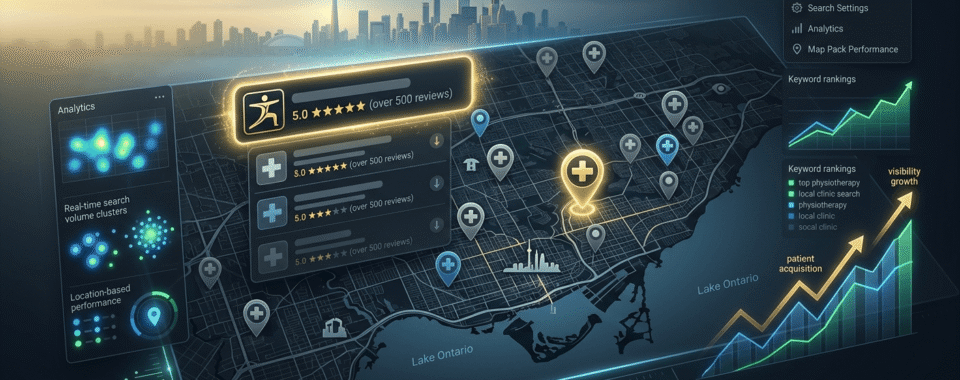
Toronto SEO in 2026: What Actually Moves Rankings for Local Businesses
If you run a business in Toronto and you’ve been wondering why your competitor keeps showing up on Google while you don’t — this post is for you.
Toronto is one of Canada’s most competitive digital markets. Whether you’re a law firm in the Financial District, a physiotherapy clinic in Leslieville, or a café in Queen West, you’re fighting for the same screen real estate against well-funded competitors who’ve been doing this for years.
The good news? Local SEO in 2026 rewards relevance and consistency over budget. And if you know what signals actually move rankings, you can compete.
Here’s what’s working right now.
1. Google Business Profile Is Your Most Important Asset
According to Whitespark’s 2026 ranking factors report, your Google Business Profile (GBP) carries more weight than any other local ranking factor — accounting for roughly 32% of local ranking signals.
That means before you touch your website, you need your GBP in order.
What Google is actually looking for:
In 2026, Google doesn’t just look at how your profile is described — it observes how your business behaves. Profiles that rank well show signs of active operations: reviews arriving consistently, owner responses that demonstrate real involvement, photos uploaded from actual jobs or locations, and posts that signal ongoing activity.
Practical actions:
- Post new photos or updates at least twice a week. Frequent activity is now a top-tier ranking signal. A 4.5-star average or higher, combined with at least 20 recent reviews and active engagement, is sufficient — a perfect 5.0 with zero negative feedback is often flagged as suspicious by AI filters.
- Your primary category should match your core revenue service. Add secondary categories only if those services are actively offered — no category stuffing. Also ensure your service descriptions are written in natural language and align with your website service pages.
- Your GBP and your website should tell the same story — same business name, location information, service area, and trust signals across both. If your profile says one thing and your website says another, that creates confusion that hurts rankings.
2. Toronto’s Neighbourhoods Are a Ranking Opportunity Most Businesses Miss
Toronto searchers are highly neighbourhood-specific. A person in Leslieville searching for a physiotherapist is unlikely to choose one in Etobicoke. Building dedicated neighbourhood pages for areas like Yorkville, The Annex, Queen West, Distillery District, and Liberty Village creates far more relevant local signals than generic city-wide targeting.
The most effective keyword structure for Toronto is: service + neighbourhood + city.
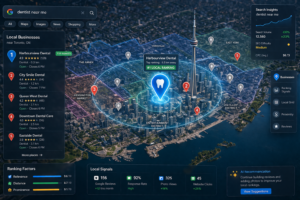
A dental clinic near Spadina and Bloor, for example, might target: dentist Annex Toronto, dentist Seaton Village Toronto, teeth whitening Annex Toronto. Each combination is a separate ranking opportunity — and neighbourhood-level keywords are significantly less competitive than broad city terms.
3. Local Rankings Are Now About Entity Signals, Not Just Pages
This is the biggest conceptual shift of 2026 — and most business owners haven’t caught up to it yet.
In 2026, Google does not rank pages for local results in isolation. It ranks business entities. Your pages, GBP profile, reviews, mentions, and user behaviour are evaluated together as a single system. This is why two businesses with similar websites can perform dramatically differently — one is recognised as a real brand operating in a real market, and the other is not.
What this means in practice: your NAP (Name, Address, Phone Number) must be consistent everywhere — Google, Yelp, Yellow Pages, and every local directory. Even small variations like “Street” versus “St.” or different phone number formats can create inconsistency issues that affect rankings. Clean, consistent citations across the web validate that your business is real and your information is accurate.
4. On-Page Tactics That Still Move the Needle
Your website remains critical — GBP alone won’t carry you for competitive keywords.
Content and keyword strategy:
Not all Toronto searches have the same intent. “SEO Toronto” might be informational. “SEO agency Toronto hire” is transactional. “Best SEO company Toronto reviews” is a comparison search. Your content needs to match the intent — informational queries need genuinely useful content, while transactional queries need clear service pages with trust signals and easy contact paths.
Technical foundations:
A site that loads quickly, works flawlessly on mobile, and uses clean code and schema sends powerful trust signals to both users and search engines. Core Web Vitals and crawlability remain essential, especially as AI increasingly factors them into rankings.
E-E-A-T signals:
Google’s quality framework isn’t going away. Establish credibility with expert bylines, case studies, transparent authorship, customer reviews, and authoritative backlinks. The stronger your E-E-A-T, the stronger your rankings.
5. Reviews Are a Conversion Tool, Not Just a Ranking Signal
AI now summarises reviews for users, so when you respond to a negative review addressing a specific complaint — like “long wait times” — it helps the AI understand that you are actively improving. Responding within 24 hours is now the expected standard.
Ask for reviews after every positive customer interaction. When you do, encourage customers to mention your location naturally — a review that says “best plumber in Etobicoke” carries more local relevance than a generic five-star rating with no text.
6. The Rise of AI Search and What It Means for Toronto Businesses
Local SEO in 2026 is increasingly about optimising for AI-driven intent, voice search, and hyperlocal proximity signals. To rank, Toronto businesses must transition from keyword density to Generative Engine Optimization (GEO), focusing on high-authority GBP updates, geotagged video content, and neighbourhood-specific landing pages that answer complex user queries directly in the Map Pack.
Being cited by AI systems like ChatGPT or Google’s AI Overviews elevates your brand credibility. Tracking not just Google rankings, but whether your content appears in AI-generated responses, is now a meaningful KPI for Toronto businesses.
The practical takeaway: write content that directly and concisely answers real questions your customers are asking. If your content is clear, authoritative, and machine-readable, AI systems will surface it.
7. Local Backlinks and Community Signals
Community engagement is a powerful tool for boosting local SEO in Toronto. Actively participating in local events, sponsoring community initiatives, or collaborating with local influencers builds strong relationships within the community. This not only enhances brand visibility but also generates valuable backlinks from local websites and press, which are essential for improving search rankings.
Target backlinks from Toronto-based media outlets, local business associations, neighbourhood blogs, and industry directories. These carry significantly more local relevance weight than generic links from unrelated national sources.
Quick-Reference Checklist for Toronto Business Owners
Here’s what you should action first, ranked by impact:
- Claim and fully complete your Google Business Profile — every field, real photos, accurate categories
- Post to GBP at least twice a week — updates, photos, offers, Q&A responses
- Audit your NAP consistency across all directories (Google, Yelp, Yellow Pages, local listings)
- Build neighbourhood-specific landing pages for each area you serve
- Create a review generation system — ask after every positive interaction and respond to all reviews
- Align your website and GBP — same services, same language, same trust signals
- Fix your technical SEO — mobile performance, Core Web Vitals, schema markup
- Build local backlinks — Toronto media, associations, community blogs
Final Thought
Toronto’s local search landscape is competitive, but it’s also fair. The businesses that consistently show up aren’t necessarily the biggest or best-funded — they’re the ones that treat their online presence as an active, living asset rather than a one-time setup.
If you do nothing else this month, log into your Google Business Profile and post an update. It takes five minutes, and it signals to Google that your business is real, active, and worth showing to people nearby.
